

Principal Newsletter: Morning Arrival Update That Families Actually Follow
Morning arrival newsletters are operational and they need to be precise. Families who receive a vague "please follow drop-off procedures" message do not change their behavior. Families who receive a specific, direct description of what the new process is and why it matters follow it at a much higher rate.
State the Change Upfront
Lead with what is different. Not background on the problem. The change. "Starting Monday, the primary drop-off lane is moving to the Oak Street entrance. The Pine Street entrance will be for bus arrivals only." Families who know what changed can read the rest of the newsletter to understand why and how. Families who have to read through three paragraphs to find out what is different often miss it.
Explain Why the Change Is Being Made
Families comply with arrival procedures at higher rates when they understand the safety reason behind them. "The old drop-off lane created a crossing conflict at the point where kindergarten students walk from the bus loop to the main entrance" is a reason families can evaluate and accept. "To improve traffic flow" is vague enough to dismiss.
Walk Through the New Process Step by Step
Give families an explicit description of the arrival sequence. Which entrance to use. Where to stop and how long to wait. Whether students exit from the right or left side of the car. Where students go once they exit the vehicle. What families should do if their student needs extra time for a seat belt or belongings. Who is available to assist.
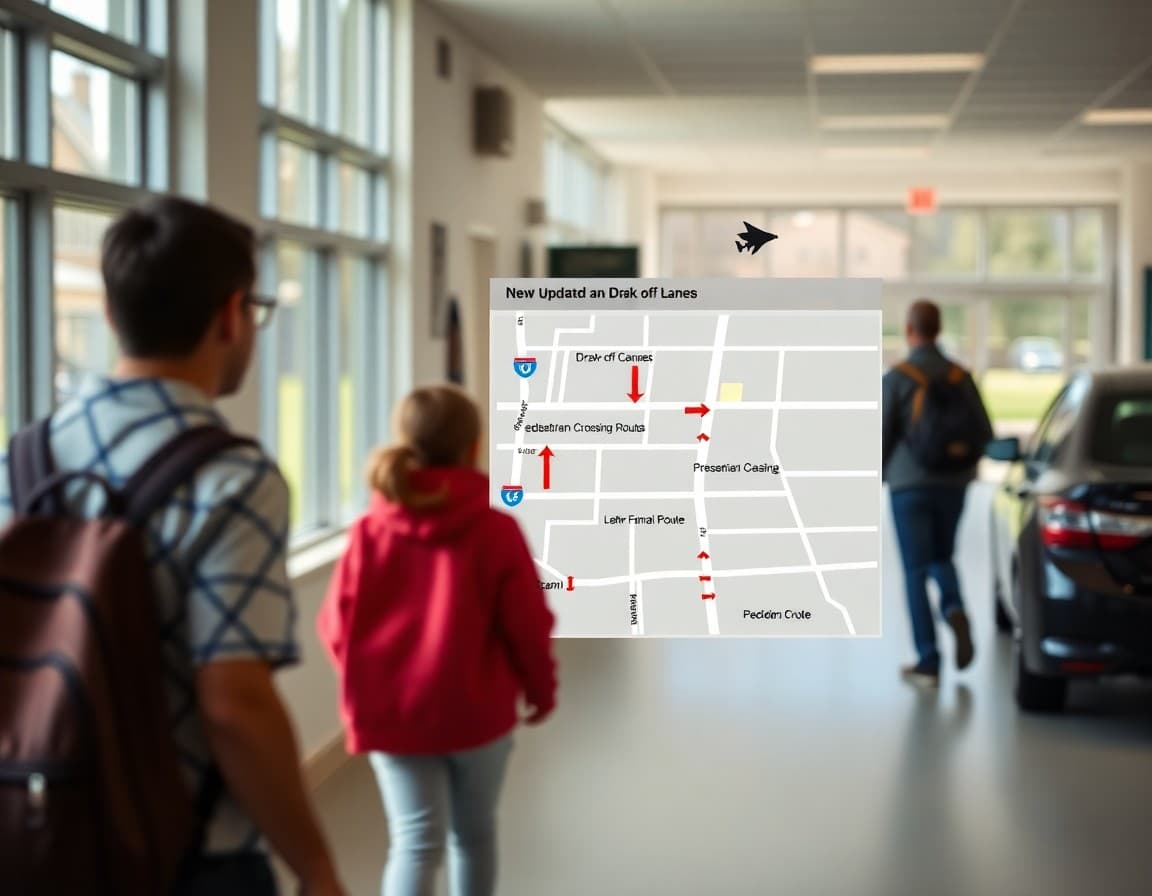
If the change involves a new traffic pattern, include a diagram. A simple map showing the drop-off lane, the direction of travel, and where students walk from the car to the door answers more questions than any text description.
Give the Timing Window
Name the arrival window: when the building opens for students, when drop-off officially begins, and when the window closes. What happens if a student arrives after the window closes. Families who know the specific window plan their morning around it.
Address the Most Common Violations
Every school has the same three arrival problems: double parking, phone use in the drop-off lane, and students being dropped off in unsafe locations. Name these specifically in the newsletter along with the safety risk each creates. Families who feel specifically addressed respond to specific requests. They tune out generic reminders.
Tell Families When the New Procedure Goes Live
Name the specific date the change takes effect. If there is a transition period when staff will be outside to guide families, mention it. Send a brief reminder the day before the change begins. Daystage makes it easy to schedule that follow-up reminder in advance so it goes out automatically.
Get one newsletter idea every week.
Free. For teachers. No spam.
Frequently asked questions
Why does morning arrival communication require a dedicated newsletter?
Because arrival patterns affect student safety, school start time, and the stress level of hundreds of families every single morning. A confusing or unsafe arrival routine has daily compounding effects. A clear newsletter that families actually read and apply reduces the daily friction that arrival problems create.
What should the newsletter include about the arrival change?
The specific change, why you are making it, what families are expected to do differently, the new drop-off flow or entry point, the timing window for drop-off, and what happens when a student arrives outside that window. A visual map or diagram is worth including if the change involves traffic routing.
How do I communicate arrival changes to families who drive versus families who take the bus?
Separate the two groups in the newsletter. Families who drive need to know the drop-off lane and entry point. Families whose students ride the bus need to know the bus arrival time and where students go when they get off. Mixing the two groups in one set of instructions causes both groups to miss what applies to them.
How do I address families who routinely ignore arrival procedures?
Acknowledge that arrival patterns are hard to change and that families are in a hurry. Then be specific about the safety reason behind the procedure. Families who understand that a double-parked car in the fire lane could delay an emergency vehicle for a child inside the building respond differently than families who feel they are being managed by a bureaucratic rule.
What tool helps principals send newsletters efficiently?
Daystage is built for school newsletters. A morning arrival update with a visual map, timing details, and a parking reminder can be formatted and sent to all families in one step.

Adi Ackerman
Author
Adi Ackerman is a former classroom teacher and curriculum writer with 8 years in K-8 schools. She writes about school communication, parent engagement, and what actually works in real classrooms.
More for Principals
Ready to send your first newsletter?
3 newsletters free. No credit card. First one ready in under 5 minutes.
Get started free