
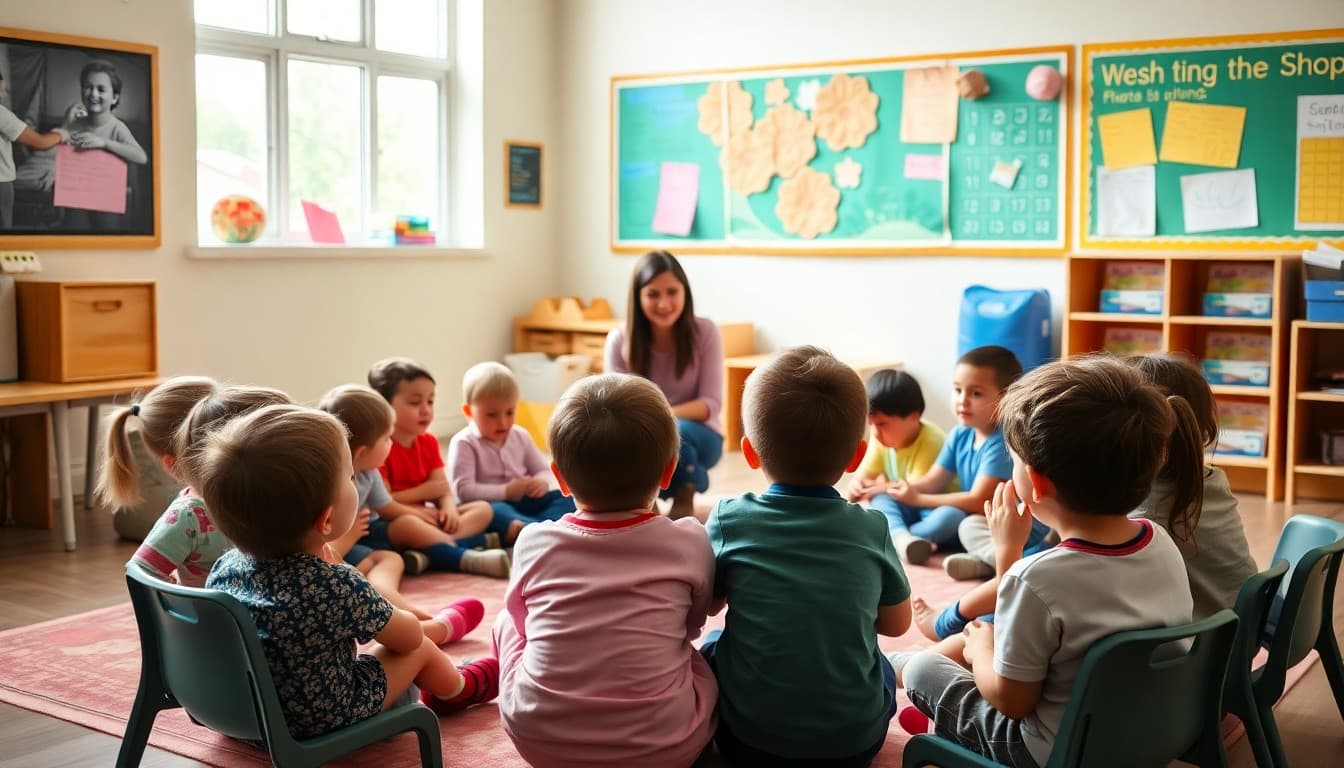
How to Explain Circle Time to PreK Parents in Your Newsletter
Circle time is the backbone of most Pre-K classroom days, but many families see it as a routine rather than a learning activity. Your circle time newsletter can change that by explaining what the ritual actually builds, why it looks the way it does, and how families can support the same skills at home during meals, read-alouds, and everyday conversations.
What Circle Time Is and What It Is Not
Start your circle time newsletter by reframing what families think they know. Circle time is not just a transition routine or a way to start the morning. It is a deliberate, structured learning environment designed to build community, language, attention, and early academic skills simultaneously. During circle time children are practicing: listening while others speak (a social and cognitive skill), taking turns contributing (self-regulation), following a shared routine (sequential thinking), participating in songs and rhymes (phonological awareness), discussing calendar and weather concepts (math and science vocabulary), and problem-solving together (collaborative thinking). That is a significant amount of development in ten minutes.
The Social Contract of Group Learning
One of the most important things circle time builds is what might be called the social contract of learning: the understanding that a group of people can share a focus together, and that each person's contribution matters. This norm, sitting together, listening when others speak, waiting for a turn, is not obvious to 3 and 4 year olds. It is a genuinely new social skill. The children who manage it well by the end of Pre-K have learned something that carries into every classroom they enter for the rest of their education. Your newsletter can frame this as the foundational purpose behind the ritual.
Academic Content Embedded in Circle Time Routines
Families sometimes wonder what is being learned while children sing calendar songs and count the days of the week. Your newsletter can explain the academic content embedded in these routines. Calendar activities build concepts of time, sequence, and number. Weather observations build science vocabulary and observation habits. Morning message or shared writing builds print awareness and letter recognition. Songs and rhymes build phonological awareness. The number of the day builds numeral recognition and one more or one less reasoning. Circle time is not a placeholder before the real learning starts. It is where a dense amount of early literacy and math content gets delivered in a high-engagement, movement-friendly format.
A Sample Newsletter Excerpt to Copy
“Every day we start with circle time: a 12-minute group meeting where we build community and launch the day together. Here is some of what we do and why. We count the days of school on a number line (number sense, one more each day). We read and add to a morning message (print awareness, letter recognition). We share a sentence about the weather (observation, vocabulary). We sing two or three songs that rhyme (phonological awareness). We do a quick movement activity (gross motor, attention reset). Circle time is designed to do a lot in a short time, and the routine of it is itself the point: children who know what to expect are more regulated, more attentive, and more ready to learn.”
Why Some Children Struggle With Circle Time
Your newsletter can normalize the challenge of circle time without alarming families. Sitting still, listening for ten minutes, and waiting your turn are tasks that require a level of self-regulation that 3 and 4 year olds are still building. A child who rolls around during the calendar song or keeps calling out when it is not their turn is not misbehaving. They are at the edge of their regulatory capacity, which is exactly where development happens. The goal is not a perfectly still, silent circle. The goal is gradual growth in the ability to sustain shared attention, and that growth is visible across the year.
How Families Can Reinforce Circle Time Skills
Close your newsletter with concrete suggestions for how families can build the same skills at home. Family meals where everyone takes a turn sharing a highlight from their day build the same social norm as circle sharing time. Read-alouds that include discussion questions build the same listening and responding skill. Simple songs and rhymes before bed build the phonological awareness that circle songs develop. Even a brief family “meeting” in the car, where each person shares one thing they are looking forward to, builds the group participation habit that circle time is trying to establish. Small, regular home rituals build the capacity that Pre-K circle time relies on.
Sending Your Circle Time Newsletter With Daystage
Daystage makes it easy to send a circle time newsletter with a photo of children gathered in your morning meeting, a brief explanation of what the routine builds, and one take-home idea for families. When parents understand what their child is learning during something as seemingly simple as a morning song, they talk about it differently at pickup, and children arrive better prepared for the group learning experience. That is the ripple effect a good newsletter creates.
Get one newsletter idea every week.
Free. For teachers. No spam.
Frequently asked questions
What does Pre-K circle time actually build beyond routine?
Circle time builds community, language, attention, and early academic skills simultaneously. During circle time children practice listening while others speak, taking turns contributing, following multi-step verbal routines, calendar and time concepts, songs and rhymes that build phonological awareness, and group problem-solving. The social contract of sitting together and attending to a shared focus is one of the most important school readiness skills Pre-K circle time develops.
Why do some Pre-K children struggle with circle time?
Circle time requires sustained attention, physical stillness, deferred turn-taking, and group listening, all in one activity. For 3 and 4 year olds who are still developing all of these capacities, circle time is genuinely challenging. Children who struggle are often those who are not yet ready to sit still for ten to fifteen minutes, those with sensory or regulatory needs, or those who are more comfortable in one-on-one or small-group interaction. This is developmental, not behavioral.
How long should Pre-K circle time be?
Research and developmental guidance suggest 10 to 15 minutes for ages 3 to 4, and up to 20 minutes for Pre-K 4s who are well into the year. Beyond that, children's attention and regulation capacity is typically exhausted, and the educational value diminishes. A focused, engaging 12-minute circle is far more productive than a 25-minute circle where children are expected to sustain attention they do not yet have.
What can families do at home to reinforce circle time skills?
Read-alouds that require listening and discussion build the same skills as circle time. Family meals where everyone takes a turn sharing something from their day build the social norm of listening while others speak. Practicing simple songs and finger plays at home builds the shared-rhythm experience of circle songs. Playing simple group games that require waiting for a turn builds the self-regulation that circle time demands.
How does Daystage help teachers share circle time information with Pre-K families?
Daystage makes it easy to send a newsletter about circle time with a classroom photo, a brief explanation of what the routine builds, and one take-home activity. Families who understand what circle time is for engage more meaningfully when their child talks about what happened during morning meeting, and are better equipped to support the underlying skills at home.

Adi Ackerman
Author
Adi Ackerman is a former classroom teacher and curriculum writer with 8 years in K-8 schools. She writes about school communication, parent engagement, and what actually works in real classrooms.
More for Pre-K
Ready to send your first newsletter?
3 newsletters free. No credit card. First one ready in under 5 minutes.
Get started free