
Preschool Math Readiness Newsletter: What Families Need to Know
Math anxiety in adults often starts early, and the way families talk about math with young children has a measurable impact on the math skills those children develop. Preschool teachers who communicate well about early math not only inform families, they shape the relationship their children will have with numbers for years to come.
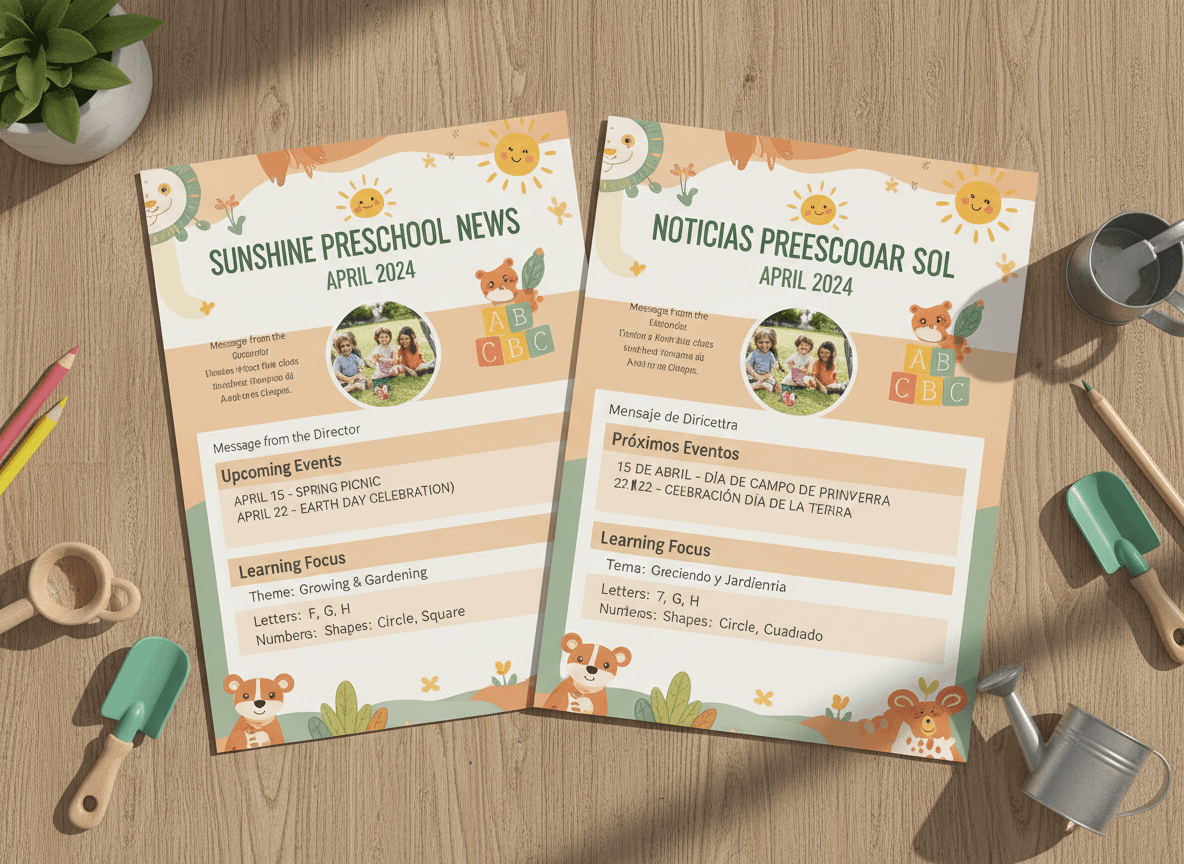
A math readiness newsletter gives families the vocabulary, the strategies, and the confidence to support math thinking at home without needing a math background themselves.
What Early Math Actually Looks Like
Many parents equate early math with counting and number recognition, and those matter, but the foundation of mathematical thinking is broader. Your newsletter can expand that picture:
- Counting with meaning: Not just reciting numbers, but understanding that each number corresponds to one object (one-to-one correspondence) and that the last number said tells you how many there are total
- Number sense: Understanding that five is more than three, that ten can be made up of five and five, that you can have the same number of things even if they are arranged differently
- Patterns: Recognizing, extending, and creating repeating patterns, which is a precursor to algebraic thinking
- Sorting and classifying: Grouping objects by attribute (color, size, shape) and explaining the rule used
- Measurement: Comparing objects by height, weight, and length; understanding the concept of "more" and "less"
- Spatial reasoning: Understanding above, below, beside, inside; building with blocks; doing puzzles
What You Are Teaching in Class
Describe specific activities from your classroom and the math they are building. Example entries for a math section of a preschool newsletter:
- "We sorted buttons by color, then by size, then invented our own sorting rules. This builds classification thinking and vocabulary for attributes."
- "Children have been building towers and comparing heights. 'Taller than' and 'shorter than' are language concepts that connect directly to measurement in kindergarten."
- "We used counting bears to practice making groups and comparing amounts. Children are working on understanding that five bears is always five bears, no matter how they are arranged."
The Home Connection
Families do not need special materials to support early math at home. They need to know which everyday moments are actually math:
- Setting the table: counting one fork for each person builds one-to-one correspondence
- Measuring ingredients while cooking: builds concepts of more, less, and equal
- Sorting and folding laundry: matching pairs, sorting by family member, counting items
- Board games: counting spaces, taking turns, comparing scores
- Building and puzzles: spatial reasoning, problem-solving
Including this list in your newsletter gives families a concrete picture of how much early math is already available in their daily routine.
Addressing Math Anxiety in Parents
Some parents will mention, sometimes as a joke, that they were never good at math. That attitude, expressed casually in front of young children, has a measurable impact on how children approach math themselves. Your newsletter does not need to address this at length, but a sentence or two acknowledging that everyone can support early math, regardless of their own math history, can make a difference.
Daystage makes it easy to send this kind of content-rich newsletter in a format that is readable on a phone without requiring families to download or print anything, which increases the likelihood that the home activities actually get tried.
Get one newsletter idea every week.
Free. For teachers. No spam.
Frequently asked questions
What math skills should preschoolers have before kindergarten?
Children entering kindergarten benefit most from being able to count reliably to ten or higher with one-to-one correspondence, recognize written numerals to ten, sort objects by attribute, understand more and less, and notice simple patterns. These are the foundation skills that kindergarten math instruction builds on.
How do you explain early math to preschool parents without using math jargon?
Replace terms like 'number sense' and 'cardinality' with plain descriptions of what children do. Instead of writing about cardinality, write: 'When you ask a child how many apples are in the bowl and they count each one and then say the total, that is the skill we are building.' Concrete descriptions of specific behaviors land far better than curriculum terminology.
Why do preschool programs use blocks and games instead of worksheets for math?
Blocks, puzzles, games, and sorting activities engage children in genuine mathematical thinking rather than rote repetition. Research consistently shows that children who develop math concepts through exploration and play have stronger math foundations entering formal instruction than children who practiced primarily through worksheets.
What can preschool families do at home to build math skills?
Count things in everyday situations: stairs, crackers, cars in the parking lot. Play board games that involve counting and taking turns. Sort laundry by color or size with children helping. Cook together and measure ingredients. These activities embed math thinking in real contexts and are more effective than flashcards.
Does Daystage have templates for preschool math newsletters?
Daystage includes structured newsletter formats that teachers can use for curriculum-specific updates like math readiness, sent directly to families as formatted emails.

Adi Ackerman
Author
Adi Ackerman is a former classroom teacher and curriculum writer with 8 years in K-8 schools. She writes about school communication, parent engagement, and what actually works in real classrooms.
More for Pre-K
Preschool Substitute Teacher Newsletter: Preparing Families When the Regular Teacher Is Out
Pre-K · 5 min read
How to Explain Play-Based Learning to Parents in Your Preschool Newsletter
Pre-K · 7 min read
Preschool Block Play Newsletter: The Math and Science Happening in the Block Area
Pre-K · 5 min read
Ready to send your first newsletter?
3 newsletters free. No credit card. First one ready in under 5 minutes.
Get started free