

Parent Communication Plan Template for Teachers: Building a System That Works All Year
Most parent communication happens reactively: a problem comes up, a deadline approaches, a parent asks a question, and the teacher responds. This is exhausting and inefficient. It also means that parents only hear from you when something needs attention, which shapes how they understand the relationship.
A proactive communication plan changes this. It gives the year structure, reduces the cognitive load of deciding what to send and when, and ensures parents feel informed throughout the year rather than only when something requires their action.
Here is a template you can adapt and set up in the first two weeks of school.
Layer 1: The weekly newsletter (the anchor of your plan)
Your weekly newsletter is the foundation. Everything else builds on top of it.
Set a day and time you will send it every week without exception. Choose a consistent subject line format that parents learn to recognize. Decide on your standard sections: this week in class, coming up, action needed, and a resource or question for home.
Write this down. "I send my newsletter every Sunday at 6 PM. It covers: classroom update, upcoming dates, one action item, and one question to ask your child." That is your newsletter contract with yourself. Keep it all year.
Layer 2: Event-specific communications
Some communications need their own email rather than a mention in the weekly newsletter. Map these out at the start of the year:
- Back-to-school intro letter: Who you are, what to expect this year, how you communicate, how to reach you. Send before school starts or on day one.
- Conference invitation: Send two to three weeks before conferences with sign-up link or instructions.
- Field trip notification: Two to three weeks before the trip with permission form and details.
- End-of-quarter update: A brief note on where the class is relative to the year's goals, what is coming in the next quarter.
- End-of-year letter: Celebration of the year, what students accomplished, and any logistics for the transition to summer.
Put these on your calendar at the start of August. If you know a field trip is in March, add a "send field trip notification" reminder on your calendar for two weeks before.
Layer 3: Urgent and one-off communications
Urgent communications happen outside the plan: a school closure, a classroom incident that parents need to know about, a sudden schedule change. Define your protocol for these now so you are not improvising during a stressful moment.
A simple protocol: urgent items that affect tomorrow go out the same day via email. Items that affect next week go in the Sunday newsletter plus a brief note the week before.
Layer 4: Individual parent communication
Your plan should also define how you handle individual parent outreach, separate from the whole-class newsletter.
A practical standard: proactively contact parents when something notable is happening with their child, both good and concerning. This does not mean daily check-ins. It means that parents should not first learn about a pattern of academic struggle at a conference. They should have heard from you two weeks before.
Set a loose goal for individual outreach: two to three positive contacts per week (a quick note about a student who did something impressive) and any necessary concern-based contacts as they arise. Documenting these contacts in a simple spreadsheet protects you and helps you track relationships over the year.
Layer 5: Setting communication norms with parents
Your communication plan only works if parents know what to expect from it. In your first newsletter or back-to-school letter, tell parents:
- When you send your newsletter (day and approximate time)
- Where to find the newsletter if they miss it (a web link, an archive)
- The best way to reach you for individual questions (email? phone? app message?)
- Your response window (e.g., "I respond to emails within two school days")
Setting these norms reduces the volume of "just checking in" messages you receive throughout the year, because parents know when to expect updates.
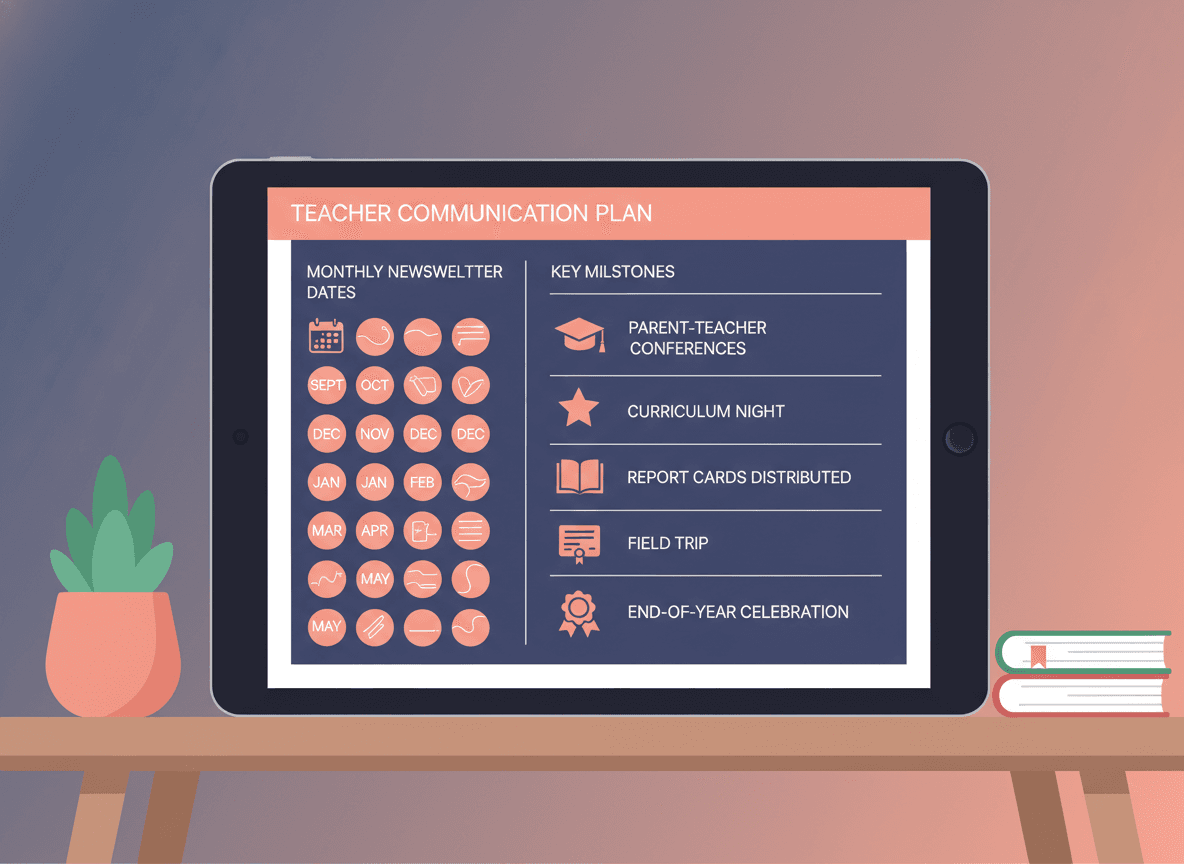
Sample annual communication calendar
Here is a skeleton template you can fill in with your specific dates:
- Week 1: Welcome letter or back-to-school newsletter. Set the tone and norms.
- Weeks 2-36: Weekly newsletters every [your chosen day].
- October: Fall conference invitation (2-3 weeks before conference dates).
- November: End-of-quarter 1 update.
- January: Mid-year check-in. How is the class tracking? What is ahead?
- February/March: Spring conference invitation (if applicable).
- April: End-of-quarter 3 update. Preview of end-of-year projects or events.
- May/June: End-of-year letter. Celebration, logistics, transition support.
How Daystage fits into a communication plan
A communication plan is only as good as the tool you use to execute it. Daystage is built for exactly this kind of consistent, recurring school communication. Set up your class subscriber list once. Send every week from the same template with your school branding. Track opens so you know when parents are engaging.
The goal is a system that runs on rails by February, because you designed it in August.
Get one newsletter idea every week.
Free. For teachers. No spam.
Frequently asked questions
When should teachers set up their parent communication plan for the school year?
In the first two weeks of school, before the reactive pattern sets in. Teachers who map out their communication layers in August, including event-specific emails and their individual outreach cadence, spend less time deciding what to send and when throughout the year.
What communication layers belong in a teacher's annual parent communication plan?
A complete plan has five layers: the weekly newsletter as the anchor, event-specific communications mapped to the calendar, a protocol for urgent one-off messages, individual parent outreach with a goal of 2 to 3 positive contacts per week, and a set of communication norms shared with parents at the start of the year.
How should teachers handle urgent communications that cannot wait for the weekly newsletter?
Define a protocol in advance so you are not improvising during a stressful moment. A simple rule: items affecting tomorrow go out the same day. Items affecting next week go in the Sunday newsletter plus a brief note the week before. The protocol keeps urgent messages from flooding the regular newsletter.
What should teachers avoid in their parent communication plan?
Avoid purely reactive communication where parents only hear from you when something needs attention. Teachers who have no proactive plan end up in a cycle where newsletters are sporadic, individual contacts are mostly negative, and parents associate communication from the school with problems.
What tool helps teachers build and stick to a parent communication plan all year?
Daystage is designed around the weekly newsletter layer that anchors everything else. It handles scheduling and templates so the newsletter goes out consistently, which is the foundation the rest of the plan builds on.

Adi Ackerman
Author
Adi Ackerman is a former classroom teacher and curriculum writer with 8 years in K-8 schools. She writes about school communication, parent engagement, and what actually works in real classrooms.
More for Parent Engagement
Why Your School Newsletter Goes to Spam and How to Fix It
Parent Engagement · 6 min read
How to Reach Families with Limited Technology Access Through School Newsletters
Parent Engagement · 6 min read
Weekly, Monthly, or Quarterly: Which Newsletter Frequency Is Right for Your School?
Parent Engagement · 6 min read
Ready to send your first newsletter?
3 newsletters free. No credit card. First one ready in under 5 minutes.
Get started free