
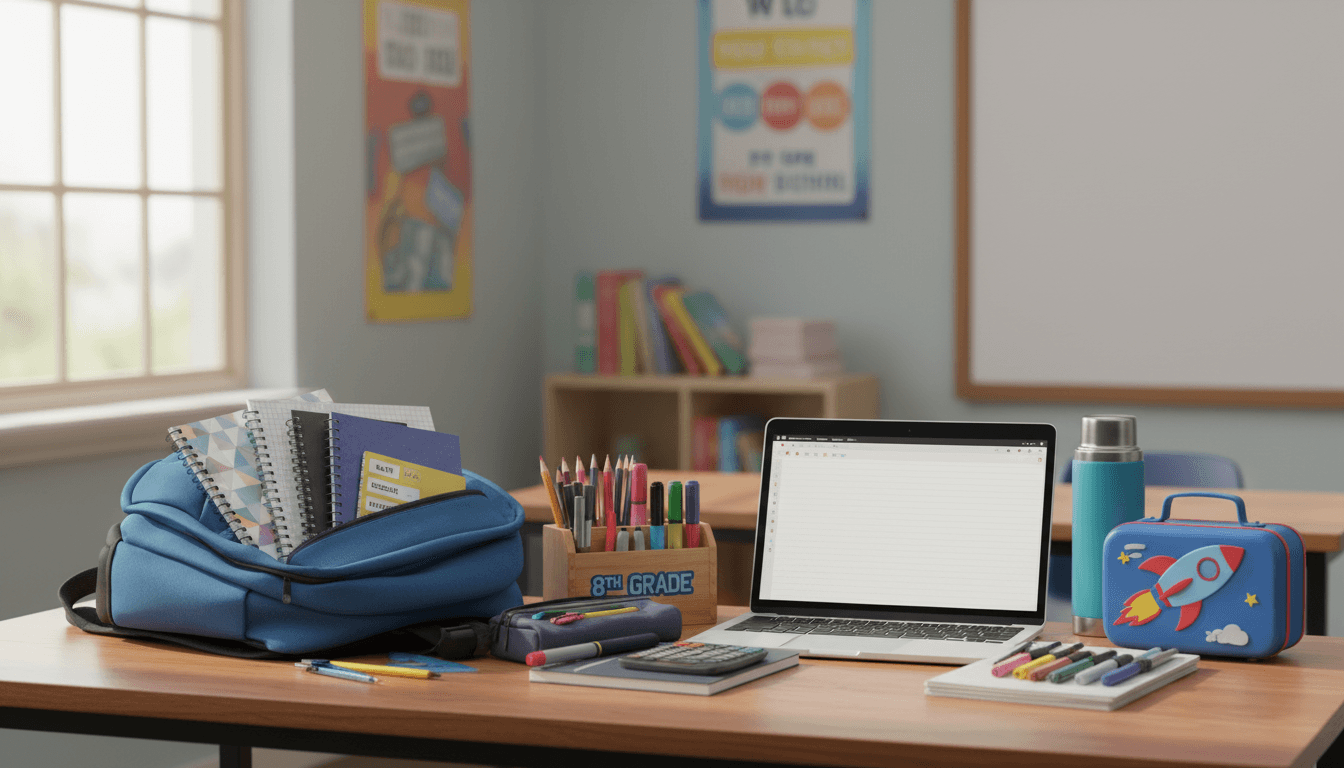
8th Grade Supply List Newsletter: What to Buy Before the Final Year of Middle School
A supply list newsletter is one of the most practical things you can send home before school starts. Families are already in back-to-school mode. They want a clear list and a reason behind each item. Give them both and you prevent a week of confusion and last-minute runs to the store.
Here is how to write an 8th grade supply list newsletter that is useful, specific, and easy to act on.
Lead with what is different about 8th grade supplies
Families who have older children or who have shopped for school supplies before sometimes assume 8th grade looks the same as 7th or 6th. It does not. The academic demands are higher, the organizational system needs to be more deliberate, and some items like a scientific calculator or specific technology become more important this year.
Open with a brief note: "Eighth grade is the most demanding year of middle school, and the right supplies make a real difference. This list is specific to our grade. Please read it rather than recycling last year's setup."
Binder system: structure for Algebra and ELA
The binder system is the foundation of academic organization in 8th grade. Be specific about what you recommend rather than leaving families to figure it out.
"We recommend a 1.5-inch three-ring binder with tabbed dividers for each class. Students in Algebra 1 especially benefit from keeping their notes in order because worked examples from earlier lessons help solve later ones. If your child prefers a separate binder per class, that works well too. The key is a system with a place for everything that actually gets used."
Mention folders if some classes use them instead of binders. Be clear about which class uses which organizational tool, especially if you have coordinated with other teachers on this in advance.
Scientific calculator: what to buy and why
The calculator question is one of the most common parent questions before 8th grade. Answer it in the newsletter and eliminate the confusion.
"Students in Algebra 1 need a scientific calculator. A basic scientific calculator like the TI-30X IIS works well and costs around fifteen dollars. Students in our advanced math course may benefit from a graphing calculator, but check with your math teacher before purchasing one. We use calculators in class and on tests, but students are expected to understand the concepts, not just operate the calculator."
If your school provides calculators and families do not need to buy one, say that clearly. "We have a class set of calculators for use during school. You do not need to purchase one unless your child wants to use one at home for homework."
Device and technology requirements
Technology expectations vary enormously by school. This section needs to reflect your actual setup, not a generic recommendation.
If your school provides Chromebooks: "Students are issued a school Chromebook on the first day of school. Please provide a sturdy backpack with a padded sleeve or compartment to protect it. Students are responsible for keeping it charged at home each night. A charger will be provided, but students who forget their charger cannot borrow one during the day."
If families provide devices: "Students are expected to have a working personal device for home use. A Chromebook, laptop, or iPad with a keyboard works well. The device needs internet access and the ability to open Google Docs. We do not require a specific brand or model."
PE uniform and lock
The PE uniform and locker lock are consistently the items families forget until the second week of school. Put them in the newsletter prominently.
"Students in PE need a school-approved gym uniform. Uniforms can be purchased at the school bookstore for twelve dollars or online through the school store link. Students also need a combination lock for their locker. Please write the combination down and keep it somewhere safe at home. We cannot open lockers for forgotten combinations during class."
Include the PE start date if it is not the first week of school, so families know whether they have a grace period.
What is different from 7th grade
Parents who shopped for a 7th grader last year will naturally reuse that list if you do not tell them what changed. A short paragraph saves a lot of back-and-forth.
"If your child is coming from 7th grade here, note a few changes for this year: the required calculator is now a scientific model, students are expected to have their own earbuds for independent work time, and the art supply fee is now collected through the office rather than brought in as supplies. Everything else on last year's list is still current."
Build the organizational habits now that high school requires
A supply list newsletter for 8th grade is a good place to bridge from supplies to habits. The organizational system students build this year follows them into 9th grade.
"High school teachers generally do not remind students to organize their binders, check the homework portal, or write down assignment due dates. This year is a good time to build those habits independently. Help your child set up their binder system in August and check in once in September. If the system is working, step back. If it is not, now is the time to adjust it."
That is more than a supply list. It is useful parenting advice for the transition year, and families will notice the difference.
Include a direct link or contact for questions
Supply questions are usually small but they pile up in August. Make it easy to get answers fast.
"If you have questions about any item on this list, email me directly or check the FAQ page on our class website. If a supply is a financial hardship, please contact the front office. We have resources available and no student should start the year without what they need."
That last sentence matters. It signals that the list is a guide, not a barrier.
Get one newsletter idea every week.
Free. For teachers. No spam.
Frequently asked questions
What supplies are most important for 8th grade specifically?
The most critical supplies for 8th grade are a functional binder system for Algebra and ELA, a scientific calculator (or graphing calculator if your school requires it), and any required technology like a Chromebook or laptop. A good planner or agenda is worth emphasizing in 8th grade specifically because the volume and complexity of assignments increases and students who do not track their work start falling behind. PE uniforms and locks are often overlooked until the first week of school.
What is the difference between a scientific calculator and a graphing calculator, and which does an 8th grader need?
A scientific calculator handles exponents, roots, trigonometric functions, and basic algebraic operations. A graphing calculator does all of that plus graphs functions and equations, which is useful in Algebra 1 and beyond. For most 8th graders in a standard Algebra 1 course, a scientific calculator is sufficient. Students in an accelerated math course may benefit from a graphing calculator, especially if their high school requires one. Check with the math teacher before buying to avoid purchasing a more expensive tool than needed.
How should parents set up a binder system for 8th grade?
A binder system works best when each class has its own section or its own binder, so notes and assignments do not get mixed. For Algebra specifically, students benefit from keeping worked examples and notes in order because they can reference previous work when solving new problems. For ELA, a section for drafts and a section for final essays with teacher feedback helps students track their growth as writers. The biggest failure of binder systems is not the system itself but not maintaining it. A five-minute weekly cleanout habit prevents the collapse.
Does an 8th grader need a Chromebook or personal device?
It depends on your school's policy. Many middle schools provide Chromebooks for students to use at school but do not send them home. If your school does a 1:1 device program that goes home, families need to know about charging routines, acceptable use policies, and whether a case or keyboard cover is recommended. If students use personal devices at home for homework, the newsletter should clarify what is needed: a working device with internet access, a Google account, and access to your learning management system.
What newsletter tool works best for sharing supply lists with 8th grade families?
Daystage makes it easy to send a well-organized supply list newsletter that families can reference before and after back-to-school shopping. You can format the list by category, add notes on where to find specific items, and include links to your school's device or technology policy. Because Daystage sends directly to families rather than through a learning management system portal, the newsletter is more likely to actually be read before the first week of school.

Adi Ackerman
Author
Adi Ackerman is a former classroom teacher and curriculum writer with 8 years in K-8 schools. She writes about school communication, parent engagement, and what actually works in real classrooms.
More for Middle School
Eighth Grade Back to School Newsletter: Setting Expectations for 8th Grade Families
Middle School · 7 min read
Eighth Grade Newsletter Template: Preparing Families for High School
Middle School · 7 min read
8th Grade Classroom Newsletter Ideas: What to Send Parents of 8th Graders All Year
Middle School · 8 min read
Ready to send your first newsletter?
3 newsletters free. No credit card. First one ready in under 5 minutes.
Get started free