

Math Newsletter Written for Students: A Working Template
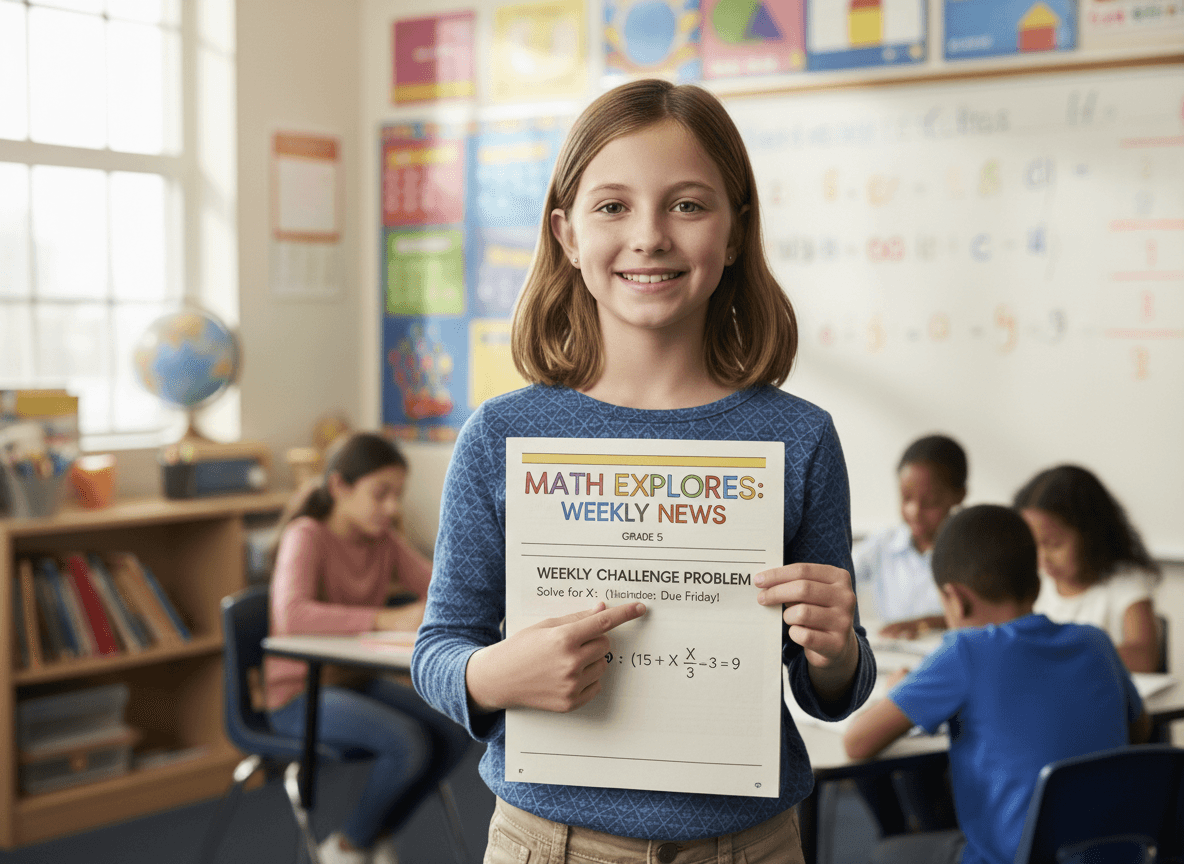
Most math newsletters are written for parents. A student-only newsletter is a different thing. The reader is 9 years old, scanning for the part that is for them, and they will close the tab in 20 seconds if nothing grabs them. Here is what works, and a working template you can copy.
Open with a sentence that talks to the kid
Not "Dear students." Not a long welcome. Try, "Hey mathematicians, this week we are doing something weird with fractions." That tone, slightly playful, direct, gets a kid to read the next sentence. The word "mathematicians" works because it gives the kid an identity to try on for the rest of the newsletter.
Use very short paragraphs
Two sentences per paragraph. Sometimes one. Kids read on screens or on hallway walls. A four-sentence paragraph reads as a brick wall and they will skip it. A two-sentence paragraph reads as a quick thought. They will finish it.
Include one challenge problem
One problem per newsletter. Not five. The first kid to bring back the solution Monday morning gets a tiny acknowledgment. A sticker. A mention on the board. Whatever. The challenge is the engine of the whole newsletter. Without it, you have written a flyer.
Include one did-you-know that touches the math
"Did you know zero was not always a number? People used to just leave a blank space where the zero should be." Fifteen seconds of reading. Real math history. It sticks. The kid tells their family at dinner. The math leaves the building, which is the whole point.
End with one tiny heads up
"Quiz Thursday. We are going to play a fraction game on Friday. Bring a sharpened pencil." That is the section that earns the open next week. Kids who see the newsletter as useful (it told me about the game) will open the next one looking for the same.
A working student-only template
Subject: "Mathematicians, this week"
Body:
"Hey mathematicians,
This week we are working on adding fractions with different bottoms (denominators). It looks tricky. It is not.
Challenge of the week: Mia ate 1/3 of a pizza. Her brother ate 2/5. How much of the pizza is left? Bring your answer Monday. First solver gets the mystery sticker.
Did you know: a long time ago, people did not have a number for zero. They just left a blank space. Imagine writing 105 as 1 5.
Heads up: quiz Thursday on the fractions we did this week. Fraction game on Friday, bring a sharpened pencil.
See you Monday. Ms. K."
One concrete example: the kid who came in early
Three weeks into running the challenge problem, I had a fourth grader show up at 7:55 am with a piece of paper and a worked-out answer to the previous week's question. He was not a strong math student. He just liked the chase. That kid opened every newsletter after that, and his classwork started lifting. The newsletter did not teach him fractions. It gave him a reason to think about them on a Saturday.
How Daystage helps with a student-only math newsletter
Daystage lets you save a separate student template and send it on a weekly cadence without rewriting the shell each time. The format holds across the year, the challenge and did-you-know slots stay ready for fresh content, and the email lands cleanly on a student device or a printed copy. The whole job becomes 10 minutes a week, which is the only way a student newsletter survives past October.
Get one newsletter idea every week.
Free. For teachers. No spam.
Frequently asked questions
Will kids actually read a math newsletter?
Yes, if it is short and has one thing to do. Kids will not read a wall of paragraphs. They will read a 200-word note that has a challenge problem and a quick did-you-know. The format has to match how kids read, which is fast and scanning for the part that is for them.
Should the student newsletter come as paper or email?
Paper for kindergarten through second grade. Email or a class platform from third grade up. Younger kids do not have inboxes. Older kids are checking screens already. Match the medium to the reader. A paper version on the desk Monday morning gets read at second grade. The same content in an email gets read at fifth grade.
What should the math challenge of the week look like?
One problem, slightly above where the class is currently working. Not impossible. Not easy. Something a strong student can crack in five minutes and an average student can crack with a little time. A first solver gets recognition the next morning. That recognition is what makes kids open the next one.
How long should a student newsletter be?
Under 200 words. One challenge, one fun math fact, one heads up about the week, a sign off. Anything more and the audience tunes out. The job of the student newsletter is not to teach. It is to keep math present in the kid's head between bell and bell.
How do I send a student newsletter without doubling my workload?
Build a template once and reuse the shape every week. Daystage lets you save a separate student-facing template alongside your parent one, so the writing is fast and the formatting stays consistent. The whole student version should take 10 minutes a week if the template is doing its job.

Adi Ackerman
Author
Adi Ackerman is a former classroom teacher and curriculum writer with 8 years in K-8 schools. She writes about school communication, parent engagement, and what actually works in real classrooms.
More for Math Newsletter
Ready to send your first newsletter?
3 newsletters free. No credit card. First one ready in under 5 minutes.
Get started free