
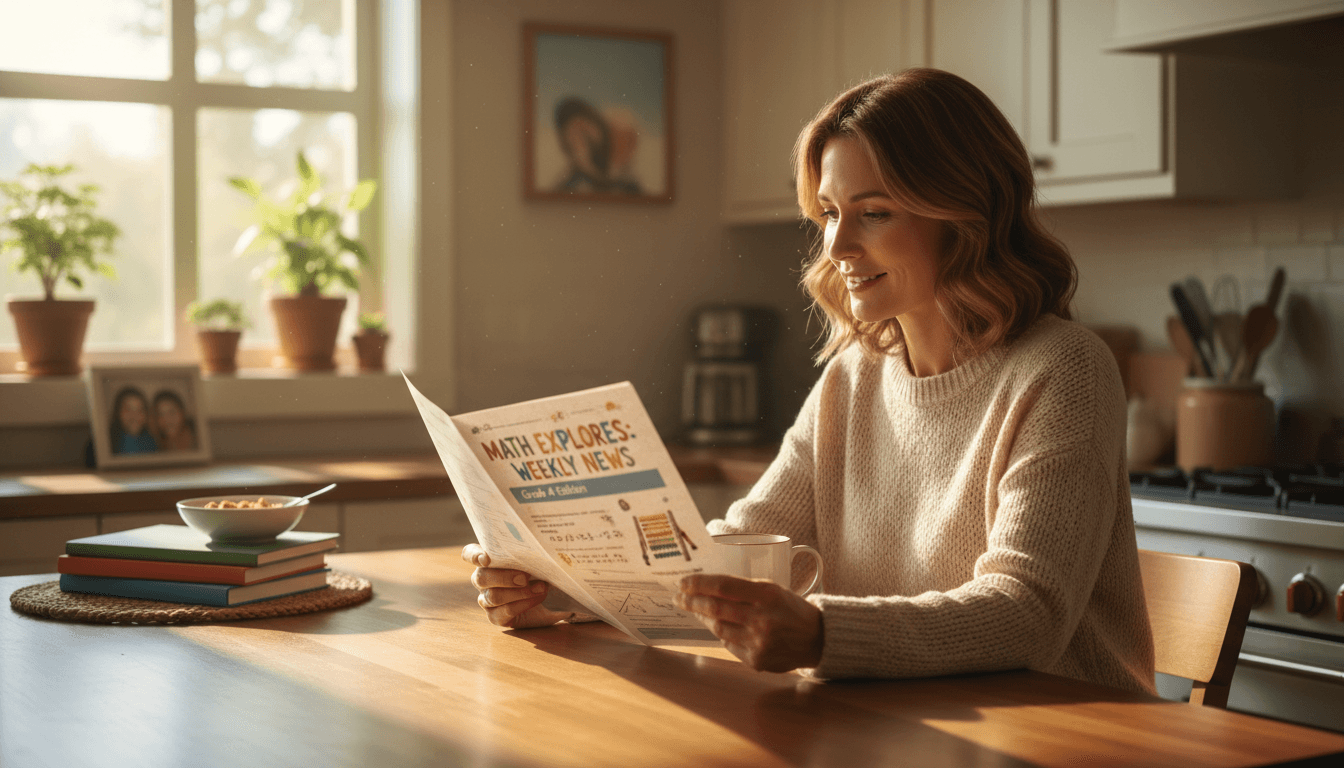
Math Newsletter Written for Parents: What to Include

A math newsletter written for parents reads differently from one written for both parents and kids. The voice changes. The vocabulary changes. The things you leave out matter as much as the things you put in. Parents do not need to know the curriculum's internal acronyms. They need to know what their child is doing in math class, in language they can hold.
Write to one tired parent on a phone
Imagine one parent, on the couch at 9 pm, phone in hand, just finished the dishes. That is your reader. Every sentence is competing with a streaming app and a sleep schedule. Short paragraphs. Real words. No headings the size of a textbook chapter. If you would not say it out loud to that parent on Back to School Night, do not write it here either.
Cut every curriculum acronym
Eureka, CPA, CGI, MTSS, Tier 2 small group, anchor chart, exit ticket. Each one is invisible armor that keeps parents at a distance. Translate each. "Anchor chart" becomes "the big chart on the wall we built together." "Exit ticket" becomes "a quick three question check at the end of class." The acronyms feel efficient to you. They feel like a foreign language to a parent.
Tell parents what they will see in the folder
This is the section that earns trust. "When you open the folder tonight, you will see a page with rectangles cut into halves and fourths. Your child is using these to compare fractions. If they say two-fourths is the same as one-half, that is correct, and we will keep building from there." Parents now know what they are looking at when they open the binder. They feel let in.
Give one tiny home tip, not a list
One tip. Not five. "This week, ask your child to spot a fraction on the way to school. A street sign that says 1/2 mile counts." A five-item list of math tips at home reads as a chore. A single tip feels like a small gift. Parents will actually try the one. They will skim past the five.
Skip kid jokes and "fun facts of the week"
Things to leave out of a parents-only newsletter: math jokes meant for kids, "fun fact" sections, comic strips, cartoony fonts, motivational quotes about growth mindset. None of these earn their place. The parent's time is short. They want the information that helps them at the kitchen table tonight.
A working parents-only template
Subject: "Math this week in Room 12: comparing fractions"
Body:
"Hi families,
This week your child is comparing fractions with halves, fourths, and eighths. We built a chart on the wall together to compare them side by side.
In the folder tonight: a page with shaded rectangles. Your child is figuring out which fraction is bigger by looking at the shaded area. They may do it differently than you remember. That is fine.
Try this once: on the way home, ask them to spot a fraction in the world. Street signs, recipes, the dial on the oven. Thirty seconds, real math.
Heads up: short quiz next Wednesday on these same fractions.
Reply any time. Ms. K."
One concrete example: the parent who finally got it
Last October a dad emailed me back after a parents-only newsletter. "I have been pretending I knew what an anchor chart was for three years. The way you described it, the big chart on the wall, I finally got it." Three years. One sentence fixed it. That is the gap a parents-only newsletter is built to close.
How Daystage helps with a parents-only math newsletter
Daystage stores the parents-only template separately from any student-facing version you write. You can keep the voice clean for the parent audience without worrying that a kid-facing line will slip in. Schedule the send for Sunday evening or Monday morning, and the email lands when parents are actually reading. That alone moves open rates more than any subject line trick.
Get one newsletter idea every week.
Free. For teachers. No spam.
Frequently asked questions
What is the biggest mistake teachers make when writing for parents only?
Using curriculum acronyms. CGI, CPA, RTI, Tier 2, anchor charts. Parents do not know these. They feel talked over. Trade every acronym for a plain sentence and the open rate climbs. Write like the parent has not been in a classroom since they were in one themselves, because that is the truth.
Should a parent-only newsletter mention the kids by class section?
Mention the class by name, not the kids. 'Room 12 wrapped the fractions unit on Thursday.' That gives the parent a hook. Naming individual kids invites comparisons and bumps into privacy. Group-level detail is plenty.
How casual is too casual when writing to parents?
If you would not say it in a hallway conversation, do not write it. Casual is fine. Sloppy is not. Contractions are good. Slang is not. The voice you want sounds like the email a friend who is also a teacher would send. Warm, plain, and short.
Should I include photos of the classroom in a parent newsletter?
One photo per newsletter is plenty, and only when it adds something. A photo of the anchor chart you built that week tells the parent more than two paragraphs about it. Photos of kids need permission and add weight to the email. The chart, the manipulatives, the math game on the floor, those photos help.
What is the right send time for a parent-only newsletter?
Sunday late afternoon or Monday at 6 am. Parents read on phones either after dinner Sunday or with coffee Monday. Send at noon and it gets buried. Daystage lets you schedule the send for either window, so the writing happens when you have time and the delivery happens when parents are actually looking.

Adi Ackerman
Author
Adi Ackerman is a former classroom teacher and curriculum writer with 8 years in K-8 schools. She writes about school communication, parent engagement, and what actually works in real classrooms.
More for Math Newsletter
Ready to send your first newsletter?
3 newsletters free. No credit card. First one ready in under 5 minutes.
Get started free