

Math Newsletter for Parents Who Cannot Help With Homework
At every back-to-school night, at least four parents pull me aside and say a version of, "I will not be able to help my kid with math homework." Sometimes it is because the math has changed. Sometimes it is because the parent never learned it. Sometimes it is both. A math newsletter for parents who cannot help with homework gives these families a way to stay involved without pretending to know long division. Here is how to write one that actually works.
Reset the role in the first paragraph
The first thing the newsletter has to do is take pressure off. Tell parents directly that teaching the math is the teacher's job. The parent's job is to keep the kid working, ask good questions, and notice when struggle turns into frustration. "If you do not remember how to do this kind of problem, that is okay. You are not the teacher tonight. You are the coach." One paragraph. Parents who have been dreading homework all summer exhale.
Give them a three-sentence script for the homework page
Scripts beat advice. Hand parents three sentences they can say, verbatim, when their kid is stuck. "What is the problem asking you to find?" "What do you already know that might help?" "What is one thing you could try first?" That is it. Those three questions work on a second grade word problem and on an eighth grade systems problem. Tell parents to put the three lines on a sticky note on the fridge.
The ask, do not solve rule
Name the trap. Parents who feel bad about not knowing the math often overcompensate by walking the kid through the answer. That teaches the kid the parent will solve it if they wait long enough. Spell it out in the newsletter. "If your child says 'I do not know how to start,' your move is to ask another question, not to show them the answer. Ask, do not solve. The minute you solve, you have taken the math out of the homework." That sentence resets the entire kitchen-table dynamic.
Give permission to stop and send back a sticky note
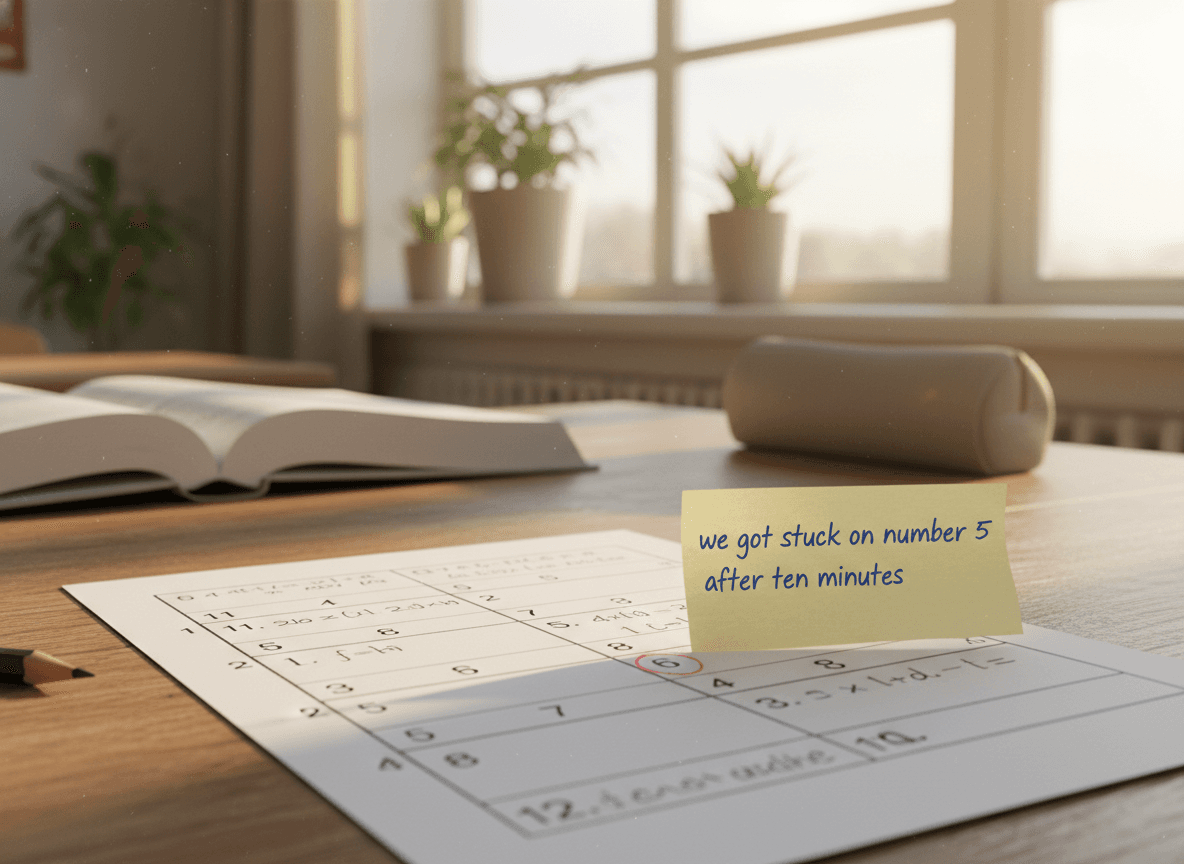
Parents need an exit ramp. Without one, homework drags out for an hour and ends in tears. Tell them, "If your child has tried for 10 minutes with the three questions and is still stuck, stop. Write a sticky note on the page with the problem number, how long you tried, and what you tried. I will pick it up the next day." Now the parent has permission to protect the relationship with math, and the teacher gets a clear data point.
A worked example: a parent who has not done fractions in 25 years
Walk through a real scene in the newsletter. "Your sixth grader brings home a page on dividing fractions. You do not remember the rule. That is okay. You ask, 'What is the problem asking?' Your kid says, 'It is asking how many halves are in three-quarters.' You say, 'Can you draw it?' They draw three-quarters of a circle and shade halves on top. They get to one and a half. You did not teach a thing. You asked three questions. The math got done." That scene tells a parent exactly what their evening can look like.
End with the heads-up section, not a guilt trip
Close with one line about what is coming this week, and one line inviting questions. Skip the lecture about reading nightly. Skip the reminder about logging homework hours. Parents who get a useful, practical newsletter once a week will engage. Parents who get a guilt newsletter will unsubscribe in their head and stop reading.
How Daystage helps with the can't-help-with-math newsletter
Daystage holds this template across the year, with the three-question script saved as a reusable block. Each quarter you refresh the example to match the unit and resend. Every family on the roster gets it the same way, formatted to read on a phone in the carpool line. The parents who needed this most in September get it again in October, January, and March, which is when the frame finally lands.
Get one newsletter idea every week.
Free. For teachers. No spam.
Frequently asked questions
What is the single most useful line for a parent who is stuck?
'Ask, do not solve.' If parents take only one thing from the newsletter, take that. The job is to ask questions that move the kid forward, not to demonstrate the answer. A parent who never learned algebra can still ask 'what is the problem asking?' and that question alone gets most kids unstuck.
What goes on the sticky note when nothing is working?
Three short lines. What problem they got stuck on, how long they worked on it, and what they tried. 'Number 4, worked 12 minutes, tried drawing it and got confused.' That sticky note tells me exactly where to start with the kid the next morning. It also signals to the kid that struggling and stopping is allowed, which protects the relationship with math.
Should I tell parents to watch a YouTube tutorial?
Not as the first move. A random YouTube video at 8pm often teaches a strategy I am not using in class, which sets up a fight the next day when the kid uses the YouTube method and gets a different answer. Send parents to the homework page itself, the kid's notebook, or the school resource if there is one. YouTube is a last resort, not a first step.
How do I phrase the newsletter so parents do not feel inadequate?
Lead with the frame that the parent's role is not to teach. 'Your job is to keep the kid in the chair and ask three questions. Mine is to teach the math.' Parents who feel inadequate disengage. Parents who feel useful stay involved. The whole newsletter should land in the useful column.
Is there a tool that makes sending this kind of newsletter easier?
Yes. I save the template in Daystage once at the start of the year and resend a refreshed version each quarter. The three-question script, the sticky note rule, and one new example. Parents who missed it in September read it in October. The system stops depending on me remembering to send it.

Adi Ackerman
Author
Adi Ackerman is a former classroom teacher and curriculum writer with 8 years in K-8 schools. She writes about school communication, parent engagement, and what actually works in real classrooms.
More for Math Newsletter
Ready to send your first newsletter?
3 newsletters free. No credit card. First one ready in under 5 minutes.
Get started free