
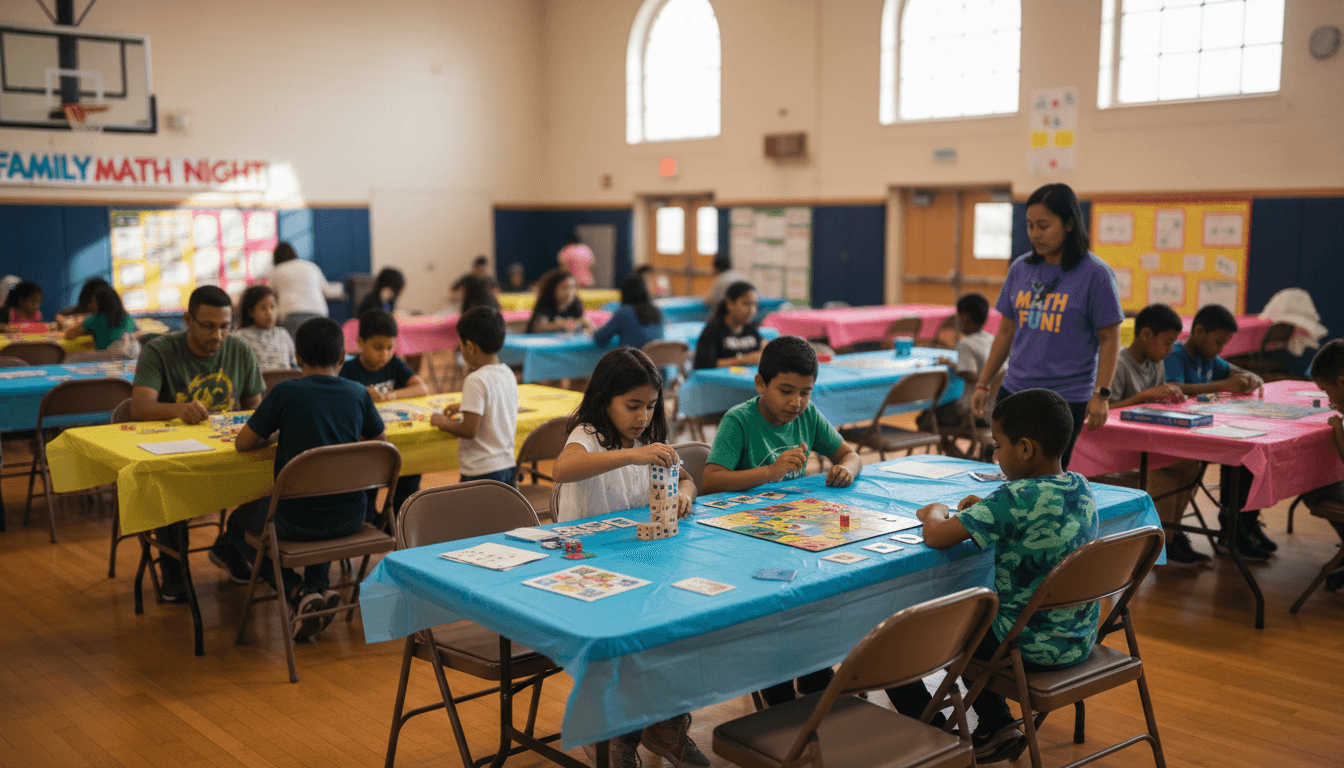
Math Newsletter for a Family Math Night: A Working Template

Family math night is one of the few events of the school year where parents and kids do math together on purpose. The newsletter around it has two jobs. The first is to get families in the door. The second is to send them home with something they can actually use at the kitchen table. Here is the template I send for math night, plus what goes in the recap email the next day.
Send the invitation as one short email, not a flyer
Most math night invites read like district flyers and parents skim them. Send the invitation as a normal newsletter. "Math Night is Tuesday, March 4, from 6 to 7:15 in the gym. Three stations, fifteen minutes each, all dice and card games. No homework, no slideshows. Bring the family. Reply to RSVP." Five sentences. Done.
Describe the three stations in one paragraph each
Tell parents what they will actually do. "Station one: Closest to 100. A card game where families build two-digit numbers and try to land closest to 100 in three rounds. Station two: Dice Sums. Roll two dice, predict the sum before the roll, win a chip when you are right. Station three: Tape-Measure Treasure Hunt. Find five objects in the room, measure them in inches, and add the lengths." Each station gets one sentence. Parents read it and can picture the evening.
Tell parents what to bring (and what not to)
Parents always ask. Answer in advance. "Just bring yourselves and your kids. We have dice, cards, paper, and pencils. No need for backpacks, calculators, or homework. Light snacks are out at the welcome table." Three sentences. That paragraph closes ninety percent of the pre-event emails.
Walk through the welcome and the closing
Math night runs better when the open and close are short and warm. Open with a thirty-second hello from the teacher, the rotation rules, and a 'have fun.' Close with a thank-you, a one-line summary of what families played, and a 'see you Friday.' Skip the slideshows. Skip the principal's address. Math night is not curriculum night. The shorter the open and close, the more time families have at the stations.
The working math-night invitation template
Subject: "Math Night, Tuesday March 4, 6 to 7:15 in the gym"
Body: "Hi families, our family math night is {date} from{time} in the {location}. Three stations, fifteen minutes each: {station 1}, {station 2}, {station 3}. All dice and card games. We provide everything. Bring yourselves and your kids. Reply to RSVP. Ms. K."
Send the recap the next morning
The day-after email is the one parents save. It has three photos from the night, a thank-you, and the directions for one game families can play at home. "Thanks for coming last night. Here is Closest to 100 in case you want to play at home this weekend: each player draws five cards from a regular deck (Ace is 1, face cards are 0). Place each card into a tens or ones spot to build two two-digit numbers that add as close to 100 as possible. Highest wins." That email gets forwarded.
How Daystage helps with the math night newsletter
Daystage holds the invitation, the RSVP link, and the day-after recap in one place. You write the invitation once, schedule the recap to send the next morning, and the whole event communication runs on its own. Families RSVP in the same tool where they read the rest of your math newsletters. The whole math-night cycle takes an hour of writing total.
Get one newsletter idea every week.
Free. For teachers. No spam.
Frequently asked questions
How many stations should a math night actually have?
Three is the sweet spot. More than three and families lose track of the rotation. Fewer than three and the night feels thin. Three stations of fifteen minutes each, with five minutes of transition, runs a clean one-hour math night. Add a welcome and a closing thank-you and the whole event is 75 minutes. That fits inside a Tuesday evening without ruining bedtime.
What supplies do I actually need for math night?
Dice (lots of them), playing cards (one deck per station), index cards, dot stickers, a few clipboards, masking tape, and a stack of blank paper. That is it. You do not need printed worksheets, you do not need bingo cards, and you absolutely do not need a slide deck. Math night should feel like games, not like school after hours.
What is one station that always works?
Closest to 100. Each player draws five cards (Ace = 1, face cards = 0). They place each card in a tens or ones spot to build two-digit numbers that add to as close to 100 as possible. Five minutes per round, two rounds per family. Parents love it because it is a real strategy game. Kids love it because they win sometimes.
What should parents leave knowing?
Three things. That math at home can be a game, not a worksheet. That the kid is doing real math when they are playing dice games and card games. And that the teacher is approachable and runs a friendly classroom. If parents leave with those three things, the night worked, regardless of attendance numbers.
How do I send the RSVP and the recap without burning a Saturday?
Two emails total. One in the week before the event with the date, time, supplies the family does not need to bring, and the RSVP link. One the day after the event with three photos, a thank-you, and the dice game directions so families can play at home. Daystage handles both. RSVP tracking lives in the same place as the send.

Adi Ackerman
Author
Adi Ackerman is a former classroom teacher and curriculum writer with 8 years in K-8 schools. She writes about school communication, parent engagement, and what actually works in real classrooms.
More for Math Newsletter
Ready to send your first newsletter?
3 newsletters free. No credit card. First one ready in under 5 minutes.
Get started free