
Math Newsletter on Manipulatives: Why We Use Them in Class

At every elementary back-to-school night, at least one parent asks why their kid is still using counters in second grade. The question is fair. The math the parent learned 25 years ago looked nothing like this. A short math newsletter on manipulatives heads off the question, explains the why, and gives families a way to support the tool at home without buying anything. Here is the structure.
Lead with the move from concrete to abstract
Open with the arc, not the tool. "In elementary math, students learn most concepts in three phases. First with objects they can hold (concrete). Then with pictures they can draw (representational). Then with numbers and symbols (abstract). Each phase builds the next. If we skip the concrete phase, the symbols later have nothing solid to stand on." One paragraph. Parents now see the manipulatives as part of a sequence, not as babying.
Name the three tools they will see on the homework page
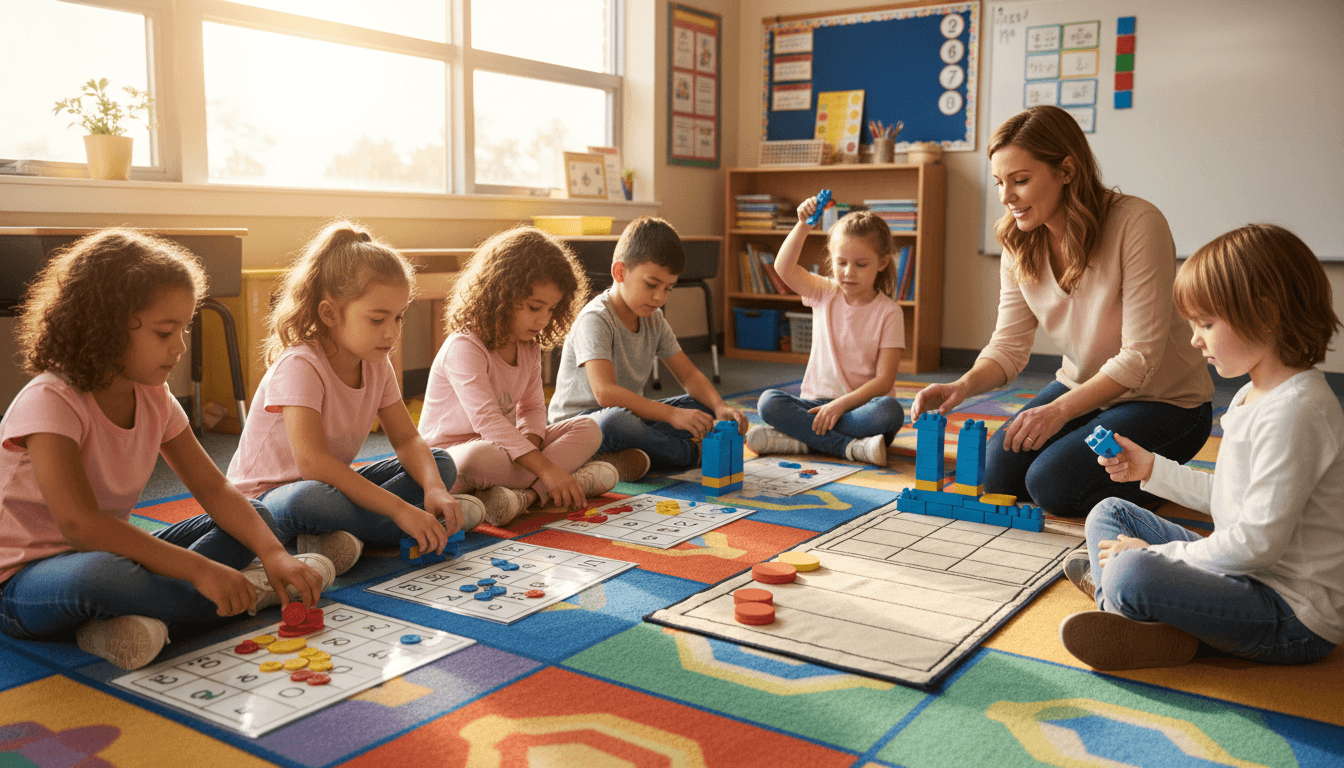
Counters, base ten blocks, ten frames. Define each in one sentence. "Counters are small chips for one-to-one counting. Base ten blocks show ones, tens, and hundreds as cubes, rods, and flats. Ten frames are a grid of ten boxes that help students see a number as parts of ten." That is the whole vocabulary section. Parents now know what they are looking at when the homework page has a picture of little squares.
Address the just-memorize-it instinct head on
Parents who learned math procedurally often want to short-cut their kid into the memorization phase. Name the instinct and gently redirect. "I know it can feel slow to watch your child line up counters for an addition problem. The counters are the model your child is building in their head. Once the model is strong, the memorization comes fast and stays. Memorization without a model fades by Thanksgiving." Direct. Specific. Parents who would never accept "trust me" accept "until Thanksgiving."
Give parents a one-line home substitute
Tell parents they do not need to buy anything. "At home, anything works as counters. Buttons. Beans. Pasta. Pennies. The brain does not care what the object is. It cares about the action of grouping. If your child reaches for a tool at the homework table, hand them one. Do not make them do it in their head." That permission slip is the whole point of the home section.
A worked example: 27 plus 35 with base ten blocks
"Last week my second graders solved 27 + 35 using base ten blocks. The kid pulls out 2 tens and 7 ones for 27. Then 3 tens and 5 ones for 35. They combine. They have 5 tens and 12 ones. They notice they can trade 10 of the ones for one more ten. Final: 6 tens and 2 ones. 62. They did the same regrouping you learned with a pencil. They did it with their hands first." That paragraph is the entire reason for the newsletter. Parents read it and exhale.
End with when the tools come off, not when they fail
Close with the timeline. "Most students move off base ten blocks for multi-digit addition by the end of second grade. Some move off in first grade. A few stay on them into third. None of those timelines are a problem. Pushing a kid off the blocks early is almost always a problem. We let the kid lead." That paragraph ends the parent worry about timing.
How Daystage helps with the manipulatives newsletter
Daystage saves this template so you write it once and resend each fall with new examples. The first month of the school year is when parents are most curious and most likely to ask the question. Sending the manipulatives newsletter in week three catches the question before it shows up in your inbox 12 times. The whole conversation moves out of email replies and into a single, calm, well-formatted note.
Get one newsletter idea every week.
Free. For teachers. No spam.
Frequently asked questions
Why do parents push back on manipulatives?
Most parents learned math without them. They watch their kid line up counters and think 'just memorize it'. That instinct made sense for the math they learned, which was procedural. The math their kid is learning now is conceptual first. The counters are not babying the kid. They are building the model that the symbols later stand for.
What is the difference between counters, base ten blocks, and cubes?
Counters are for one-to-one counting and simple addition. Base ten blocks (ones, tens, hundreds) are for place value and multi-digit operations. Snap cubes are flexible: they can show patterns, equal groups, or be used as counters. Each one matches a phase of the curriculum. The newsletter does not need to teach all three. One paragraph naming the three is enough.
What if my kid wants to use counters at home for homework?
Let them. The instinct to grab a tool is a good one. Hand them buttons, beans, pasta, anything. The point is the model, not the brand-name plastic. A kid who uses counters at home is showing you they understand that math is about quantities, not just symbols.
When do students stop needing manipulatives?
Gradually, and on their own timeline. Most students move from concrete (counters) to representational (drawings) to abstract (symbols) over two or three years. Pushing a kid off counters too early stalls their progress. Letting them stay on counters past the point they need them is also a problem. The teacher reads the room. Parents do not need to manage this at home.
How do I send this newsletter without it sounding like a curriculum lecture?
Keep it short, use a real classroom scene, and end with one tiny home action. Daystage holds the template so you can save it after the first send and reuse it next year with new examples. The point is to defuse the 'just memorize it' instinct, not to teach parents the entire elementary math philosophy.

Adi Ackerman
Author
Adi Ackerman is a former classroom teacher and curriculum writer with 8 years in K-8 schools. She writes about school communication, parent engagement, and what actually works in real classrooms.
More for Math Newsletter
Ready to send your first newsletter?
3 newsletters free. No credit card. First one ready in under 5 minutes.
Get started free