
Math Newsletter on Math Centers: A Template That Explains It

Math centers are the part of the elementary math block parents understand least. They hear "stations" and picture free play. They see their kid come home humming a dice game and worry no real math happened. A short math newsletter on math centers settles the picture in one read. Here is the template I send every three weeks to keep families clear on what the math block actually looks like.
Open with the structure, not the activities
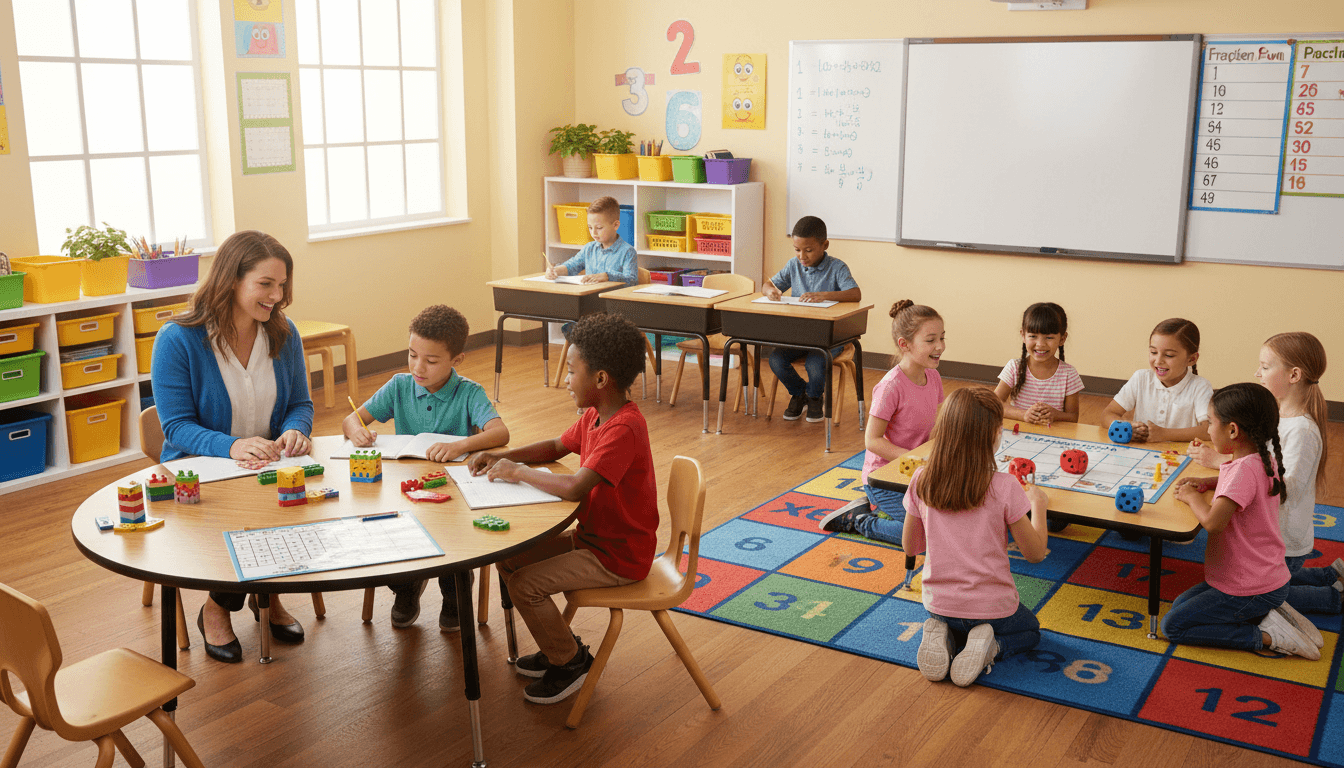
Lead with the shape of the block. "Math in Room 12 runs as three 20-minute rotations. Every student visits every station every week. One station is teacher-led, one is independent practice, one is a math game. The teacher-led station is where new learning happens. The other two reinforce skills already introduced." Three sentences. Parents now have a frame for the rest of the newsletter.
Station one: small group with the teacher
Describe what happens at the teacher table. "At my table, I meet with groups of four to six students. We work on the focus skill of the week using manipulatives and a whiteboard. This is where I introduce new strategies, watch how each kid thinks, and pull kids who need more time on a specific step." One paragraph. Parents understand that the teacher is not "just" facilitating, they are teaching.
Station two: independent practice
"At the independent station, students work a short page on the skill we covered last week. The page is timed to about 15 minutes. They self-check with a colored answer key, mark what they missed, and put the page in their folder for me to review." Parents now know what the worksheet that comes home represents. Not homework. Reinforcement of last week's skill.
Station three: the math game
This is the paragraph that earns the newsletter. Name the skill the game targets. "The math game this week is 'Race to 100' with two dice. Students roll, add the dice, and add the sum to their running total. Goal is to reach 100 first. The skill is addition fluency to 20. The kid playing it three times in a rotation gets about 60 reps of two-digit addition in a session. That is the same amount of practice as a worksheet, without the page." Specific reps. That changes the way a parent reads "math game."
A 30-second classroom scene
Drop the reader into the room. "Picture this from Tuesday: six kids at my table working on regrouping, six kids at the independent station with quiet pencils, six kids rolling dice and arguing happily about who is closer to 100. Every 20 minutes, a timer goes off and they rotate. By the end of the block, every student has had small group instruction, hands-on practice, and reinforcement. That is the design." One scene. Parents picture it.
Address the every-kid-visits-every-station rule explicitly
Head off the favoritism question. "Every student rotates through all three stations every week. No student is stuck at one station. If you see your child come home talking about the dice game three days in a row, that is the cycle. The teacher-led station shows up on a different day for that same kid." Specific. Parents stop tracking which game their kid mentioned most.
How Daystage helps with the math centers newsletter
Daystage saves the three-station template so each new rotation becomes a 15-minute write. Swap in the new skill, the new game, the new focus, and send. Add a photo of the room running if you have permission. Parents who read it the first time know what the math block looks like. By December, the question "what does my kid actually do in math?" stops showing up at conferences.
Get one newsletter idea every week.
Free. For teachers. No spam.
Frequently asked questions
Why do parents think centers are play instead of practice?
Because they often involve dice, cards, and movement. Parents see laughter and assume the academic work is happening elsewhere. The newsletter has to spell out what skill each game is targeting. Once a parent sees that the dice game is targeting addition fluency to 20, the perception shifts from play to practice in one sentence.
How many stations should I describe in the newsletter?
Three is the sweet spot. Most classrooms run three or four rotations, but four is too much to explain in a parent newsletter. Pick three and describe each in one sentence. If your rotation has a fourth, lump it into the third paragraph. Parents do not need full lesson plans. They need a mental picture of what the math block looks like.
What if a parent asks why their kid never plays the fun game?
Every kid rotates through every station over the week. That is the structural answer. If the question is really 'why isn't my kid doing the harder enrichment game,' that is a different conversation and you can offer it. The newsletter prevents that confusion by stating up front that every student visits every station across the rotation cycle.
Should I send pictures of the centers in the newsletter?
Yes, one good photo is worth two paragraphs. Take a wide shot of the room during a rotation, not a posed kid at a table. Parents see the room running and the question 'what is my kid doing for an hour' answers itself. Make sure you have photo permission for every face that shows up.
How do I send a clear centers newsletter without spending two hours on it?
Use a template that has three blanks: station one, station two, station three. Save the structure in Daystage and refill it every two or three weeks as the rotations change. Each newsletter takes 15 minutes, not two hours. The format does the heavy lifting.

Adi Ackerman
Author
Adi Ackerman is a former classroom teacher and curriculum writer with 8 years in K-8 schools. She writes about school communication, parent engagement, and what actually works in real classrooms.
More for Math Newsletter
Ready to send your first newsletter?
3 newsletters free. No credit card. First one ready in under 5 minutes.
Get started free