

High School Geometry Newsletter: A Template With Examples
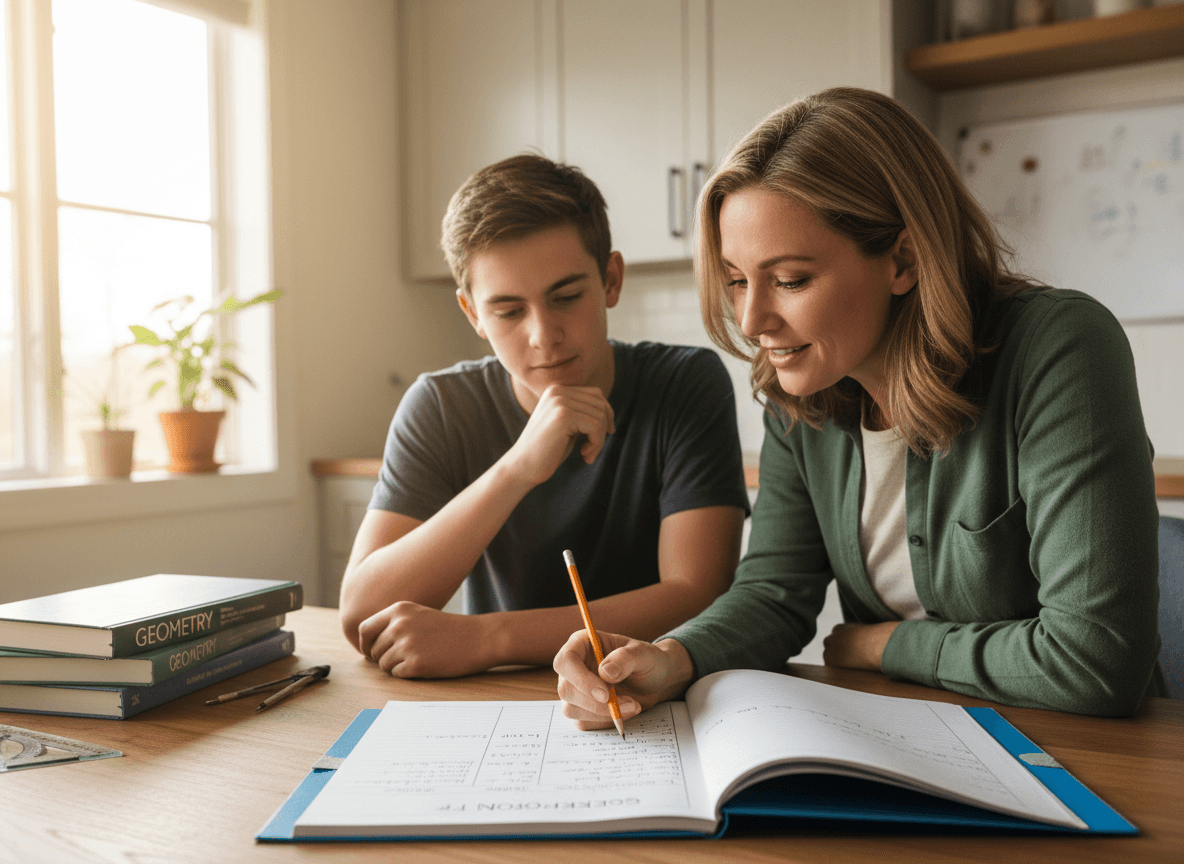
High school geometry is the year math stops being mostly numerical and becomes mostly logical. Proofs land in week three. Congruence and similarity follow. Area and volume formulas pile up. Parents who were comfortable through Algebra 1 often go quiet in geometry, because the page looks unfamiliar fast. A short geometry newsletter, sent every two weeks, keeps families oriented. Here is a template that works.
Open with the unit in plain English
Lead with what the kid is doing. "This week we are proving that two triangles are congruent. The kids are given some matching sides and angles, and they have to write a chain of statements that ends with 'the triangles are congruent.' Each statement has a reason." That sentence does the work. Parents now know what the homework looks like.
Walk through one proof
Pick a short proof and show the structure. "Given: AB is parallel to CD, and AC equals BD. Prove: triangle ABC is congruent to triangle BAD. The kid writes statements like 'AB is parallel to CD (given),' 'angle ABC equals angle BAD (alternate interior angles),' and so on, until the last line proves congruence." Parents read it and recognize the page. They do not have to teach it.
Handle 'why do we do proofs?'
Send the why once, in October. "Proofs are the first math where the answer is not a number. The point is to learn the move of justifying each step. That skill is what makes higher math, software, and law work. We practice it on triangles because triangles are simpler than anything you will use it on later." One paragraph. Parents repeat it to their kid at dinner.
Translate congruence and similarity
Two sentences. "Congruent means same shape, same size. Similar means same shape, different size. A photo and the same photo blown up to poster size are similar. Two copies of the same photo are congruent." Parents stop mixing them up after that.
Use area and volume formulas as a home reference
Send one newsletter mid-year with the formulas the kids are using right now (area of a triangle, circle, trapezoid; volume of a prism, cylinder, pyramid, sphere). Tell parents to print it and put it on the fridge. Most homework questions evaporate when the formula is on the wall.
The working template
Subject: "Geometry in Period 5 this week: {topic} (test on the 22nd)"
Body: "Hi families, this two-week stretch is {topic}. Here is one worked example or proof: {example}. If your child is using steps that look unfamiliar, ask them to explain. Coming up: {test, project, schedule}. Reply with questions. Ms. K."
What to leave out
Skip the rank lists. Skip the long write-up on which colleges weight geometry grades. Skip the academic rationale for axiomatic systems. Parents need the example, the dates, and one short paragraph of translation.
How Daystage helps with the high school geometry newsletter
Daystage holds your template and lets you send one email to every family across all sections of geometry in one click. You write the newsletter biweekly, swap in the worked example or the proof, and the email lands clean on every parent's phone. Open rates tell you which families are tracking with you and which need a quick check-in before conferences.
Get one newsletter idea every week.
Free. For teachers. No spam.
Frequently asked questions
Why do parents struggle with geometry more than algebra?
Two reasons. Proofs do not look like any math parents remember doing in college or work, and the vocabulary is dense (congruent, similar, supplementary, alternate interior angles). Even parents who handled their kid's Algebra 1 homework go quiet in geometry. The newsletter has to translate both the format of the work and the language used.
What is the cleanest way to explain a two-column proof to a parent?
A proof is a chain of small justified steps. Each line has a statement and a reason. The reason is either something given, a definition, a property, or a theorem we proved earlier. Tell parents they do not need to read the proof line by line. They need to know that proofs are about explaining why, not just getting an answer.
Why do high school geometry students keep asking 'why do we have to do proofs?'
Because proofs are the first math class where the answer is not a number, and that throws kids. Address it head-on in one newsletter. 'Proofs teach the move of justifying every step. That skill shows up in higher math, in law, in software engineering, in every field that depends on argument. We do them now because they are easier to learn on triangles than on linear algebra.' Send that paragraph in October.
What about congruence versus similarity, which always confuses students?
Tell parents the difference in one sentence. 'Congruent means same shape, same size. Similar means same shape, different size.' Two photos of a triangle, one identical and one half-size, in the newsletter, and parents are unstuck for the year.
Do high school parents actually read newsletters?
Less than middle school parents, but the ones who do tend to be the ones with the most academic anxiety, which is the population most worth keeping informed. Daystage's open-rate view shows you who is reading. The non-openers usually do not need the email anyway. The openers are the parents you will see at conferences.

Adi Ackerman
Author
Adi Ackerman is a former classroom teacher and curriculum writer with 8 years in K-8 schools. She writes about school communication, parent engagement, and what actually works in real classrooms.
More for Math Newsletter
Ready to send your first newsletter?
3 newsletters free. No credit card. First one ready in under 5 minutes.
Get started free