

Kindergarten Listening Newsletter: Following Directions at School
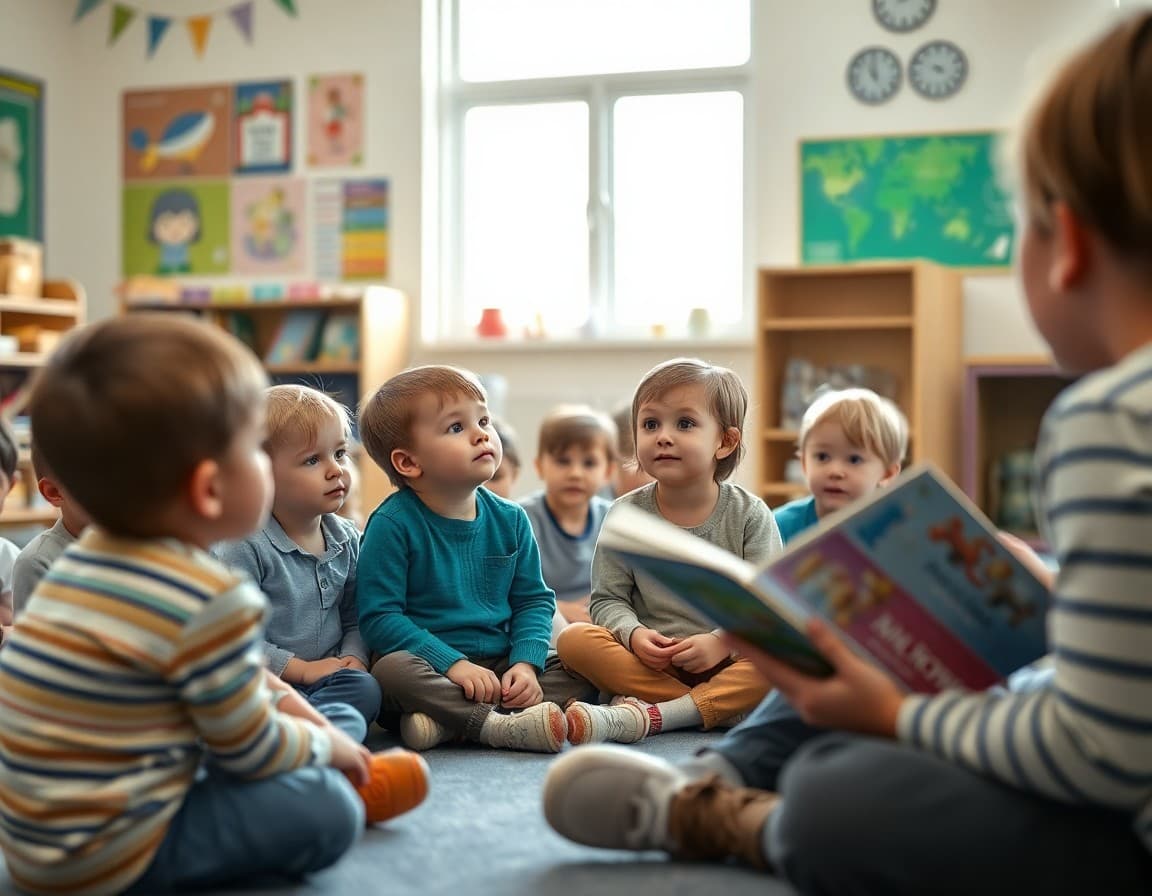
Listening is the skill that underlies nearly every other kindergarten learning goal. A child who follows directions accurately, attends to a group read-aloud, and hears corrections on their letter formation is a child who learns faster. Building listening as an intentional skill, at home and in the classroom, is worth explicit attention in your family communication.
Explain Why Listening at School Is Different From Listening at Home
Many parents report that their child listens well at home but struggles to follow directions in the classroom. This discrepancy is real and has a developmental explanation. At home, most directions are one-on-one, repeated if needed, and given by a deeply familiar person in a familiar space. At school, directions are given to a group of 20-25 children simultaneously, rarely repeated, and given by an adult the child barely knows yet in an entirely new environment.
This is not defiance or selective hearing. It is the genuine challenge of applying a skill in a more demanding context than the one where it was learned. Your newsletter should help families understand this so they respond with coaching rather than frustration.
The Look-Listen-Wait Sequence
Teach families a simple three-step listening routine they can practice at home and that mirrors what the classroom uses. Look: find the speaker's face and make eye contact. Listen: stay quiet while the speaker talks, do not interrupt or start moving. Wait: hold your body still until the speaker finishes before doing anything or responding.
Practice this explicitly at home before school starts. Sit across from the child, say "Let's practice listening: Look, listen, wait. Ready?" Then give a simple 2-step direction and wait. Praise the completion of each step: "You looked at me. You waited until I was done. You did both steps of the direction. That is excellent listening."
Two and Three Step Directions: The Classroom Standard
Kindergarten teachers regularly give 2-3 step directions as a group: "Put your mat in the closet, wash your hands, and come back to the circle." A child who can only hold one step at a time will miss the second and third and appear to have not listened. This is not a listening problem. It is a working memory demand that some five-year-olds have not yet fully built.
Families can practice multi-step directions at home through daily routines. "Before you sit down for breakfast: put your shoes in the closet, put your backpack by the door, and wash your hands." This three-step direction is realistic and meaningful. Practicing it daily builds both listening and the routine of following sequential directions.
Active Listening Games
Simon Says is the classic listening game and it works because it requires children to distinguish between conditional directions (only follow if Simon says) and unconditional directions. This level of auditory discrimination is exactly the kind of attentional work that classroom listening demands.
Other effective games for home: freeze dance (listening for the music to stop), verbal story games (add one sentence to a story, then the next person adds one, requiring them to listen to the previous turn), and direction relay (each family member gives the child one step of a direction in sequence, requiring the child to remember and execute them all).
Describe Your Classroom Listening Expectations
Families who know exactly what listening looks like in your classroom can reinforce the same expectations at home. Be specific in your newsletter: "In our classroom, I expect children to have their bodies still on the carpet during group time, their eyes on the speaker, and their voices quiet while I am giving instructions. I wait for full attention before I give directions so that every child hears the full instruction."
Describe your strategy for children who struggle to meet those expectations: "When a child is having trouble staying focused, I use their name first to get attention before giving the direction. I also use visual cues like a countdown on my fingers for transitions so children know a direction is coming." Families who understand the classroom approach can mirror it at home with transitions and mealtimes.
Listening for Understanding vs. Listening for Direction
There are two types of listening that matter in kindergarten: listening to directions (follow this procedural instruction) and listening for understanding (comprehend and respond to what is being communicated). Both are important and both need home practice, but they feel different.
Listening for understanding is built through read-aloud comprehension conversations, discussions about observations and experiences, and storytelling. Listening to directions is built through the practice routines described above. Both types compound over time. A child who develops both by mid-kindergarten is positioned well for the increasing academic demands of first grade where neither type can be scaffolded as heavily by the teacher.
Get one newsletter idea every week.
Free. For teachers. No spam.
Frequently asked questions
What listening skills do kindergartners need for school?
Key listening skills for kindergarten include: making eye contact with the speaker, waiting for the speaker to finish before responding, following 2-3 step verbal directions without visual support, staying with a group activity without wandering, and asking for clarification when something is not understood. These skills look simple but require sustained attention and self-regulation that five-year-olds are still developing.
Why do some kindergartners have trouble following directions even though they understand them?
Understanding a direction and executing it are separate skills. A child can understand 'put your backpack in your cubby and sit on the carpet' but still not follow through because their attention is captured by something else, they are overwhelmed by the simultaneous demands of a new environment, or they have not yet built the habit of applying directions to themselves in a group context. Following directions in a group at school is a more demanding task than responding to one-on-one directions at home.
How can families practice listening skills at home?
Give 2-3 step directions at home and wait for the child to complete each step before adding more. Play games that require listening: Simon Says, Mother May I, or freeze dance. Read aloud and ask comprehension questions that require the child to have been listening. Practice the 'Look, Listen, Wait' sequence before any direction: make eye contact, listen without interrupting, wait for the full direction before starting.
What is the difference between hearing and listening?
Hearing is involuntary; the ears process sound automatically. Listening is intentional; the brain actively attends to and processes what it hears. Many children who are labeled as 'not listening' are actually hearing but not actively processing. Teaching children that listening requires a deliberate choice to pay attention, and providing the tools to make that choice, is more effective than repeatedly telling a child to 'listen up.'
Can Daystage help send listening skills newsletters to kindergarten families?
Yes. Daystage lets teachers send monthly social-emotional learning newsletters to families with specific listening skill focus areas aligned to what the classroom is working on. Including game suggestions, conversation scripts for families, and honest descriptions of what listening practice looks like in the classroom gives families the context and tools to reinforce listening at home.

Adi Ackerman
Author
Adi Ackerman is a former classroom teacher and curriculum writer with 8 years in K-8 schools. She writes about school communication, parent engagement, and what actually works in real classrooms.
More for Kindergarten Transition
Ready to send your first newsletter?
3 newsletters free. No credit card. First one ready in under 5 minutes.
Get started free