

Minnesota Homeschool Newsletter: Local Resources and Guide for Families
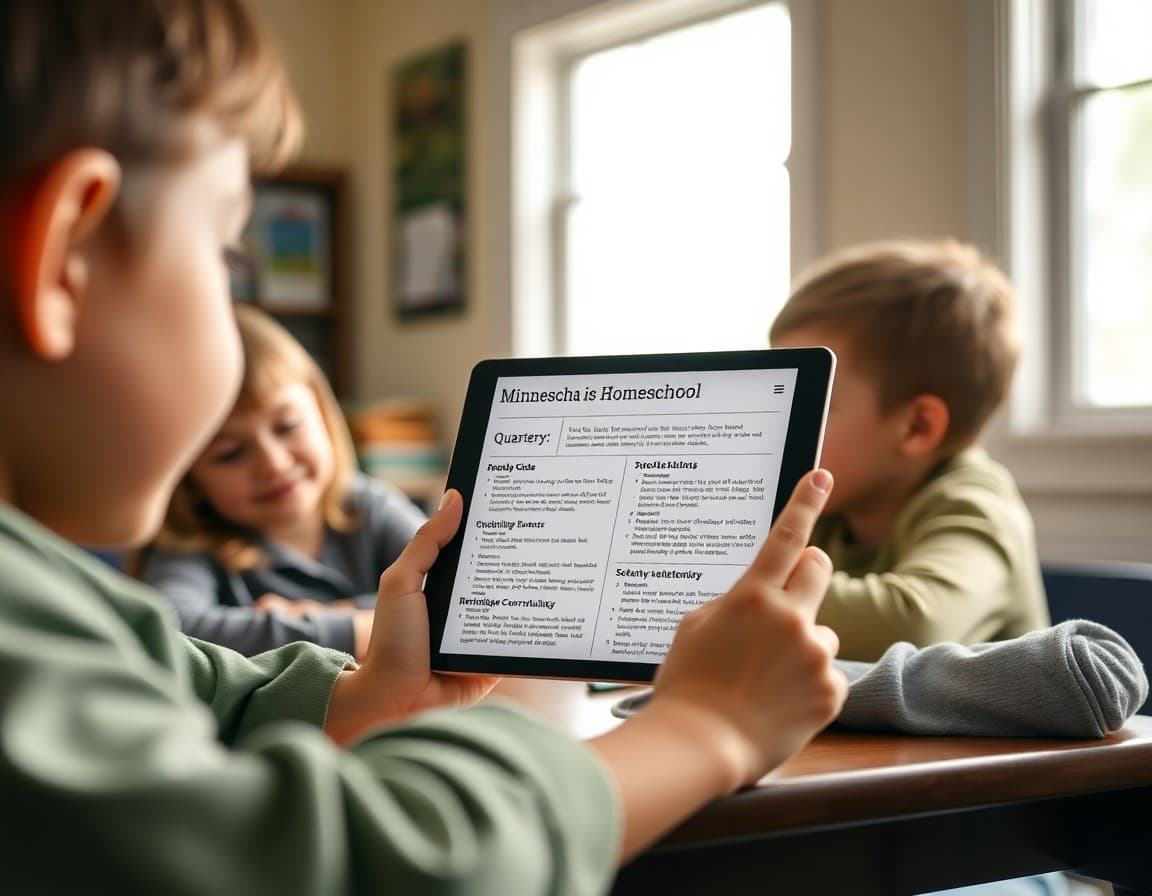
Minnesota has more specific homeschool requirements than most Midwestern states, but the requirements are clear and manageable. Quarterly reports, annual testing, and a statement of assurance create a regular documentation rhythm that a newsletter habit fits naturally. Build the newsletter practice and the quarterly reports become straightforward.
Minnesota's quarterly reports and how newsletters support them
Quarterly reports to the local school district are Minnesota's most distinctive ongoing requirement. Each report must document educational activities in required subjects for the preceding quarter. A newsletter sent regularly throughout the quarter gives you the documentation base for the report without requiring you to reconstruct three months of learning from memory.
Build your newsletter with the quarterly report in mind. When you note which required subjects were covered in each newsletter entry, assembling the quarterly report becomes a matter of organizing what you have already documented rather than creating new documentation.
Minnesota's land of 10,000 lakes as science curriculum
Minnesota's freshwater resources are genuinely extraordinary. More than 10,000 lakes, the headwaters of the Mississippi River at Lake Itasca, the Boundary Waters Canoe Area Wilderness, and the North Shore of Lake Superior all provide exceptional natural science curriculum. Water ecology, migratory bird biology, forest ecosystems of the North Woods, and winter ecology are all available through direct observation in Minnesota.
Boundary Waters trips, even short ones near the entry points, provide science experiences that no classroom can replicate. The BWCA's wolf population, moose, loons, native fish communities, and boreal forest ecology have been the subject of serious scientific research for decades. Families who engage with this research create curriculum that connects their students to active science.
Dakota and Ojibwe heritage
Minnesota is the homeland of the Dakota Sioux and Ojibwe peoples, and the history of these nations is an essential part of any honest Minnesota education. The 1862 Dakota War, the history of treaty-making and treaty violation, and the living presence of tribal nations across the state all provide curriculum content that connects to both historical and contemporary issues.
The Minnesota History Center in St. Paul has excellent resources on both indigenous history and Minnesota's immigrant heritage. The Pipestone National Monument in southwestern Minnesota, where Native Americans have quarried the distinctive red stone for sacred pipes for centuries, is an extraordinary field destination.
Winter as curriculum
Minnesota winters are not an obstacle to learning. They are curriculum. Winter ecology, including animal tracking, bird behavior at feeders, ice formation science, and weather observation, is available outside the door for months. Many Minnesota homeschool families build winter outdoor study into their schedule and document it in the newsletter.
"This week we tracked a white-tailed deer from the edge of our yard into the woodlot, identified the gait pattern from the tracks, estimated the deer's speed from stride length, and recorded the temperature, snow depth, and wind conditions" is a newsletter entry that covers science, math, and outdoor skills in a single afternoon.
Twin Cities educational resources
The Minneapolis-St. Paul metro area has an extraordinary concentration of museums and educational institutions. The Science Museum of Minnesota, the Minnesota Museum of American Art, the Bell Museum of Natural History, the Minneapolis Institute of Art, and the Walker Art Center all provide world-class educational visits. Twin Cities homeschool families have access to resources comparable to any major metropolitan area.
Preparing for annual testing
Minnesota's annual testing requirement for students in grade 3 and above requires advance planning. Knowing your test date allows you to document the skills covered in your curriculum throughout the year and identify any areas needing additional attention before testing. A newsletter archive showing consistent instruction across required subjects provides context for understanding test results.
Daystage keeps your newsletter archive organized so you can review what was covered in each subject area at any point in the school year.
Get one newsletter idea every week.
Free. For teachers. No spam.
Frequently asked questions
What are Minnesota's homeschool requirements?
Minnesota requires parents to submit a statement of assurance to their local school district each year. The statement covers the parent's qualifications, subjects to be covered, and assessment plans. Minnesota requires quarterly reports to be filed with the school district, and annual standardized testing for students in grades 3 and above.
What do Minnesota's quarterly reports require?
Minnesota quarterly reports are submitted to the local school district and must document educational activities in required subjects. The reports are an opportunity to demonstrate consistent instruction across the school year. A newsletter that covers required subjects each quarter makes preparing the quarterly report significantly easier.
What are Minnesota's testing requirements for homeschool students?
Minnesota requires annual standardized testing for homeschool students in grades 3 and above. The test must be administered by a qualified examiner and results submitted to the local school district. The testing requirement is among the more specific in the Midwest and requires advance planning.
What homeschool groups are active in Minnesota?
Minnesota Homeschoolers Alliance (MHA) provides legal resources and community connection. Numerous regional co-ops and support groups serve families across the Twin Cities, Rochester, Duluth, and the rural parts of the state. Minnesota's Norse and German immigrant heritage has created some distinctive homeschool community cultures in certain regions.
How does Daystage help Minnesota homeschool families?
Minnesota families with quarterly report requirements benefit significantly from a consistent newsletter that documents instruction across all required subjects. Daystage provides a platform for building and sending newsletters that serve both as community communication and as the basis for quarterly report preparation.

Adi Ackerman
Author
Adi Ackerman is a former classroom teacher and curriculum writer with 8 years in K-8 schools. She writes about school communication, parent engagement, and what actually works in real classrooms.
More for Homeschool
Ready to send your first newsletter?
3 newsletters free. No credit card. First one ready in under 5 minutes.
Get started free