

Teacher Newsletter for AP Computer Science Units: Helping Families Understand the Course
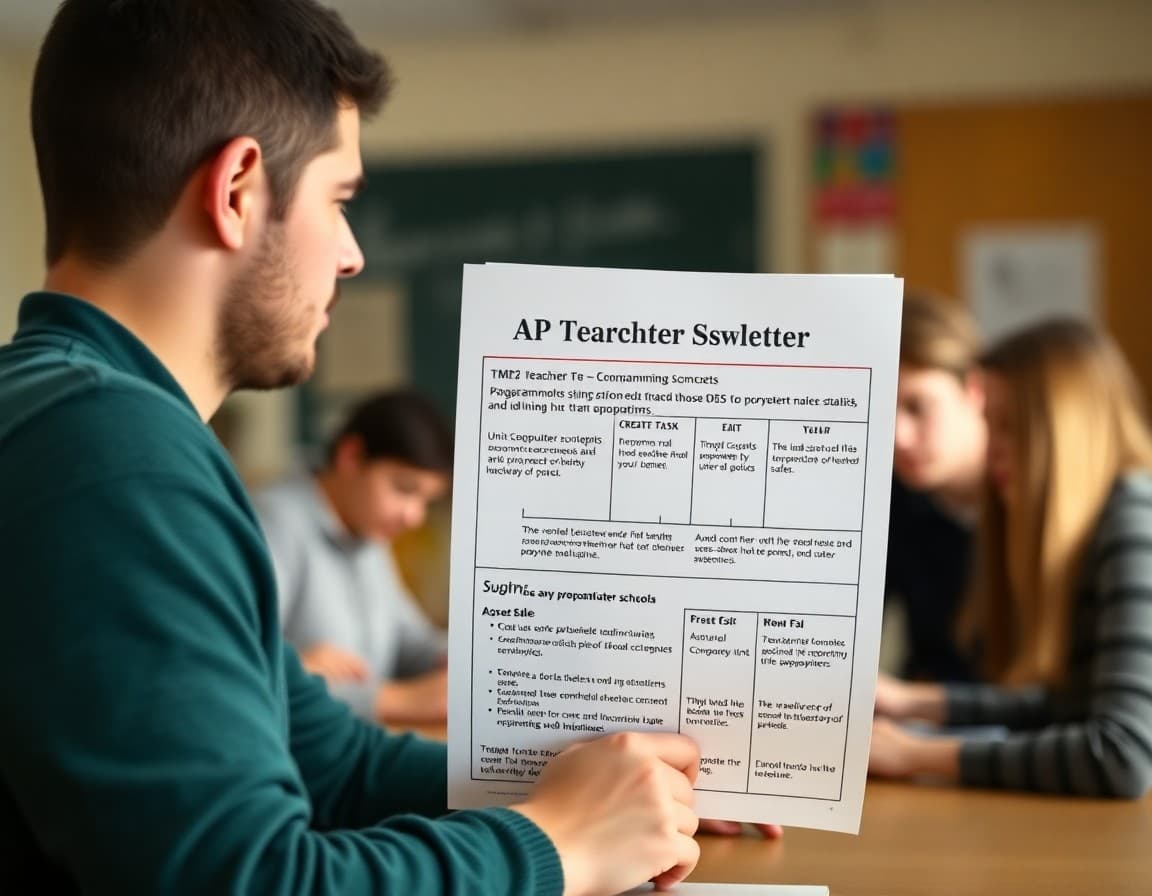
What AP Computer Science Develops in Students
AP Computer Science develops computational thinking alongside programming skill. Students learn to break problems into logical components, design algorithms, write and debug code, and analyze the efficiency of their solutions. These skills transfer far beyond software development into any domain that involves systematic problem-solving. A unit newsletter that frames the course this way helps families understand why AP CS is valuable regardless of whether their student plans to pursue a computing career.
The Current Unit: Concepts and Practice
Whether the unit covers variables and data types, control structures, object-oriented programming, or algorithm analysis, a plain-language explanation of what students are learning and why it matters gives families a framework for following their student's work. You do not need to explain the syntax in a newsletter. A description of what the concept enables students to build is enough.
The Create Performance Task: Start Early
The create performance task requires students to design and document an original program. The timeline is set by the College Board, but students who wait until the final weeks to start face serious pressure. A newsletter that introduces the task at the start of the semester and explains the documentation requirements helps families understand why early independent work matters. This is not the kind of project that succeeds with a late-night sprint.
Debugging as a Skill, Not a Failure
Debugging, the process of finding and fixing errors in code, is a central programming skill, not evidence that a student does not understand the material. Students who learn to debug systematically become much stronger programmers than those who only write code that works on the first attempt. A newsletter that explains debugging as a normal and productive part of the work helps families respond with encouragement rather than alarm when their student spends two hours on a single problem.
Practice Outside Class and What It Looks Like
Programming improves through practice, not just class time. Students who work through practice problems, modify example programs, and attempt small independent projects outside class develop fluency much faster than those who only code during class periods. Let families know what productive at-home practice looks like so they can encourage specific habits rather than just asking whether homework is done.
Exam Preparation and the Multiple-Choice Section
The AP Computer Science exam multiple-choice section includes code tracing questions where students must follow execution logic and identify output. This requires both conceptual understanding and careful attention to detail. A spring newsletter covering the exam format, timing, and preparation strategies helps families understand how to support the final preparation phase.
Keeping Families Informed With Daystage
AP Computer Science teachers who use Daystage for unit newsletters find that families are more comfortable with a technically demanding course when they receive consistent plain-language communication. Regular updates demystify the course and build the family confidence that supports student persistence through difficult units.
Get one newsletter idea every week.
Free. For teachers. No spam.
Frequently asked questions
What should an AP Computer Science unit newsletter explain to families?
An AP Computer Science unit newsletter should explain the programming concept or computational thinking skill in focus, what project or practice students are working on, what the create performance task involves, and how the unit connects to the exam. Families who understand the dual structure of AP CS, a performance task and an exam, can support their student's planning throughout the year.
What is the AP Computer Science create performance task?
The create performance task is a significant portion of the AP CS A or AP CS Principles score. Students develop a program of their own design, document their process, and respond to written prompts about their design decisions and algorithm complexity. The task cannot be completed the week before the deadline. A newsletter that introduces the task early in the year helps families understand the timeline.
What is the difference between AP CS A and AP CS Principles?
AP Computer Science A focuses on object-oriented programming in Java. It is more mathematically and programmatically rigorous and is considered a direct pathway into computer science majors. AP Computer Science Principles covers computational thinking, data, algorithms, and the internet across multiple programming options. Both offer college credit but at different levels and with different focuses.
How can families support AP Computer Science students who do not code?
Families do not need to understand programming to support AP CS students. Asking their student to explain what their program does, what problem it solves, and what was hard to get working encourages the kind of reflection that builds deeper understanding. Protecting dedicated coding time outside class and ensuring access to a working computer are the most practical forms of support.
What tool helps AP teachers send newsletters efficiently?
Daystage is built for school communication. AP Computer Science teachers use it to send formatted newsletters with concept overviews, project timelines, and exam preparation notes directly to parent email lists.

Adi Ackerman
Author
Adi Ackerman is a former classroom teacher and curriculum writer with 8 years in K-8 schools. She writes about school communication, parent engagement, and what actually works in real classrooms.
More for High School
Teacher Newsletter for STEM Pathways: Communicating Program Goals to Families
High School · 6 min read
Teacher Newsletter for AP Science Units: Helping Families Understand Lab and Exam Work
High School · 6 min read
Teacher Newsletter for Honors Class Introductions: Setting Expectations With Families
High School · 6 min read
Ready to send your first newsletter?
3 newsletters free. No credit card. First one ready in under 5 minutes.
Get started free