
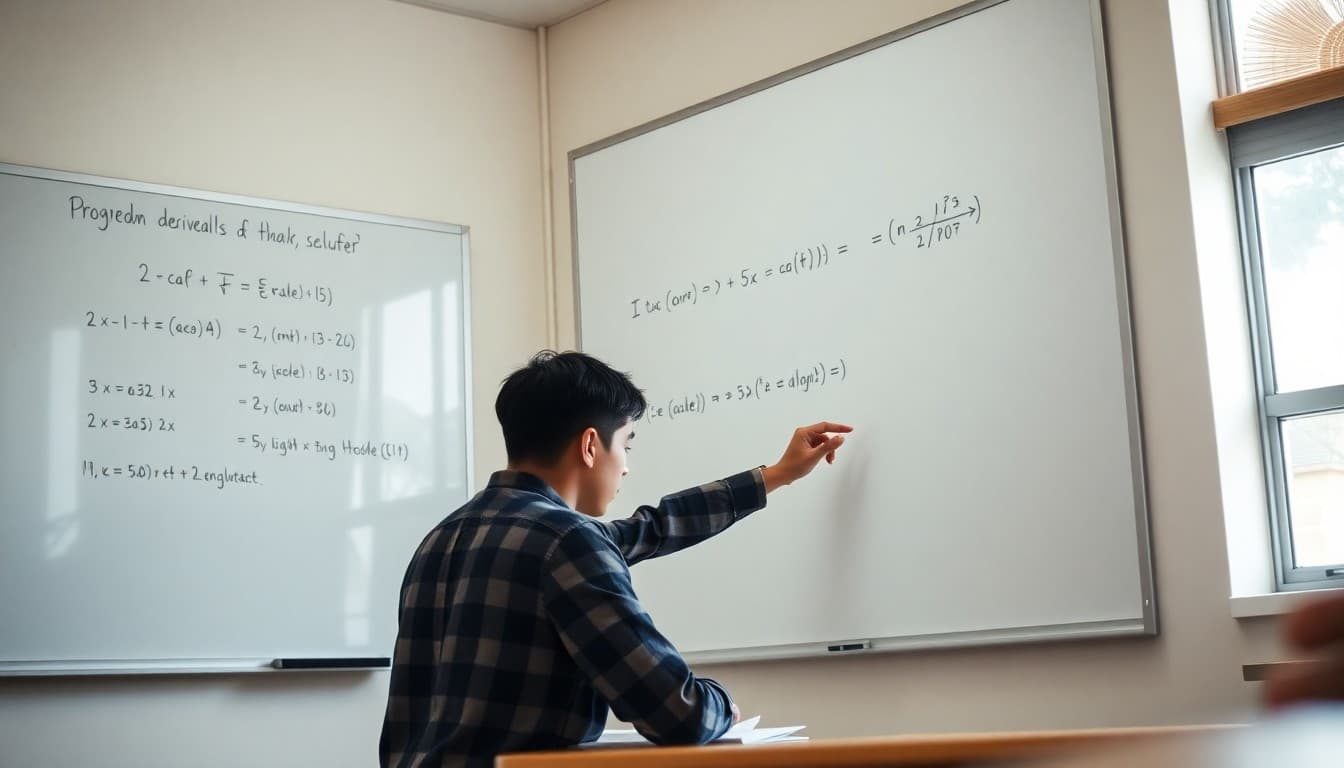
Teacher Newsletter for AP Calculus Units: Keeping Families Informed on Key Concepts
What AP Calculus Asks of Students
AP Calculus is one of the most demanding courses in a high school curriculum, not because the concepts are impossibly complex but because they require consistent practice and genuine engagement with abstract mathematical thinking. A unit newsletter that is honest about the workload and specific about what students are learning helps families set realistic expectations and create the study habits the course requires.
The Current Unit: Concept and Skills Overview
Whether the unit focuses on limits, derivatives, integration techniques, or differential equations, families benefit from a plain-language explanation of what the concept is and why it matters mathematically. You do not need to teach calculus in the newsletter. A sentence or two that connects the concept to something intuitive, such as explaining that a derivative measures instantaneous rate of change, gives families enough context to support their student's learning.
Homework Volume and Problem Practice
Calculus is a skill as much as it is a body of knowledge. Students who attend class but do not practice problems outside it will understand the concept but be unable to execute the procedure under exam conditions. Your newsletter should be explicit about how many problems students should be completing per night and what a productive practice session looks like. Families who understand why the practice volume matters are more likely to protect study time.
Free Response Preparation Throughout the Year
The AP Calculus free response section rewards clear work, correct notation, and the ability to apply concepts in unfamiliar contexts. Students who practice free response questions early in the year arrive at the exam with much less anxiety than those who encounter the format for the first time in April. Let families know when free response practice is the focus of a unit so they can encourage their student to prioritize that work.
Calculator Policy and Its Implications
AP Calculus allows a graphing calculator for parts of the exam and requires no-calculator work on other sections. Students who become overly dependent on calculators for algebraic steps struggle when the calculator is not allowed. Your newsletter should explain the calculator policy and help families understand why mental math and algebraic fluency still matter in an AP Calculus course.
Managing the Difficulty Spike Midyear
Most AP Calculus courses experience a difficulty spike around the integration unit when the procedural complexity increases significantly. Sending a newsletter at the start of that unit that names the challenge and explains the support resources available, tutoring, office hours, practice problem sets, helps families respond proactively rather than reactively.
Consistent Updates With Daystage
AP Calculus moves quickly, and a short newsletter at the start of each unit costs very little time. Daystage makes it easy to draft and send those updates on a consistent schedule. Families who receive regular communication feel less anxious about a demanding course and are more likely to encourage the daily practice the course requires.
Get one newsletter idea every week.
Free. For teachers. No spam.
Frequently asked questions
What should an AP Calculus unit newsletter include?
An AP Calculus unit newsletter should explain the conceptual focus (limits, derivatives, integrals, or differential equations), what skills students are building, what the homework and assessment load looks like, and how the unit connects to the May exam. Families who understand what calculus units are actually about can set appropriate expectations and support study habits without needing to understand the math themselves.
What is the difference between AP Calculus AB and AP Calculus BC?
AP Calculus AB covers limits, derivatives, and basic integration, roughly equivalent to one semester of college calculus. AP Calculus BC covers all of AB plus sequences and series, polar coordinates, and more complex integration techniques, roughly equivalent to two semesters. A newsletter that clarifies this distinction helps families understand the scope of what their student is studying.
How much daily practice does AP Calculus require?
AP Calculus students who succeed on the exam typically practice thirty to sixty minutes of problems per day outside class. The skills are procedural as well as conceptual, meaning that understanding an idea is not enough; students must practice applying it correctly under time pressure. Families who set consistent homework expectations early in the year see better outcomes at exam time.
What do the AP Calculus free response questions look like?
The AP Calculus free response section includes six questions, some with multiple parts. Questions typically involve graph analysis, related rates, area and volume calculations, differential equations, and interpretation of results in context. Students must show work clearly and use appropriate notation. A newsletter that describes the free response format helps families understand why showing work is required, not optional.
What tool helps AP teachers send newsletters efficiently?
Daystage is built for school communication. AP Calculus teachers use it to send formatted newsletters with unit summaries, homework schedules, and exam preparation notes directly to parent email lists.

Adi Ackerman
Author
Adi Ackerman is a former classroom teacher and curriculum writer with 8 years in K-8 schools. She writes about school communication, parent engagement, and what actually works in real classrooms.
More for High School
Teacher Newsletter for AP Statistics Units: Connecting Concepts to Family Understanding
High School · 6 min read
Teacher Newsletter for AP Science Units: Helping Families Understand Lab and Exam Work
High School · 6 min read
Teacher Newsletter for Honors Class Introductions: Setting Expectations With Families
High School · 6 min read
Ready to send your first newsletter?
3 newsletters free. No credit card. First one ready in under 5 minutes.
Get started free