

Statistics Unit Newsletter for Parents: High School Guide
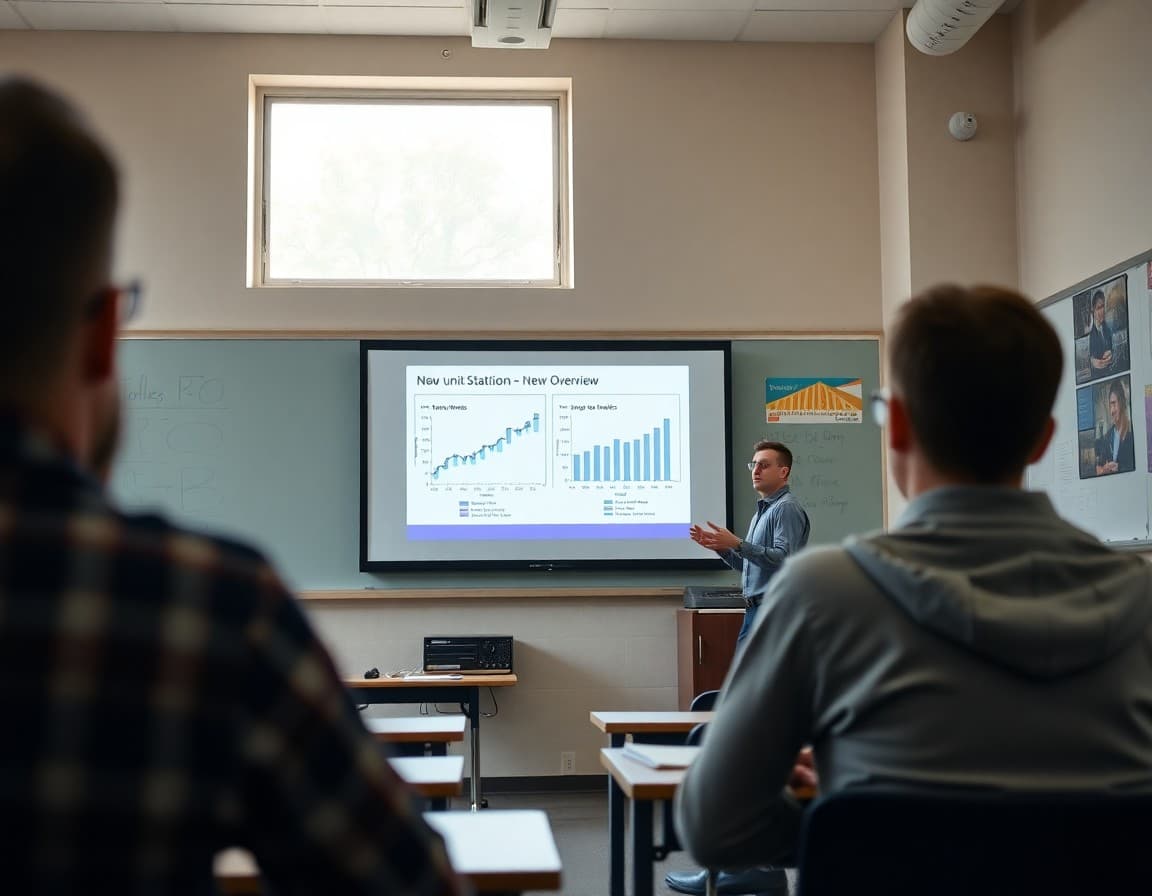
High school statistics is one of the most practically relevant courses students take, and parents who understand what is being studied are better equipped to support their student's engagement with the material. A unit newsletter at the start of each major topic keeps families informed without requiring them to relearn statistics from their own school years.
The Case for Unit Newsletters in High School Statistics
High school statistics moves quickly and covers a lot of ground. A unit newsletter at the start of each major topic gives parents a preview of what their student will be working through for the next three to five weeks. It also gives students one more signal about the unit's importance and scope before diving into the content. Teachers who send regular unit newsletters report fewer "I didn't know this was so important" conversations during report card season.
Framing the Unit Topic for Parents
Start with the unit name and its central question. For a unit on sampling and inference: "We are starting our sampling and inference unit. The central question is: when can we trust a conclusion drawn from data collected on a sample to be true of an entire population?" For a hypothesis testing unit: "We are studying hypothesis testing, which is how statisticians decide whether a result from an experiment is meaningful or whether it could have happened by chance."
That framing is intellectually honest and gives parents language to use with their student.
Key Vocabulary in Plain Language
Include the essential vocabulary for the unit with real-world definitions. For a sampling unit: population (the entire group you want to learn about), sample (a smaller group chosen to represent the population), sampling bias (a flaw in how the sample was chosen that makes it unrepresentative), and margin of error (how much the sample result might differ from the true population value). For hypothesis testing: null hypothesis (the assumption that nothing unusual is happening), p-value (the probability that the observed result could have happened by chance), and significance level (the threshold for deciding whether a result is meaningful).
A Template Opening for Any Statistics Unit
Here is a flexible unit opener:
"We are starting our [UNIT NAME] unit on [DATE]. Students will investigate: [central question]. Over the next [X] weeks, we will cover [key concepts]. Major assignments include [list with due dates]. By the end of the unit, students will be able to [learning outcomes]. The unit assessment is on [DATE]. Key vocabulary: [brief list]. To support your student at home: [one specific suggestion]. Questions? [contact info and office hours]."
College and Career Connections
High school statistics is foundational for AP Statistics, college introductory statistics, and nearly every quantitative field from medicine to political science to economics. Naming those connections in the newsletter gives students and families a reason to take the material seriously beyond the grade. "This unit's concepts are the core of how scientists evaluate whether treatments in clinical trials actually work" is exactly the kind of statement that makes a statistics unit feel worth mastering.
What the Major Assessment Requires
Tell parents what the unit assessment will ask students to do. For a regression unit: "The test includes interpreting slope and intercept in context, evaluating the strength of a linear relationship using r-squared, and identifying whether a scatter plot shows a linear, non-linear, or no relationship." For a hypothesis testing unit: "Students will state and test a hypothesis, interpret a p-value in context, and write a conclusion in language that a non-statistician can understand." Knowing the assessment requirements helps students study strategically and helps parents understand the level of thinking required.
At-Home Support for High School Statistics
Give parents one specific, non-intimidating suggestion. "Ask your student to explain this unit's central question to you in plain language and give you a real-world example. If they can do it without looking at notes, they are in good shape. If they struggle to explain it, that is a signal to review before the test." That framing works for any parent, regardless of their own statistics background, and it is genuinely useful for student learning.
Get one newsletter idea every week.
Free. For teachers. No spam.
Frequently asked questions
What should a high school statistics unit newsletter include?
Cover the unit topic, the central question students will investigate, major assignments and their due dates, key vocabulary, how the unit connects to AP Statistics or college coursework if applicable, and one way families can support at home without needing to know the math. High school statistics parents are generally more comfortable receiving detailed academic information than parents of younger students.
How do I explain advanced statistics concepts like hypothesis testing or confidence intervals in a parent newsletter?
Use analogies and real-world applications. Hypothesis testing is how scientists decide whether an experiment's result was due to the treatment or just chance. A confidence interval is like a margin of error in a poll: when a news story says 'the candidate leads by 5% with a margin of error of 3%,' that is a confidence interval. Those analogies make abstract concepts recognizable without requiring parents to understand the mathematics.
Should a high school statistics unit newsletter mention college preparation?
Yes. Many high school statistics courses prepare students for AP Statistics, college introductory statistics, or data science courses. Noting this connection motivates students who are thinking about college and helps parents see the course as career-relevant rather than just a graduation requirement. A brief sentence connecting the unit to real-world applications in medicine, social science, business, or technology is also effective.
What at-home support can parents of high school statistics students provide?
At the high school level, the most useful home support is organizational: asking about upcoming deadlines, checking whether their student has started projects early, and encouraging them to seek help during office hours if they are struggling. For content support, asking their student to explain a concept in plain language is the most effective strategy regardless of whether the parent has a statistics background.
How does Daystage support high school statistics teachers in communicating with families?
Daystage makes it practical to send unit newsletters throughout the year without spending significant time on each one. With a saved template, you update the unit-specific content and send it in under 15 minutes. For high school statistics, that might mean a unit newsletter for each major topic: descriptive statistics, probability, sampling distributions, hypothesis testing, and regression. Five newsletters over the year, well-timed and clearly written, build genuine family engagement.

Adi Ackerman
Author
Adi Ackerman is a former classroom teacher and curriculum writer with 8 years in K-8 schools. She writes about school communication, parent engagement, and what actually works in real classrooms.
More for High School
Ready to send your first newsletter?
3 newsletters free. No credit card. First one ready in under 5 minutes.
Get started free