
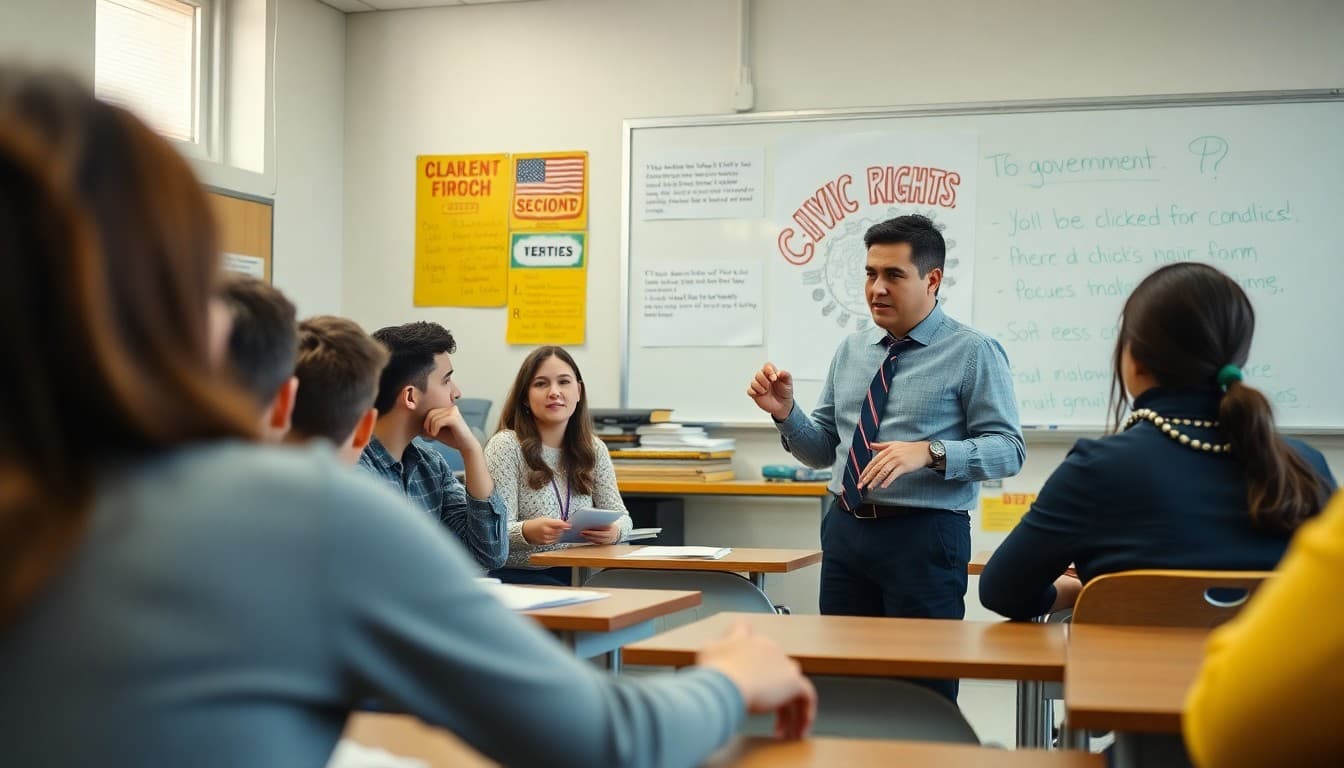
Civics Unit Newsletter for Parents: High School Guide

High school civics is taught at the moment when its content becomes most directly applicable. Students are approaching voting age, increasingly exercising civil liberties in their own digital and social lives, and starting to form the civic identity that will shape how they engage with democracy as adults. A unit newsletter connects that urgency to what's happening in your classroom and gives parents a way into the conversation.
What's Different About High School Civics
At the high school level, civics moves beyond structure into application. Students don't just learn how bills become laws; they analyze specific legislation and its constitutional basis. They don't just learn what the First Amendment says; they study the case law that defines where those rights begin and end. They're expected to form and defend civic arguments, not just describe processes.
Your unit newsletter can acknowledge this shift: "This unit asks students to apply the constitutional principles they've studied to real cases and current events, not just describe them. That applied analysis is what distinguishes high school civics from what they covered in middle school."
What to Include in a High School Unit Newsletter
Cover the unit focus, 3 to 5 key concepts with enough depth to give parents real context, one or two current events connections, and two home conversation starters that go deeper than factual recall. High school parents can handle more sophisticated framing than elementary parents. Use it.
Template Excerpt: Civil Liberties Unit
"We're starting our Civil Liberties unit this week. Students will examine the specific rights guaranteed by the Bill of Rights, how the courts have interpreted those rights over time, and where the courts have ruled those rights end when they conflict with other rights or public safety.
This is immediately relevant to your student's life. The speech they post online, the searches they might encounter at school or by police, the right to protest: all of these are governed by constitutional rights and their court-defined limits.
At home: ask your student which First Amendment rights they use most in their daily life. Then ask: 'Are there any limits on those rights? What are they, and why do they exist?' That conversation covers the core tension this unit explores."
Connecting to Voting Age
For students who are 17 or 18, the voting content in a civics course is not abstract. If your unit includes electoral systems, voter registration, or civic participation, connect it to their timeline directly: "Students who will turn 18 before or shortly after the next election can pre-register now in most states. Your student knows how to do this by the end of this unit." That kind of direct application makes the content real in a way that builds lasting civic engagement.
Handling the Complexity of High School Civics
High school civics covers genuinely complex territory: judicial review, civil rights history, the tension between security and liberty, the mechanics of electoral systems. Your newsletter doesn't need to simplify these topics for parents; it needs to orient parents to what their student is grappling with. A sentence like "this unit covers some genuinely contested territory where reasonable people disagree about how to balance competing constitutional values" is more honest and more useful than pretending the content is simple.
Why It Matters Right Now
Close the newsletter by connecting the unit to the civic environment your students are about to enter as adults. They're going to vote, serve on juries, potentially run for office, definitely pay taxes, and almost certainly navigate situations where knowing their civil liberties matters. The more concretely you can connect what they're learning in your classroom to those real futures, the more seriously both parents and students take the work.
Get one newsletter idea every week.
Free. For teachers. No spam.
Frequently asked questions
What civics topics does high school cover that middle school doesn't?
High school civics goes deeper into constitutional law, the electoral system, comparative government, civil liberties case law, and civic participation at the adult level. Students are approaching or at voting age, which makes electoral system content immediately relevant. Advanced courses may include media literacy, civil rights history and law, international institutions, and policy analysis. The level of abstraction and the expectation of nuanced analysis are both significantly higher than at the middle school level.
How do I write a civics newsletter that resonates with high school parents?
Connect the unit content to decisions and situations their student will face as young adults. A unit on voting connects to their student potentially casting their first vote within months or years. A unit on civil liberties connects to rights their student exercises daily on social media, in public spaces, and in relationships with authorities. High school parents respond to newsletters that frame civic education as immediate life preparation, not abstract academic content.
How do I handle controversial topics in a high school civics newsletter?
Describe the controversy in terms of the civic concepts it illustrates rather than taking a position on it. 'We're studying a current Supreme Court case as an example of how the court balances competing constitutional rights' is informative without being partisan. If parents receive communication that feels consistently balanced and process-focused, they're less likely to object when a genuinely contentious topic comes up.
How often should I send unit newsletters for a high school civics course?
Once per major unit, which is typically every two to four weeks depending on your course structure. Combined with test prep newsletters before assessments, that usually produces 10 to 14 newsletters per year. High school parents are less likely than elementary parents to read every communication, so quality and relevance matter more than frequency.
What role does Daystage play in a high school civics communication strategy?
Daystage gives high school teachers a consistent platform for parent communication. You can include links to news sources, save templates by unit type, and track what's been sent across the year. For civics specifically, being able to quickly update a template with current events references makes the process of connecting your newsletter to the news much faster.

Adi Ackerman
Author
Adi Ackerman is a former classroom teacher and curriculum writer with 8 years in K-8 schools. She writes about school communication, parent engagement, and what actually works in real classrooms.
More for High School
Ready to send your first newsletter?
3 newsletters free. No credit card. First one ready in under 5 minutes.
Get started free