

American History High School Newsletter: Learning Updates for Parents
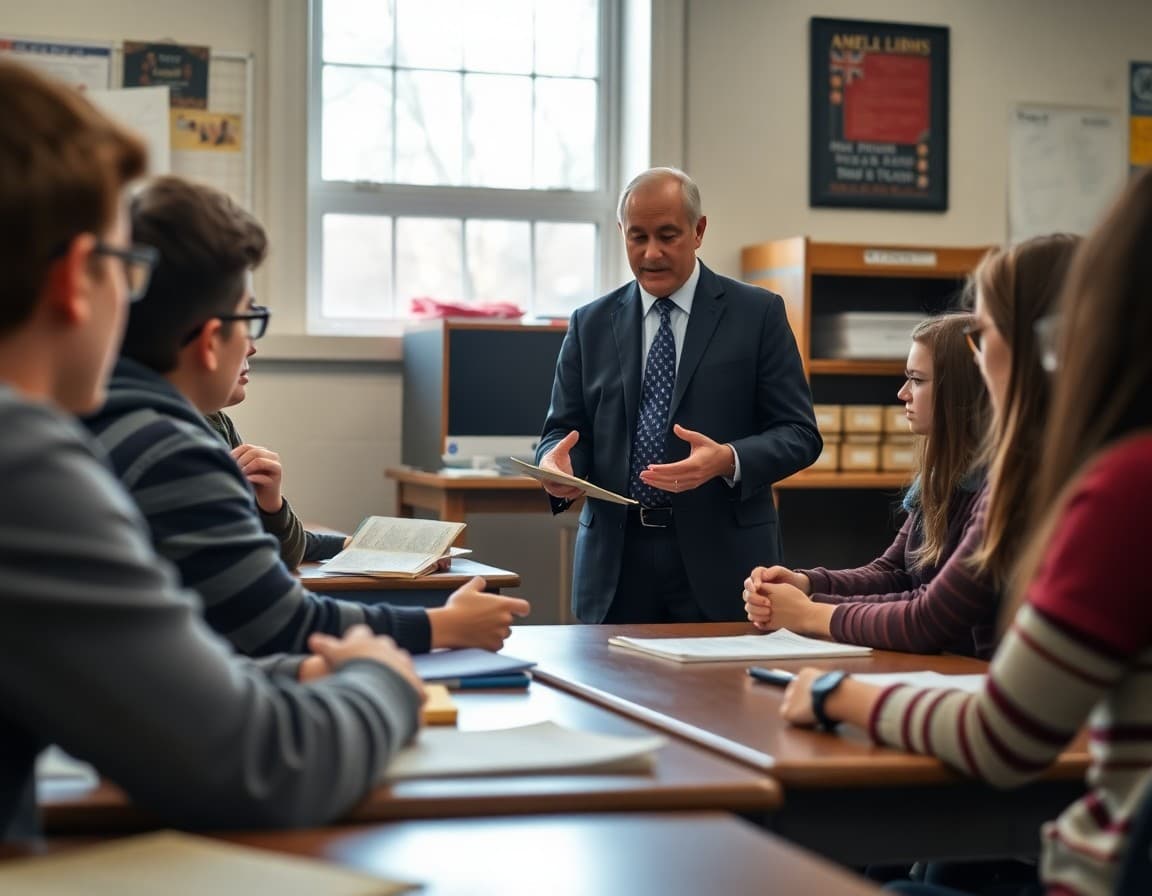
American history in high school is not just content delivery. It is the development of skills that students will use in every analytical course for the rest of their education: reading primary sources critically, building arguments from evidence, recognizing multiple perspectives on contested questions, and understanding how the past shapes the present. A newsletter that explains this to families changes how they perceive the course from required content to genuine intellectual preparation.
Share the Year's Curriculum Arc
Give families a roadmap. A typical US History sequence might cover: Colonial America and the Revolution in September and October, the Constitution and early republic in November, antebellum America and the Civil War in December and January, Reconstruction and the Gilded Age in February, the Progressive Era and WWI in March, the 1920s through WWII in April, and the Cold War through the present in May. Families who see the full arc appreciate how the year builds rather than seeing each unit as unrelated.
Explain How Primary Source Analysis Works
Many families assume history class is about memorizing dates and events. In a well-taught high school course, it is primarily about analyzing evidence and constructing arguments. Your newsletter should explain what primary source analysis involves: reading a document for its author's perspective, considering what the author wanted readers to believe, identifying what the source reveals about the historical context, and comparing it to other sources that tell a different story. This skill is the foundation of the AP History exam and of college-level history.
Name the Historical Thinking Skills the Class Is Building
College Board identifies five historical thinking skills: causation, comparison, continuity and change over time, contextualization, and argumentation. If you are in an AP course, name which of these skills the current unit emphasizes. If you are in a standard course, explain the equivalent analytical habits. Families who know the skills their student is building understand why history class involves writing and discussion rather than just textbook reading and quizzes.
Connect History to Current Events
American history has extraordinary connections to current political, social, and cultural events. During a Reconstruction unit, ask families to talk with their student about contemporary debates over historical monuments and memory. During a Progressive Era unit, connect to current debates about regulation and corporate power. During a Civil Rights unit, discuss how those movements' strategies are still used. These connections build the kind of historical consciousness that is the real goal of the course.
Explain the Writing Assignments
History writing at the high school level is argument-based, not narrative. Students are not writing stories about what happened. They are making specific claims about causation, significance, and change, and supporting those claims with specific evidence. Your newsletter should explain this so families understand why their student needs to produce a thesis, use primary sources as evidence, and address counterarguments rather than just describing historical events.
Sample Newsletter Section for American History
Here is copy you can adapt:
"We are studying Reconstruction this month. Students should understand the political goals of Reconstruction, the specific policies enacted, and why Reconstruction ultimately failed to achieve its goals of racial equality. A good home question: ask your student to explain what the 14th Amendment was supposed to do and what actually happened to those rights in the following decades. That gap is the central historical argument of the unit. Next essay is due [DATE]."
Prepare Families for the AP US History Exam
If your class is AP US History, tell families that the exam rewards historical thinking skills more than content memorization. Students who have read, discussed, and written about primary sources all year are better prepared than those who spent the final weeks reviewing facts. The most effective preparation is practicing DBQ writing under timed conditions starting in January, not creating a 50-page content review guide in April.
Recommend Accessible Resources
The Library of Congress has a free primary source database at loc.gov/collections. The Gilder Lehrman Institute has free digital primary sources and lesson-connected materials at gilderlehrman.org. Ken Burns documentary series on American history are free with a PBS subscription and are both high quality and curriculum-aligned. These are the kinds of resources families can actually use when their student wants to go deeper on a topic that caught their interest.
Get one newsletter idea every week.
Free. For teachers. No spam.
Frequently asked questions
What skills does a high school American history course build beyond content knowledge?
High school American history builds historical thinking skills: analyzing primary sources, evaluating perspective and bias, constructing arguments supported by evidence, comparing multiple interpretations of the same event, and distinguishing historical fact from interpretation. These skills are tested on the AP US History exam and are directly applicable to any writing-intensive college course.
What is a DBQ and why does it matter?
A document-based question (DBQ) is an essay in which students must analyze several primary source documents and construct a historical argument using them as evidence. It is a central skill in AP US History and in college history courses. Students who can write a strong DBQ have mastered evidence-based argumentation in a specific historical context. This skill transfers to every analytical writing assignment they will encounter after high school.
How can families support American history learning at home?
Discuss current events in historical context. Ask their student to explain how a current political debate connects to something they studied in class. Watch a documentary together and ask their student to identify the argument the filmmaker is making. Ask their student to explain why a specific historical event still matters today. These conversations build the kind of contextual thinking that history class is trying to teach.
What does the AP US History exam require?
The AP US History exam includes multiple choice, short-answer, document-based questions, and a long essay question. It tests content knowledge across all of American history from pre-contact through the present, but primarily rewards the ability to construct historical arguments using evidence and to analyze primary sources. Content alone is not sufficient: students need to apply historical thinking skills explicitly.
What newsletter tool makes American history updates easy to send to high school families?
Daystage lets you link to primary source documents, include relevant news connections, and send a clean newsletter that covers the current unit's key themes and upcoming assessments. Families who receive organized history updates engage more with the subject.

Adi Ackerman
Author
Adi Ackerman is a former classroom teacher and curriculum writer with 8 years in K-8 schools. She writes about school communication, parent engagement, and what actually works in real classrooms.
More for High School
9th Grade Social Studies Newsletter: How to Communicate History and Geography to Freshman Parents
High School · 7 min read
Eleventh Grade Social Studies Newsletter: Keeping Junior Families Connected to What History and Civics Teach
High School · 6 min read
Department Newsletters in High School: Why Subject-Area Communication Works
High School · 5 min read
Ready to send your first newsletter?
3 newsletters free. No credit card. First one ready in under 5 minutes.
Get started free