
School Sleep Newsletter: How to Talk to Families About the Sleep Crisis in Kids
Student sleep deprivation is a documented public health problem, and school staff see the effects every day. Students who fall asleep during instruction, cannot retain what was taught in first period, and move through the school day on insufficient rest. Research consistently links chronic sleep deprivation to lower academic performance, higher rates of anxiety and depression, and impaired physical development.
Schools that communicate about sleep are not oversteping. They are sharing information that directly affects student performance and wellbeing. The question is how to do it in a way that informs rather than lectures.
The data on student sleep deprivation by grade level
Including data in a sleep newsletter grounds the communication in something other than opinion. The numbers are striking enough to warrant attention without editorializing.
The American Academy of Sleep Medicine recommends 9 to 12 hours of sleep per night for children ages 6 to 12, and 8 to 10 hours for teens ages 13 to 18. Research consistently finds that a majority of middle and high school students fall significantly short of these targets. The CDC reports that more than two-thirds of high school students are chronically sleep-deprived.
What families often do not realize is that the effects of sleep deprivation accumulate across the week. A student who loses one hour of sleep per night Monday through Thursday arrives at Friday with the equivalent of a full night's deficit. A newsletter that shares this concept, briefly and concretely, tends to shift how parents think about bedtime more than any recommendation on its own.
What teachers can share without blaming parents
Teachers who observe chronic fatigue in students often want to say something but do not know how to raise it without it sounding like a criticism of the parent's household.
The approach that works: frame sleep as a school performance issue rather than a parenting judgment. "Students who get adequate sleep retain new information more effectively, which directly affects how much they get out of our classroom instruction" is about academic outcomes. "Students need more sleep" can read as a parenting critique.
A classroom newsletter section on sleep does not need to mention specific students or imply that the teacher is dissatisfied with students' home lives. It can be a general informational section, the same way a section on nutrition or physical activity would be.
Homework load and the sleep connection
Many families do not make the connection between homework volume and sleep loss. When a student is doing homework until 10 PM, the choice between finishing the homework and going to bed on time is a real dilemma. A newsletter that acknowledges this tension is more honest and more effective than one that presents sleep recommendations without engaging with the reality.
Schools with explicit homework load policies can reference those policies in the sleep newsletter. "Our grade-level team aims to assign a maximum of 30 minutes of homework per night. If your child is consistently spending more than that, please reach out and we will problem-solve together." This kind of statement reduces the implicit pressure on students and gives families a path to take.
Screen time and phones: suggestions without judgment
Blue light from screens suppresses melatonin production and delays sleep onset. Most research recommends removing screens at least one hour before bedtime. Most families know this. Many struggle to implement it.
A newsletter that presents screen curfew suggestions as research-backed recommendations rather than rules works better than one that implies families are failing by not already implementing them. "Research suggests that removing screens an hour before bed can meaningfully improve sleep quality. One family-tested approach: charge all devices in a common area overnight rather than in bedrooms."
Framing suggestions as "family-tested" or "works for many families" rather than "you should do this" reduces the defensive response that wellness recommendations often trigger.
Age-appropriate bedtime guidelines
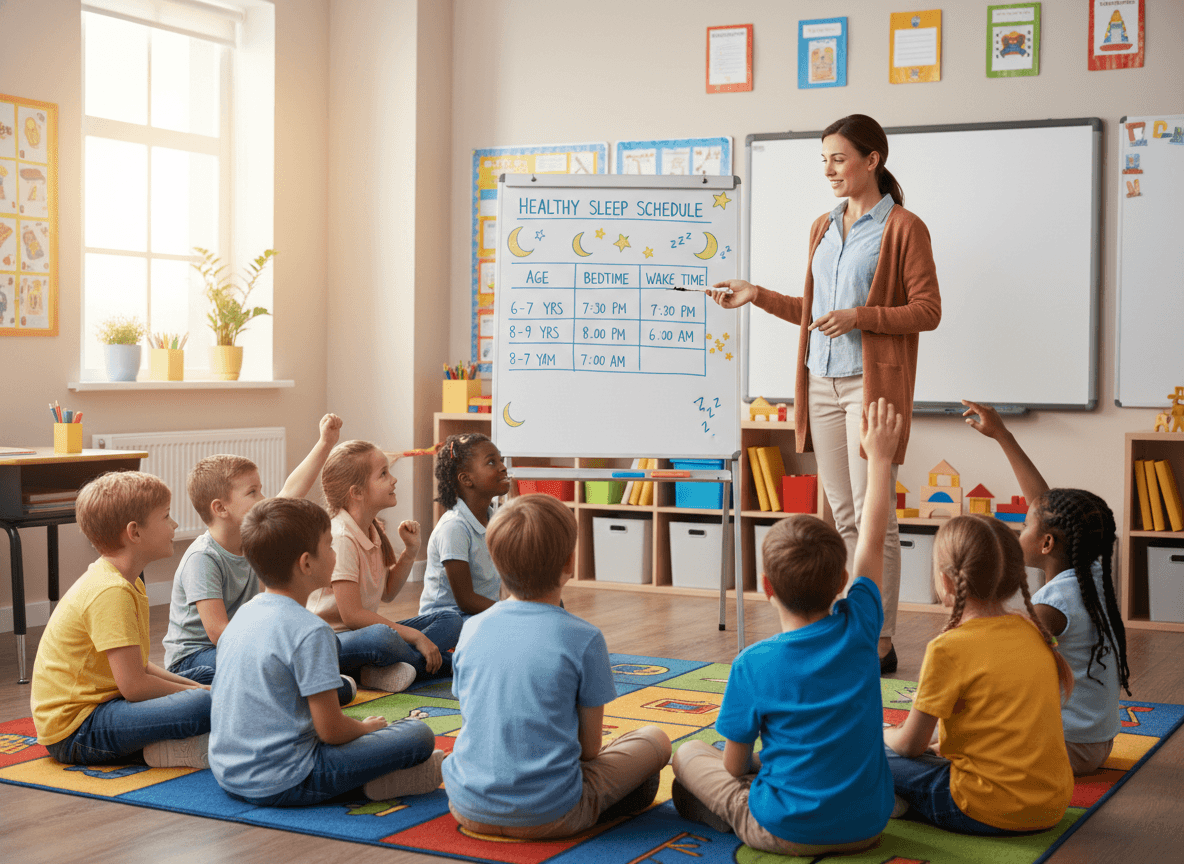
Including specific bedtime guidelines by age gives families a concrete target rather than a general recommendation. Based on recommended sleep hours and typical school start times:
Kindergarten through second grade students with a 7:30 AM start time need to be asleep by 7:30 to 8:00 PM to get ten or more hours. Third through fifth grade students typically need to be asleep by 8:00 to 9:00 PM. Middle schoolers with an 8:00 AM start and a recommendation of nine hours need to be asleep by 10:00 to 11:00 PM, which many are not.
Present these as ranges informed by research, not mandates. "If your fifth grader is routinely staying up past 10 PM, they are likely entering school on under seven hours of sleep, which affects learning and mood" is informational. It states a consequence. It does not blame.
Making sleep a regular newsletter topic
Sleep communication works best when it appears at the moments when it matters most: back to school in September when schedules are being reestablished, before major testing in the spring, and after winter break when sleep schedules have often drifted significantly.
Daystage makes it easy to add a brief, recurring sleep health section to your newsletter at these key moments without recreating it from scratch. A short, factual, non-preachy sleep section two or three times per year does more than a single intensive sleep-focused issue.
Get one newsletter idea every week.
Free. For teachers. No spam.
Frequently asked questions
When should schools communicate about student sleep to families?
The three highest-impact moments for sleep communication are back to school in September when schedules are being reestablished, before major testing in spring when late-night studying is most common, and after winter break when sleep schedules have often drifted significantly. A brief, factual sleep section at each of these moments does more than one intensive sleep-focused newsletter issue.
What should a school sleep health newsletter include?
Include the recommended sleep hours by age group (9 to 12 hours for ages 6 to 12, 8 to 10 hours for teens), specific bedtime ranges based on your school's start time, the cumulative effect of nightly sleep loss across the week, and one practical suggestion families can implement. Framing screen curfew suggestions as research-backed recommendations rather than rules reduces the defensive response wellness communication often triggers.
How should schools communicate sleep guidance to parents without sounding preachy?
Frame sleep as an academic performance issue rather than a parenting judgment. 'Students who get adequate sleep retain new material more effectively, which affects how much they get from classroom instruction' is about outcomes families already care about. A newsletter that acknowledges the homework-sleep tension directly is more honest and more effective than one that presents sleep recommendations without engaging with the real-world constraints families face.
What are common mistakes in school sleep communication?
Presenting sleep hours as mandates rather than research-based guidelines triggers resistance in families who already feel over-instructed. A second mistake is ignoring the homework connection. When students are doing homework until 10 PM, telling them to be asleep by 9 PM is not actionable. Schools with explicit homework load policies can reference them directly in the sleep communication to address this tension honestly.
How can Daystage support consistent sleep health communication?
Daystage makes it easy to add a brief recurring sleep health section at the key moments in the school year without recreating it from scratch each time. Set up the structure and standard language once, then update only the seasonal framing. Two or three well-timed sleep sections per year reach families when the information is most actionable.

Adi Ackerman
Author
Adi Ackerman is a former classroom teacher and curriculum writer with 8 years in K-8 schools. She writes about school communication, parent engagement, and what actually works in real classrooms.
More for Health & Wellness
School Opioid and Naloxone Policy Newsletter: What Families Need to Know
Health & Wellness · 5 min read
Vision and Hearing Screening Newsletter: How to Communicate Results and Next Steps
Health & Wellness · 7 min read
School Asthma Management Newsletter: Helping Students Breathe Easier Every School Day
Health & Wellness · 5 min read
Ready to send your first newsletter?
3 newsletters free. No credit card. First one ready in under 5 minutes.
Get started free