
Does Publishing Your School Newsletter Help Your School's SEO?
Most schools don't think about their newsletters as content that lives on the web. They send an email, maybe attach a PDF, and move on. But if you're already producing regular school communication, there is a real question worth asking: could that content be doing more work for your school's online presence?
What School SEO Actually Looks Like
School websites don't typically compete for high-traffic commercial keywords. The valuable search territory for a K-12 school is hyper-local: "Washington Elementary School open house 2027," "Jefferson Middle School robotics program," "Lincoln High School AP course offerings." Families searching these terms are already interested in your school. A newsletter archive that covers these topics gives search engines more pages to index and more context about what your school offers.
Why PDF Newsletters Are SEO Dead Weight
Many schools post their newsletters as PDF files. Google can sometimes read text in PDFs, but it treats them as lower-quality content than HTML pages. Image-based PDFs (scanned documents or newsletters exported as images) are essentially invisible to search engines. A newsletter that took two hours to produce and is stored as a PDF on your server contributes almost nothing to your school's searchability.
HTML Newsletter Archives Work Differently
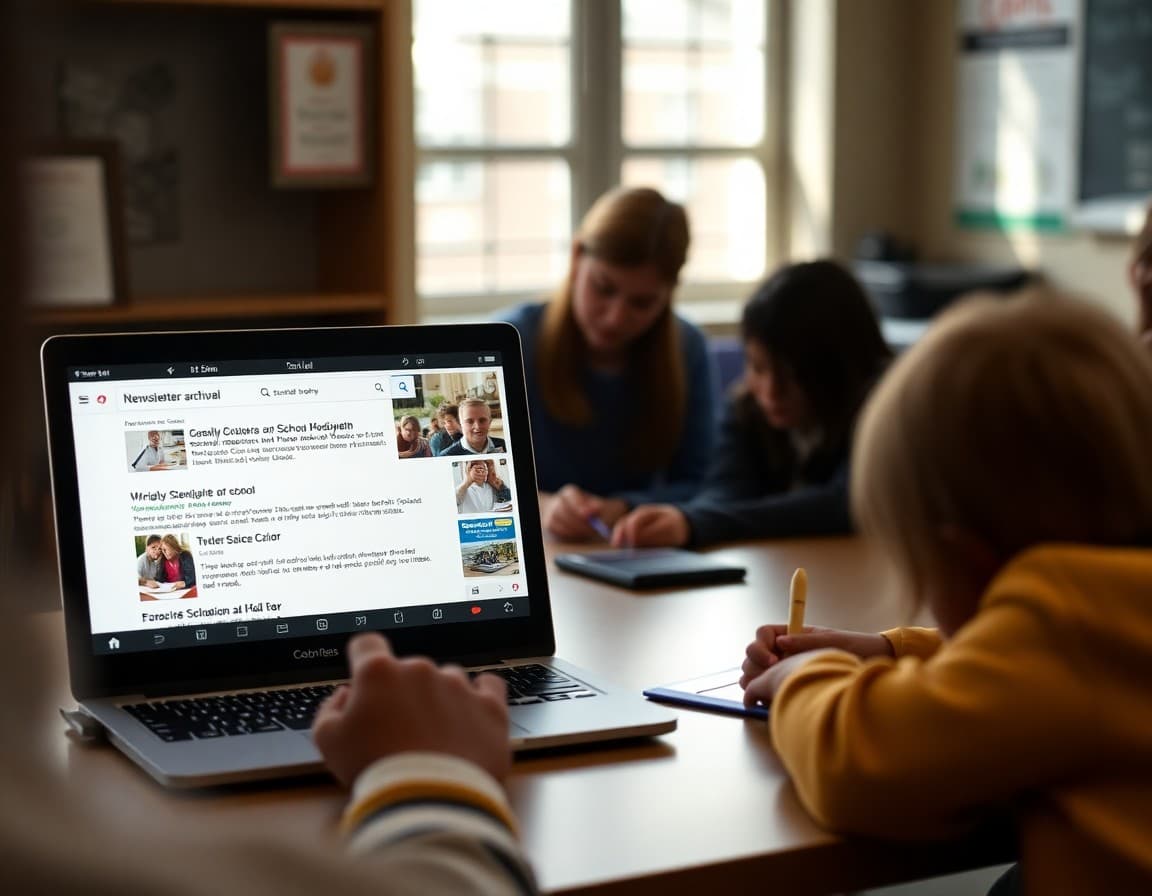
When a newsletter is published as a real web page with readable text, it functions like any other page on your site. Search engines can index it, follow links within it, and use the content to understand what your school does. Over time, a school that publishes 40 newsletters a year as HTML pages builds a body of indexed content that increases the chance of showing up when families search for specific programs or events.
What Content in Newsletters Actually Gets Searched
Not all newsletter content has SEO value. Routine reminders about permission slips and lunch menus don't drive search traffic. The content that helps with SEO is the kind that families outside your current community might search for: program descriptions, event recaps with names and dates, school achievement announcements, and community partnership features. Including these in your newsletters and archiving them online builds a searchable record of your school's programs over time.
Template Excerpt: Newsletter Intro That Doubles as Web Content
Here is an example of a newsletter opening that reads well as both an email and a web page:
Riverside Elementary STEAM Night - Friday, March 14
Riverside Elementary School's annual STEAM Night returns on Friday, March 14 from 6 to 8 PM. Students from kindergarten through fifth grade will present projects from the spring science unit. Parents and community members are welcome. This year's theme is "Engineering in Nature." Light refreshments will be served by the PTA.
This paragraph names the school, the event, the date, the grade levels, and the topic. If archived online, it becomes findable by anyone searching for "Riverside Elementary STEAM Night" or "Riverside Elementary events 2027."
Privacy Considerations for Public Archives
Before publishing newsletters publicly, review the content for student names, photos, and personal details. A newsletter that says "Congratulations to Sofia M. and James T. for their reading milestones" should not be indexed by Google. Publish general school news and keep anything mentioning individual students behind a login or in a private link that isn't submitted to search engines. Most schools find a natural split: school-wide newsletters go public, classroom newsletters stay private.
How to Set Up a Newsletter Archive
The simplest approach is to add a "Newsletters" page to your school website and link each issue as an HTML page or embed. Update it each time you send. If your newsletter platform generates a web-hosted version of each issue, use that link. Add the archive page to your school website's main navigation so search engines can find it when crawling your site. That single structural change is enough for most school newsletter archives to start accumulating indexed content within a few weeks.
Realistic Expectations
Publishing newsletters online won't transform your school's search rankings overnight. The benefit is gradual and primarily helps with local searches specific to your school's programs and events. Think of it less as an SEO strategy and more as a side benefit of good communication housekeeping. If you're already sending quality newsletters, archiving them in a searchable format is a 20-minute setup that compounds in value over time.
Get one newsletter idea every week.
Free. For teachers. No spam.
Frequently asked questions
Does posting school newsletters online actually improve search rankings?
It can, but only if the newsletters are published as readable HTML, not as PDFs. Google indexes text-based content well but struggles with scanned or image-based PDFs. If your newsletter archive is a folder of PDF links, it is contributing almost nothing to your school's search presence.
What search terms might a school newsletter archive help rank for?
Locally-specific phrases work best: your school name plus event names, program names, or community initiatives. A family moving into the district and searching for information about a specific school program is more likely to find a newsletter archive than a generic about page.
Should every teacher newsletter also be published online?
Classroom newsletters don't need to be indexed publicly, and many families would prefer they weren't. School-wide newsletters and program updates are the better candidates for public archives. Classroom newsletters can still be hosted on a web page for convenience without being submitted to Google for indexing.
Are there privacy concerns with publishing school newsletters publicly?
Yes. Never publish student full names, photos, or other personally identifiable information in a publicly indexed newsletter. If your newsletters mention individual students by name, those issues should stay behind a login. Only publish general school news that you'd be comfortable with any member of the public reading.
Does Daystage host newsletters on a public web page?
Yes. Every Daystage newsletter gets a public web link that families can share and that can be added to your school website. The content is rendered as readable HTML, which means it can be indexed by search engines if you want that. For privacy-sensitive classroom content, you can keep the link unlisted so it isn't indexed.

Adi Ackerman
Author
Adi Ackerman is a former classroom teacher and curriculum writer with 8 years in K-8 schools. She writes about school communication, parent engagement, and what actually works in real classrooms.
More for Guides
Ready to send your first newsletter?
3 newsletters free. No credit card. First one ready in under 5 minutes.
Get started free