

Illinois Elementary School Newsletter Guide for Teachers
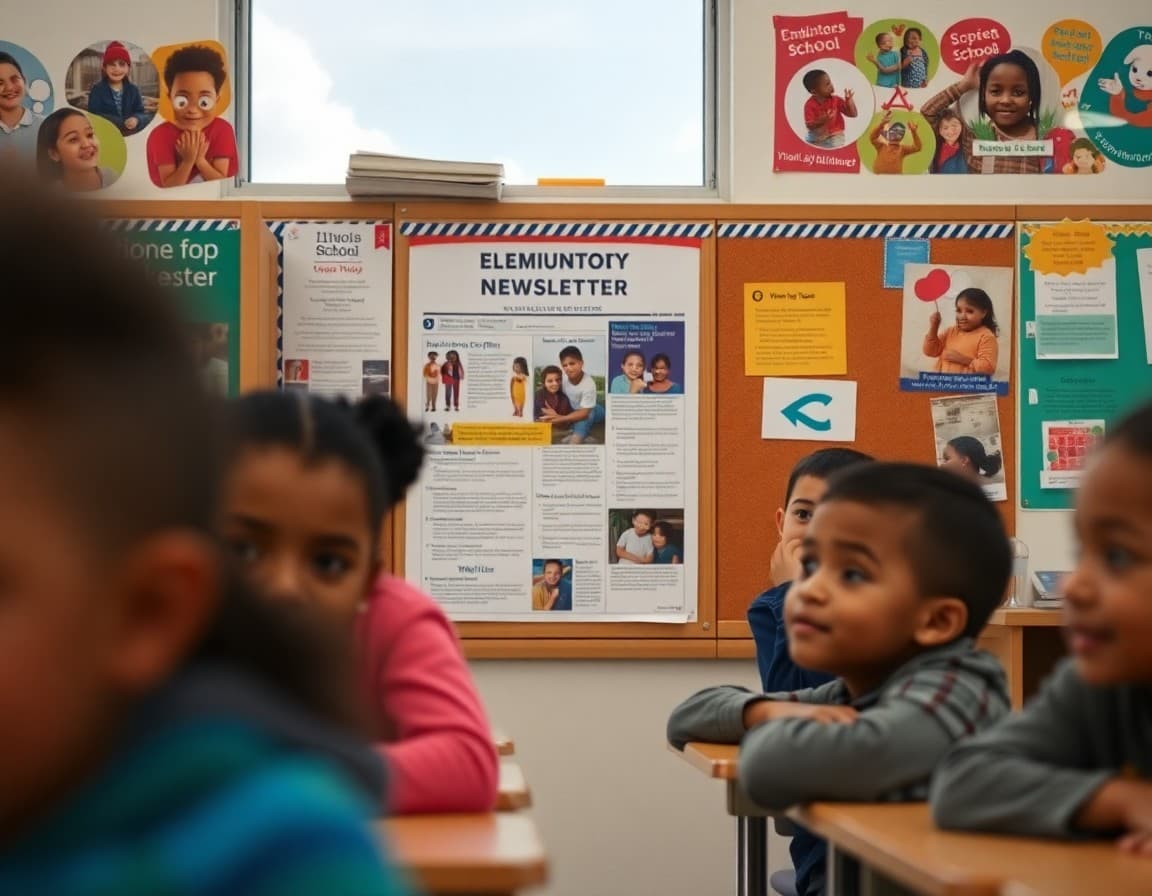
Illinois elementary schools range from high-poverty Chicago schools on the South and West Sides to affluent suburban districts on the North Shore and downstate rural schools in Champaign County. The families those schools serve are among the most diverse in the Midwest. A good elementary newsletter works across that range by being specific, practical, and consistently delivered. This guide covers what Illinois elementary newsletters need to include and how to make them work for your community.
Illinois Learning Standards and Newsletter Content
Illinois adopted the Common Core-based Illinois Learning Standards for ELA and math, with Next Generation Science Standards for science. A monthly newsletter section that explains which standards students are working toward -- in plain language, not standard code numbers -- helps families understand why certain assignments come home. "This month in 4th grade ELA, students are analyzing how authors use point of view to shape a story. At home, after reading together, ask 'who is telling this story and what do they think about what's happening?' That question targets exactly the skill we are building." That kind of translation is what makes newsletter content useful rather than decorative.
Illinois Assessment of Readiness: Preparing Elementary Families
The Illinois Assessment of Readiness (IAR) is administered to students in grades 3-8 each spring. Elementary families in grades 3-5 need newsletter coverage of the IAR starting in January. The IAR tests ELA and math, and its adaptive format means students see questions calibrated to their performance level. Many Illinois families, particularly first-generation immigrant families, do not understand what an adaptive standardized test is or why score percentiles matter. A February newsletter that explains IAR scoring in plain language -- "a score of 3 or above means your child is on track for grade-level work; a score of 4 or 5 means they are exceeding grade level" -- gives families context for results they will see in the spring.
Newsletter Structure for Illinois K-5
A structure that works across the grade band:
- Classroom update: current units in ELA, math, science/social studies in 2-3 sentences
- Homework and reading: what to expect, how families can help
- IAR preparation: (January-April) specific updates on what is being assessed and when
- Important dates: Illinois school calendar events, early release days, conferences
- One ask: the single most important thing you need families to do this month
Chicago Public Schools: Specific Communication Context
Chicago Public Schools (CPS) is its own district with policies that sometimes go beyond Illinois state requirements. CPS has a family engagement policy that specifies how schools communicate with families and requires Local School Councils (LSCs) to be informed about major school communications. If you teach in a CPS school, check with your principal and LSC about any school-specific newsletter requirements. CPS also has translation services for major languages -- Spanish, Polish, Arabic, Chinese, and others -- that teachers can access for newsletter translation. Using the district translation service rather than a free online tool produces more accurate results for professional communications.
Template Excerpt: March Illinois 3rd Grade Newsletter
A sample opening section:
"March is our IAR preparation month. The test window opens April 14 for 3rd graders. We spend the next two weeks reviewing the skills most commonly tested: finding the main idea in informational texts and solving two-step word problems. The best preparation is consistent reading every evening and a full night's sleep during test week. Our school offers a free breakfast on test days -- please make sure your student arrives by 8:00 AM. I will send a complete test schedule home March 31. If your student needs accommodations, those are already in place from their IEP or 504 plan -- no additional action is needed from families."
Reaching Illinois's Multilingual Elementary Families
Illinois has over 200,000 ELL students statewide, with the largest concentrations in Chicago, Aurora, Rockford, and Elgin. For elementary newsletters in these communities, Spanish translation is the most critical investment. In Chicago's Pilsen and Little Village neighborhoods, virtually all family communication benefits from Spanish. In Skokie, West Rogers Park, and portions of Evanston, Arabic and Mandarin translation matter. In Waukegan, Spanish and a smaller number of other languages serve different community segments. Your school's EL coordinator knows your specific language demographics and can point you toward the district's translation resources.
Building Consistent Newsletter Habits in Illinois Schools
Illinois teachers face competing demands from district mandates, state reporting requirements, and the daily reality of classroom management. A newsletter that takes 45 minutes to produce each week is not sustainable. Build a template once, with fixed sections that rarely change, and commit to filling in content on a specific day each week or month. That discipline is the difference between teachers who send 35 newsletters in a year and teachers who send four. Tools like Daystage preserve your template between issues so you are never starting from a blank page.
Get one newsletter idea every week.
Free. For teachers. No spam.
Frequently asked questions
What should an Illinois elementary school newsletter include?
Illinois elementary newsletters should cover current academic units aligned to Illinois Learning Standards, upcoming Illinois Assessment of Readiness (IAR) dates for grades 3-5, school events, homework expectations, and family involvement opportunities. Chicago Public Schools and suburban districts often have specific communication protocols teachers should align with, so check your district's family engagement policy before setting your newsletter cadence.
Does Illinois have requirements for elementary school communication?
Illinois law requires schools to have a parental involvement policy and to communicate regularly with families. Chicago Public Schools has specific parent engagement policies that go beyond state minimums. Title I schools in Illinois have federal family engagement plan requirements. The Illinois State Board of Education's Every Student Succeeds Act plan emphasizes family engagement, particularly in high-poverty districts. While there is no specific newsletter mandate, newsletters are one of the most documented forms of family communication.
How often should Illinois elementary teachers send newsletters?
Weekly newsletters work well for K-2 classrooms in Illinois, especially for reading benchmark updates and sight word practice. Grades 3-5 can typically manage with a twice-monthly newsletter. The key is consistency. Illinois families in Chicago and suburban districts often have multiple communication channels competing for their attention, so a predictable newsletter schedule -- same day, same format -- helps families know when to look for your update.
What languages matter most for Illinois elementary newsletters?
Spanish is the most widely needed language for Illinois elementary newsletters, particularly in Chicago, Aurora, Joliet, Cicero, and downstate Decatur and Waukegan. Chicago Public Schools also serves significant Arabic-speaking, Polish-speaking, and Mandarin-speaking communities. The South and West Side communities have significant African American families whose primary language is English but whose cultural communication norms may differ from the school's default assumptions. Language access means both translation and cultural competence.
What tool helps Illinois elementary teachers manage newsletter production?
Daystage is a practical option for Illinois elementary teachers who want to reduce newsletter production time. A reusable template means each week or month is mostly content updates rather than formatting. For Chicago teachers managing large class rosters and complex family demographics, a tool that handles translation support and delivery tracking is especially useful.

Adi Ackerman
Author
Adi Ackerman is a former classroom teacher and curriculum writer with 8 years in K-8 schools. She writes about school communication, parent engagement, and what actually works in real classrooms.
More for Guides
Ready to send your first newsletter?
3 newsletters free. No credit card. First one ready in under 5 minutes.
Get started free