
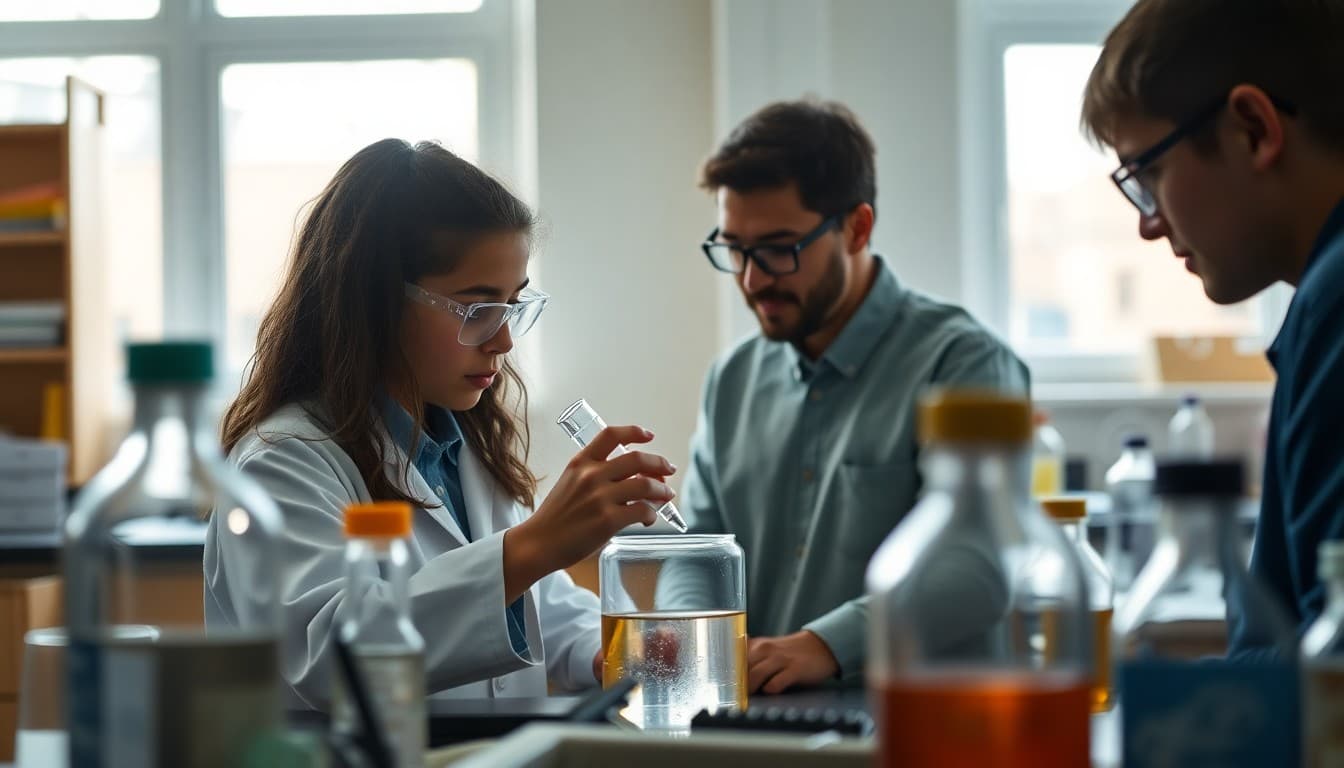
Gifted Science Research Newsletter: Student Investigations
Student science research programs give gifted learners one of the most intellectually demanding and rewarding experiences available in secondary school: the process of asking a question that matters, designing a way to answer it, and discovering something that was not previously known. The communication challenges that come with these programs are real. Research timelines are long, the work is often invisible to families who do not see it happening at school, and the competition structure is unfamiliar to most parents. A gifted science research newsletter solves all three problems.
What Original Research Actually Means at the Student Level
The term "original research" can intimidate families who picture Nobel Prize-level discoveries. The newsletter should reframe it accurately. At the student level, original research means a question the student formulated, a method the student designed, and conclusions drawn from data the student collected. It does not require discovering something unknown to all of science. A seventh grader who investigates whether the bacterial populations on school cafeteria tables vary by surface material, meal period, and cleaning schedule is doing original research. The question is specific, the method is designable with school equipment, and the answer is not already known for that particular school environment.
The Research Timeline and Why It Matters
Science research projects have long development cycles, and the newsletter should make the full timeline visible to families. For a spring science fair, a September start is not early. The question development phase alone should take two to three weeks. A thorough literature review takes another two to four weeks. Experimental design, safety review approval, and materials acquisition can take another three to four weeks before any data is collected. Data collection may run six to eight weeks. Analysis, write-up, and display preparation take the final six to eight weeks. A student who starts in September for a March fair has just enough time to do this properly if they work consistently.
Accessing Research Mentors and University Partnerships
Students whose research questions require equipment or expertise beyond the school can sometimes access university labs, hospital research departments, government agencies, or nonprofit research organizations as partners. These relationships require significant lead time to establish and must meet human or animal subjects research guidelines even at the student level. The newsletter should describe how your program connects students with mentors, what the application or outreach process looks like, and what students are expected to do independently versus with mentor support. A clear mentor relationship policy prevents misunderstandings about who owns the intellectual contribution to the project.
Safety Review and Research Compliance
ISEF-affiliated fairs require that any research involving human subjects, vertebrate animals, potentially hazardous biological materials, or controlled substances complete a specific safety review process before data collection begins. This is not optional and is not waivable by the student's family. The newsletter should describe your school's review process, name the forms required, and specify the submission deadline. Students who collect data before completing required safety review may be disqualified from competition regardless of the quality of their work.
Template Excerpt: Science Research Program Season Opener
Here is an excerpt for the start-of-year newsletter:
"Welcome to the science research program for 2026-2027. The Regional Science Fair is March 14. To meet that deadline, you should complete the following by these dates: Research question and literature review outline by October 1. Experimental design draft by October 22. Safety review forms submitted by October 29. Data collection begins November 5. Final report draft by January 21. Board and abstract due February 11. Students competing at the regional level who qualify will advance to the State Fair on April 25. Contact Dr. Marchetti at [contact] with questions."
Major Competitions Worth Targeting
The Regeneron International Science and Engineering Fair is the most prestigious pre-college science competition in the world, with 1,800 students competing annually after qualifying through affiliated regional or state fairs. First-place winners receive $75,000. The Regeneron Science Talent Search, for twelfth graders, is the oldest and most selective science competition in the United States, with 40 finalists invited to Washington D.C. each March. State junior academies of science host competitions for middle school and high school students, many of which require submission of a written paper rather than a display board. Name the competitions your program targets and describe what winning at each level looks like.
How Families Can Support Without Interfering
The specific challenge with science research communication to families is the temptation to help in ways that cross into doing. The newsletter should address this directly. Families who proofread a discussion section are helping. Families who rewrite it are undermining the project and may run afoul of competition integrity policies. The clearest guidance: ask your student to explain their research in plain language to a family member who is not a scientist. If they can explain it clearly, they own it. If they cannot, they need more time working through it themselves before the presentation, not more help from someone who can explain it for them.
Get one newsletter idea every week.
Free. For teachers. No spam.
Frequently asked questions
What makes a student science research project genuinely original?
An original student research project addresses a question that has not been fully answered in published literature, or applies a known method to a new context or population. The student formulates the question, designs the experiment or data collection method, collects and analyzes data, and draws conclusions. A replication of a published experiment with identical variables is not original research. A student who tests the same hypothesis using a different organism, location, or population is beginning to approach originality.
What competitions are available for student science researchers?
Major competitions include the Regeneron Science Talent Search (grades 11-12), the Regeneron International Science and Engineering Fair (grades 9-12), the Junior Science and Humanities Symposia (grades 9-12), the Siemens Competition (grades 11-12), and state-level science fairs that often serve as qualifiers for ISEF. For middle school students, many states run regional science fairs with a similar structure.
Does a student need a university lab partner to do real research?
No, though access to a lab or professional mentor significantly expands what is possible. Many students conduct rigorous original research using materials available at school or at home. Behavioral research, ecological studies, computer simulations, historical data analysis, and survey-based investigations can all be conducted without specialized laboratory equipment. The quality of the question and the rigor of the methodology matter more than the setting.
How early should a student start a science research project?
For major competitions with spring deadlines, students ideally begin the research question and literature review phase in September of the prior year. Data collection that depends on seasons, plant growth, animal behavior, or long-term observation needs more than a few months. Students who start in January for a March fair date are working with a compressed timeline that limits what kind of investigation is feasible.
Can Daystage help communicate science research program information to families?
Yes. Gifted coordinators and science research teachers use Daystage to send competition deadline newsletters, research milestone reminders, and mentor introduction information to families of student researchers. The newsletter format works well for the detailed, deadline-heavy communication that science research programs require.

Adi Ackerman
Author
Adi Ackerman is a former classroom teacher and curriculum writer with 8 years in K-8 schools. She writes about school communication, parent engagement, and what actually works in real classrooms.
More for Gifted & Advanced
Ready to send your first newsletter?
3 newsletters free. No credit card. First one ready in under 5 minutes.
Get started free