
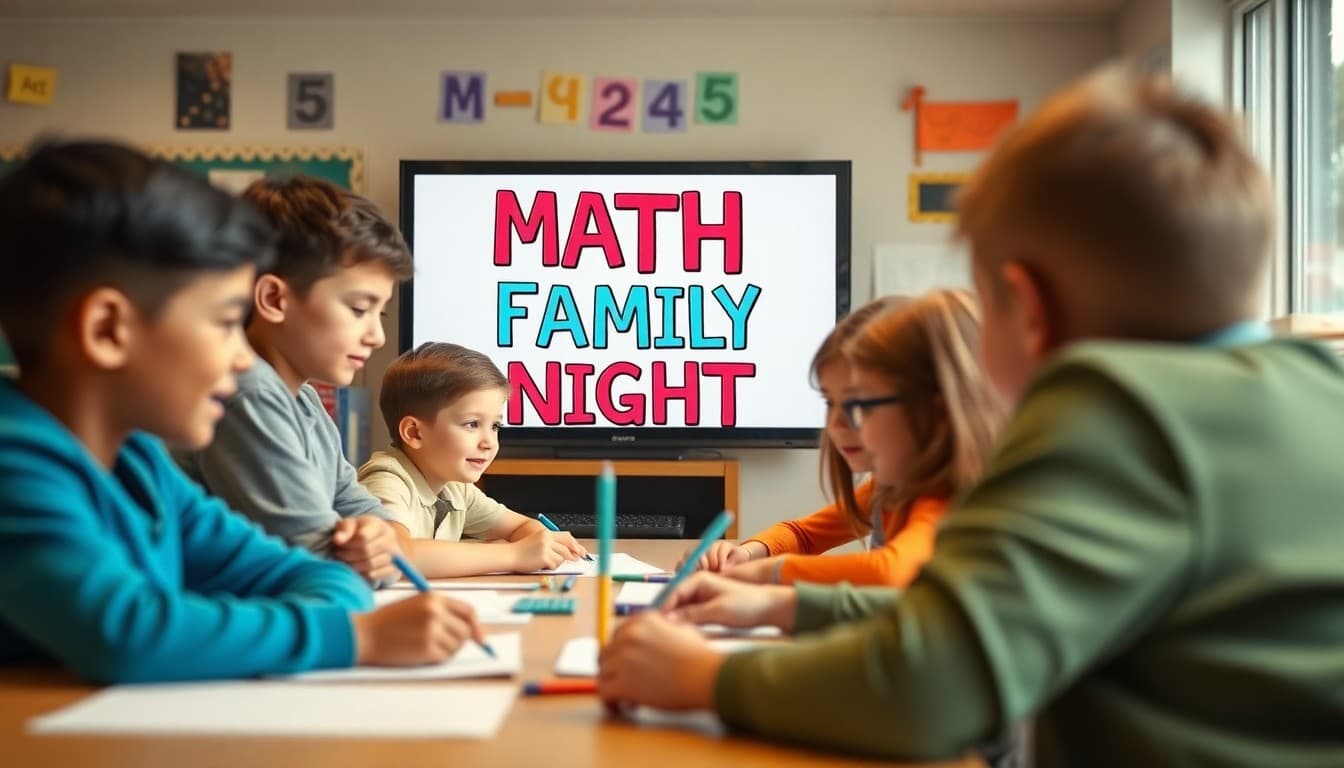
Math Night Newsletter Template for Elementary Families

Math night is one of the most useful school events you can offer families, and one of the hardest to fill. Families who love math are already engaged. Families who struggled with math in school feel no particular pull toward a math-themed evening. Yet the families in the second group are often the ones whose children would benefit most from a parent who understands what they are learning.
This template and guide covers how to write a math night invitation that speaks to both groups, makes the event feel approachable, and gives families a clear picture of what they will experience.
Open with Reassurance, Then Excitement
The first sentence of a math night newsletter should address the elephant in the room: not everyone loves math. "Whether math was your best subject or your most dreaded one, Family Math Night is designed to be playful, hands-on, and genuinely fun for both kids and adults" covers both audiences in one sentence and signals that this is not a test.
From there, move into what makes the evening worth attending: specific activities, take-home materials, and the direct connection to what children are doing in their classrooms.
Activity Preview Section
List the specific activities families will find at the event stations. Concrete activity names are more compelling than categories. "Multiplication war (a card game that builds fact fluency)" is more inviting than "math games." "Estimation station where families guess the number of objects in containers and learn the school's estimation strategies" is more compelling than "hands-on activities."
List four to six activities. This is enough to give families a sense of the variety without overwhelming the invitation.
Sample Newsletter Template Excerpt
Here is a template you can adapt:
Subject line: Family Math Night - Feb 6, Games, Prizes, and Free Math Tools to Take Home
Opening: Whether you love math or have always found it tricky, Family Math Night at Lincoln Elementary on February 6 is for you. Spend 90 minutes playing math games with your child, meeting their teachers, and taking home tools you can use to support math at home.
What's at the event:
- Multiplication War: A card game for grades 2-5 that builds fact speed
- Fraction Pizza: Build fractions with play food, great for grades 3-5
- Estimation Station: Guess and check challenges for all ages
- Math Art: Geometry and symmetry activities for grades K-2
- Parent Q&A station with our math curriculum coach
Take-home materials: Every family receives a game guide with instructions for 5 math games you can play at home with a standard deck of cards.
Event Details:
Date: Friday, February 6, 2026
Time: 6:00 to 7:30 p.m.
Location: Lincoln Elementary Cafeteria and Gymnasium
Free admission. Bring your child.
Connecting to Current Classroom Math
A brief section connecting the event to what students are currently studying in class gives the invitation immediate relevance. "Students in grades 3 and 4 are currently working on multiplication and fractions, and our stations are designed around those exact skills" tells families that attending this specific night, not just any math event, has direct benefit for their child right now.
Take-Home Materials as Attendance Incentives
Free take-home materials significantly increase attendance at family math events. A simple card game using a standard deck, printed instruction sheets for five at-home math games, or a manipulative kit in a zip-lock bag are all low-cost and high-value. Mention these in the invitation newsletter prominently. Families who know they will leave with something useful are more likely to come.
The Day-Of Reminder
Send a brief reminder the morning of math night. Include the time, location, and one compelling detail from the invitation. "Don't forget: tonight is Family Math Night. Gates open at 6:00 p.m. Every family takes home a card game kit." Three sentences is the right length for a morning reminder.
Post-Event Follow-Up for Non-Attendees
Within a few days of the event, send the game instructions and resource list to all families who did not attend. A brief note explaining that these are the same materials distributed at the event brings the content to families who wanted to come but could not. It also demonstrates that the school thinks about all families, not just the ones who show up in person.
Get one newsletter idea every week.
Free. For teachers. No spam.
Frequently asked questions
What is the purpose of a school math night for families?
Math night gives families direct exposure to how math is currently taught in school, which often differs significantly from how parents learned it. Families who understand the approaches their children are using are better equipped to help at home without accidentally creating confusion. The event also builds positive math identity by making math playful and accessible rather than intimidating.
How do you address math anxiety in the newsletter invitation?
Acknowledge it directly and briefly. A single sentence like 'Whether math is your favorite subject or your least favorite, this evening is designed to be hands-on and stress-free' normalizes math anxiety without dwelling on it. Families who feel anxious about math are the ones most likely to skip the event, so addressing the feeling up front can increase attendance among the families who would benefit most.
What math activities work best for family night events?
Card and dice games that reinforce number sense, estimation stations with everyday objects, building challenges that incorporate measurement and geometry, and strategy games like Set, Uno, or Rummikub all work well. Activities that families can replicate at home with simple materials are especially valuable because they extend the learning beyond the event.
Should the newsletter explain the school's math curriculum?
A brief mention is helpful, especially if your school uses a specific program that parents find unfamiliar or confusing. One paragraph explaining the core approach, for example 'We use a problem-based math curriculum that asks students to solve problems before being taught procedures, which builds mathematical reasoning before fluency,' gives families context for the activities they will experience.
How does Daystage help with math night newsletter communication?
Daystage lets you build an event newsletter with activity descriptions, a schedule, take-home resource links, and an RSVP button. You can send it to your full family list and include photos from previous events to help new families understand what to expect.

Adi Ackerman
Author
Adi Ackerman is a former classroom teacher and curriculum writer with 8 years in K-8 schools. She writes about school communication, parent engagement, and what actually works in real classrooms.
More for School Events
Ready to send your first newsletter?
3 newsletters free. No credit card. First one ready in under 5 minutes.
Get started free