

Newcomer Student School Newsletter: Welcome to Your New School
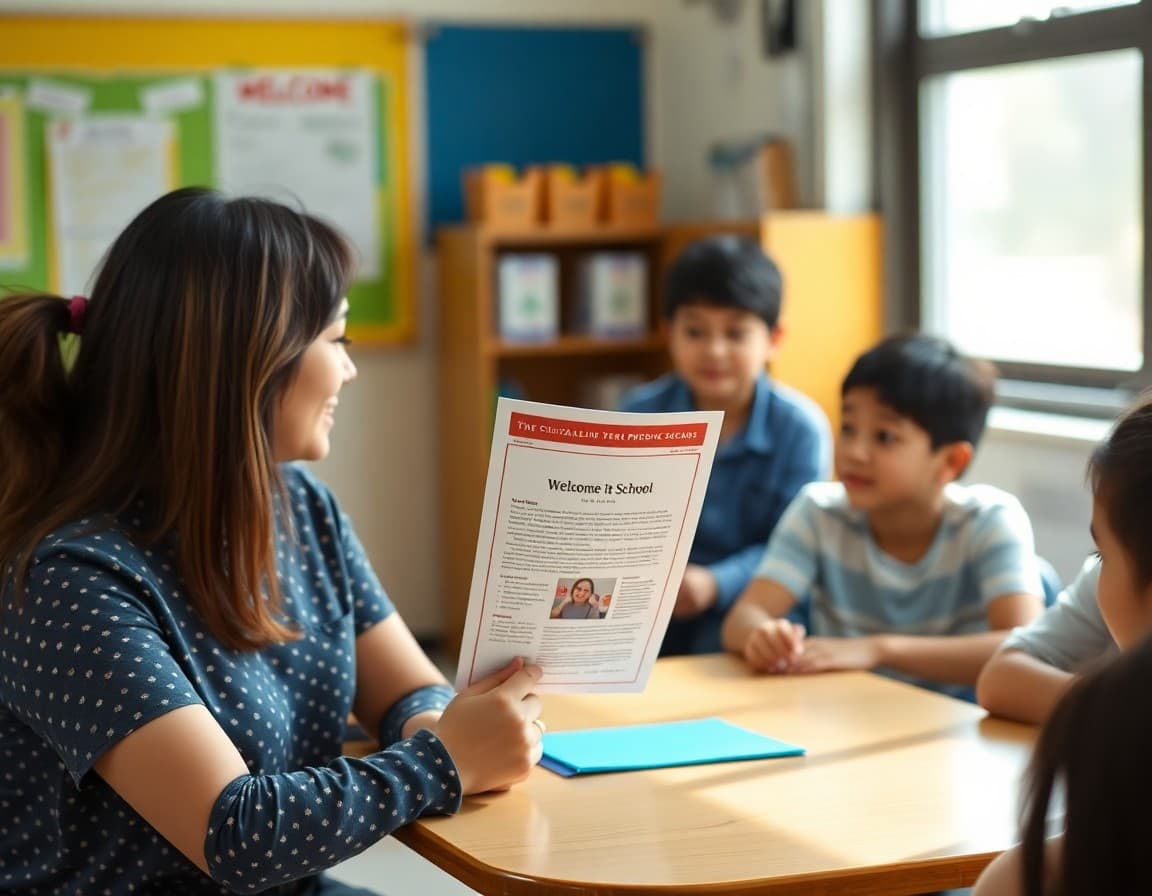
A student arrives from another country. They may have come from a refugee camp, a rural village, or a major city. They may have had years of formal schooling or very little. Their parents are trying to understand a new school system while also navigating housing, employment, and a language they are still learning. The first newsletter you send this family sets the tone for everything that follows.
What Newcomer Families Actually Need in Week One
Before anything else, newcomer families need the practical information that keeps daily life running. What time does school start? Where do they drop off their child? Who do they call if their child is sick? What do they do about lunch? These are not small questions when you are unfamiliar with how American schools work.
A good first-week newsletter covers five things: daily schedule and arrival/dismissal procedures, free and reduced meal application, the name and contact information of the person assigned to support their family, an explanation of how translation services work at your school, and what happens next in the enrollment process. Keep this to one page if possible. Dense packets of information rarely get read in full.
Writing for Families Still Learning English
Plain language is not condescending. It is respectful. Write at a 6th-grade reading level even if you are sending to adults. Use short sentences. Avoid idioms like "hit the ground running" or "keep an eye out." Replace vague phrases with specific ones: instead of "contact the school office," write "call us at (555) 234-5678 between 8 a.m. and 4 p.m."
Spell out acronyms the first time you use them. Many families will not know what "ELL," "ESL," "504," or "RTI" mean. If you must use them, define them in parentheses. Better yet, avoid them in newcomer communications entirely when plain language works just as well.
A Template Section That Works
Here is a section that has worked well for schools welcoming newcomer families:
"Welcome to [School Name]. We are glad your family is here. This newsletter will help you understand how our school works. If you have questions, please call [Name] at [Phone Number]. We have staff who speak [Language]. We want to help you."
Simple. Human. Specific. Notice it names who to call and what languages are available. That specificity is what makes families actually pick up the phone.
How to Handle Translation Without a Large Budget
Translation does not have to be expensive. Start with the languages most represented in your newcomer population. If you have 12 families who speak Tigrinya and 1 who speaks Thai, prioritize Tigrinya first.
Build relationships with bilingual staff, community liaisons, and parent volunteers who can review translated content before it goes out. Google Translate handles Spanish, Portuguese, and Mandarin reasonably well. It struggles more with Arabic, Somali, Haitian Creole, and languages with less digital content. For those, a human reviewer is worth the extra step.
Some districts share translation costs across schools or use a district-level translation coordinator. If your district has Title III funding, translation services are an allowable expense under that grant.
Visuals and Formatting That Cross Language Barriers
A photo of the school entrance helps families know they are in the right place. A map showing where to park and where to enter is worth more than three paragraphs of directions. A photo of the person they will meet when they arrive reduces anxiety significantly.
Use numbered lists for sequential steps: "1. Park in the lot on Oak Street. 2. Enter through the blue door. 3. Go to the front desk and say your child's name." This format works across literacy levels and languages.
Covering Rights and Protections
Newcomer families are often unaware of their rights under federal law. Schools are legally required to enroll students regardless of immigration status, under Plyler v. Doe. Families do not need to provide a Social Security number to enroll. Communicating this clearly and directly in the first newsletter removes a significant barrier for undocumented families who fear enrollment will expose their status.
Under Title III of the Every Student Succeeds Act, schools must notify families of their child's English proficiency level, the instructional program being used, and the right to opt out of ELL services. Include a brief plain-language explanation of this in your first communication, with a follow-up letter when testing results are available.
Building a Newsletter Series, Not Just a One-Time Send
A single welcome newsletter is a start. A 90-day newcomer communication series is a system. Consider a cadence that looks like this: Week 1 covers logistics and contacts. Week 3 covers school routines, homework expectations, and parent-teacher communication. Week 6 covers the first report card, how grades work in the U.S., and how to request a conference. Week 12 covers upcoming events, how to get involved, and community resources beyond the school.
Spacing the information out gives families time to absorb and act on each piece before the next one arrives. Schools that use this approach report stronger family engagement and fewer last-minute enrollment issues.
Measuring Whether Your Newsletter Is Working
Track whether families are showing up for key events, whether they are calling the right people when they have questions, and whether students are arriving prepared for their first days. If families are still confused about basics at week three, revisit your first-week newsletter and simplify it further.
Ask your bilingual staff and community liaisons what questions they are still fielding after the newsletter goes out. Those recurring questions are the content for your next newsletter. Let the community's confusion guide your editorial calendar.
Get one newsletter idea every week.
Free. For teachers. No spam.
Frequently asked questions
What should a newcomer school newsletter include?
A newcomer school newsletter should cover the basics every new family needs immediately: daily schedule, drop-off and pick-up procedures, school contact information, free meal eligibility, and who to call with questions. Keep the language simple and get it translated into the family's home language before sending. One page with clear headings works better than a multi-page document for families still orienting to a new country.
How do schools get newsletters translated for newcomer families?
Most districts with newcomer populations have access to translation services through their Title III budget or a community partnership. Google Translate works for a fast first draft but should be reviewed by a bilingual staff member or parent volunteer before sending. Some schools build a network of bilingual parents who volunteer to check translations for accuracy, especially for languages like Somali, Pashto, or Burmese where automated translation is less reliable.
How often should schools send newcomer-specific newsletters?
During the first four to six weeks of enrollment, a newcomer family benefits from weekly check-in newsletters. After that, the regular school newsletter with translated versions is usually enough. Some schools send a 30-day, 60-day, and 90-day onboarding newsletter to mark milestones and introduce new resources as families settle in. The key is not overwhelming families with too much information at once.
What tone works best for newcomer family communication?
Warm, direct, and jargon-free. Avoid acronyms like IEP, AYP, or MTSS without explaining them. Avoid cultural references that may not translate. Write in short sentences and use bullet points over dense paragraphs. A friendly, informational tone signals to families that the school is a safe place to ask questions. Starting with a genuine welcome before jumping into logistics makes a real difference.
Can Daystage help create multilingual newcomer newsletters?
Yes. Daystage lets you build a newsletter in English and then add translated sections for different language groups, all in one send. You can include photos of school staff, maps of the building, and key phone numbers so families have everything in one place. Teachers and counselors report that families who receive a clear first-week newsletter show up with fewer urgent questions and more confidence navigating the school.

Adi Ackerman
Author
Adi Ackerman is a former classroom teacher and curriculum writer with 8 years in K-8 schools. She writes about school communication, parent engagement, and what actually works in real classrooms.
More for ELL & ESL
Ready to send your first newsletter?
3 newsletters free. No credit card. First one ready in under 5 minutes.
Get started free