
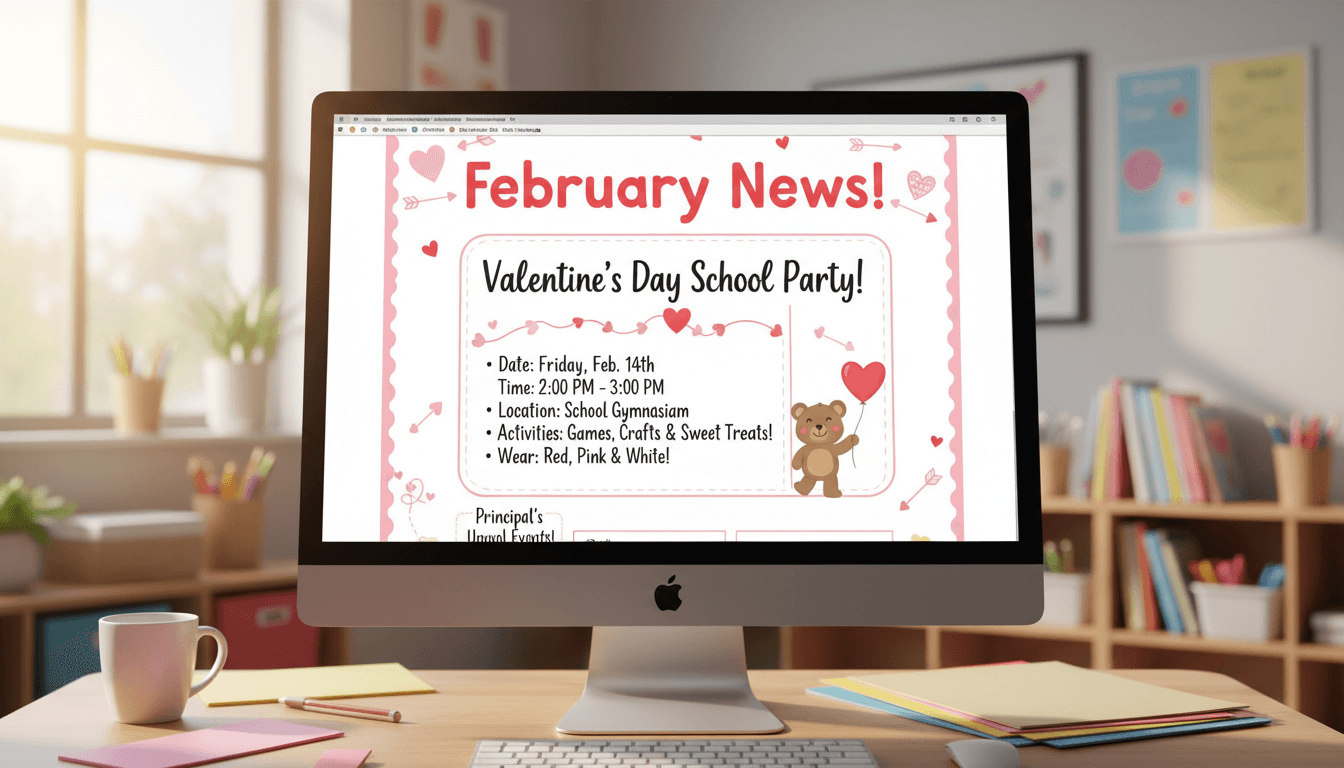
February Newsletter Template for Elementary School Parents
February is a month with a lot of moving parts. Valentine's Day party logistics, National Reading Month kicking off, mid-year benchmark results coming back, and Dental Health Month activities all land in the same four weeks. A clear February newsletter gets the details out early so families can participate instead of scrambling.
Use this template to cover each area without writing the newsletter from scratch.
Opening: What February Looks Like This Year
Start with a short overview. Families who scan newsletters quickly will decide in the first two sentences whether to keep reading. Mention the two or three biggest things happening this month so they know the newsletter is worth their attention.
Sample opening: "February is a busy one. We have our Valentine's Day party on the 14th, National Reading Month starts February 1st, and mid-year assessment results are ready to share. Details on all three are below."
Valentine's Day Party: Everything Parents Need to Know
Cover this fully so you do not get 15 separate emails asking the same questions. Include the date and time of the party, whether you are doing card exchanges, how many students are in the class, and what the food or treat policy is. If your school has peanut or tree nut restrictions, state them explicitly. If families want to bring a treat, specify the form (store-wrapped, no homemade items, etc.).
Example: "Our Valentine's party is Friday, February 14th from 2:00 to 2:45 PM. We have 22 students in our class. If your child would like to bring valentines, please bring one for each student. A class list will be attached to this newsletter. Treats are welcome but must be store-bought and nut-free. Please label any treats with ingredient information."
National Reading Month Launch
National Reading Month begins February 1st and runs through March. February is the ramp-up phase. Introduce your classroom or school-wide reading challenge early so families have the full month to participate.
Explain the goal clearly: are students tracking minutes, titles, or pages? Is there a classroom goal or individual goal? What happens at the end? For example: "Starting February 1st, our class is tracking reading minutes at home. Our goal is 500 minutes by February 28th. Students log their minutes each morning in their reading journals. If we hit our goal, we earn a class choice activity on March 1st. You can support this by reading together for 15 to 20 minutes at night and having your child record the time."
Mid-Year Assessment Results
If your school completed benchmark reading or math assessments in late January, February is the time to debrief with families. Do not wait for March conferences to surface results that could change how families support learning at home right now.
Keep the explanation factual and forward-looking: "We finished our mid-year iReady reading assessment the week of January 20th. Results will be sent home with report cards on February 7th. Based on this data, I have adjusted my small group assignments. Students working below grade level benchmarks will receive additional reading support starting this week. If you would like to discuss your child's results before conferences in March, please email me to schedule a call."
Dental Health Month: A Classroom Connection
February is National Dental Health Month, and most elementary teachers tie it to health science lessons. Let families know what you are covering so they can reinforce it at home. Even a one-sentence note makes the lesson feel connected to real life.
Try this: "This month in health, we are learning about dental hygiene: why we brush twice a day, what sugary foods do to teeth, and how dentists keep our smiles healthy. Ask your child to demonstrate the two-minute brushing technique we practiced in class. It sounds small, but the kids are genuinely proud when parents notice."
Curriculum Update: Reading, Writing, and Math This Month
Give families a one-paragraph snapshot of where you are academically. February often lands in the middle of a writing unit, the midpoint of a math module, and the start of nonfiction reading. Specific details help parents ask better questions at home.
February curriculum snapshot example: "In reading, we are working on compare and contrast using two nonfiction texts about the same topic. In writing, we are drafting our opinion essays and working on using evidence from texts to support our claims. In math, we finished multiplication and are moving into division using the relationship between the two operations."
Winter Reminders: Coats, Attendance, and Cold Season
February is peak illness season in most regions. Remind families about your attendance policy for sick children, how to report absences, and whether make-up work is posted online. Also include any outdoor recess temperature policy if your school goes outside in winter.
Keep the tone factual, not scolding: "If your child is sick, please keep them home and notify the office by 8:30 AM. Make-up work for any absence is posted on our class page under the Assignments tab. Students should return to school when they have been fever-free for 24 hours without medication."
February Events and Dates
Close with a clean list of dates. February typically includes: report card distribution, Presidents' Day, Valentine's party, 100th Day of School for lower grades, and reading challenge milestones. Keep the list to the six or eight dates that actually require family action or awareness.
Sample dates: February 1 (reading challenge begins), February 7 (report cards home), February 14 (Valentine's party, 2:00 PM), February 17 (Presidents' Day, no school), February 28 (reading challenge closes). Confirm with your school calendar before sending.
Get one newsletter idea every week.
Free. For teachers. No spam.
Frequently asked questions
What should go in a February elementary school newsletter?
February has three natural anchors: Valentine's Day party logistics, National Reading Month launch, and Dental Health Month activities. A strong February newsletter handles the party details early so families are not scrambling the day before, explains any reading challenge or incentive program kicking off this month, and gives families a simple at-home connection activity tied to one of the content areas you are currently teaching.
How do I handle Valentine's Day party logistics in the newsletter?
Spell out the details completely. State the date and time of the party, whether students are exchanging valentines, how many students are in the class, and any allergy or food restrictions for treats. If your school has a bring-one-for-everyone policy, say so explicitly. The more specific your newsletter is about party logistics, the fewer last-minute emails and texts you field the week of February 14th.
How do I communicate mid-year reading benchmark results to parents?
Frame results around what the data means for the next eight weeks, not just where a student scored. If your class completed an iReady or DIBELS benchmark in late January, February is the right time to share what those scores indicate and how you are responding with small group instruction. Keep the explanation brief and jargon-free. Tell families what they can do at home to support the skills you are working on.
How do I launch National Reading Month in the newsletter?
Introduce whatever reading challenge or incentive your school is running and give families specific participation instructions. Include the start date, how students log minutes or books, whether there is a classroom or school-wide goal, and any reward tied to participation. If families can track progress at home, explain how. A reading month launch buried at the bottom of a newsletter rarely gets traction. Lead with it.
What is the best newsletter tool for elementary schools in February?
Daystage is built for exactly this kind of monthly newsletter: party details, reading challenges, curriculum updates, and event calendars all in one place. Teachers set up a template, update the content for February, and send it to family inboxes in a few minutes. The platform tracks open rates, so if you notice families are not opening the newsletter, you can follow up before the Valentine's party catches everyone off guard.

Adi Ackerman
Author
Adi Ackerman is a former classroom teacher and curriculum writer with 8 years in K-8 schools. She writes about school communication, parent engagement, and what actually works in real classrooms.
More for Elementary
Ready to send your first newsletter?
3 newsletters free. No credit card. First one ready in under 5 minutes.
Get started free