
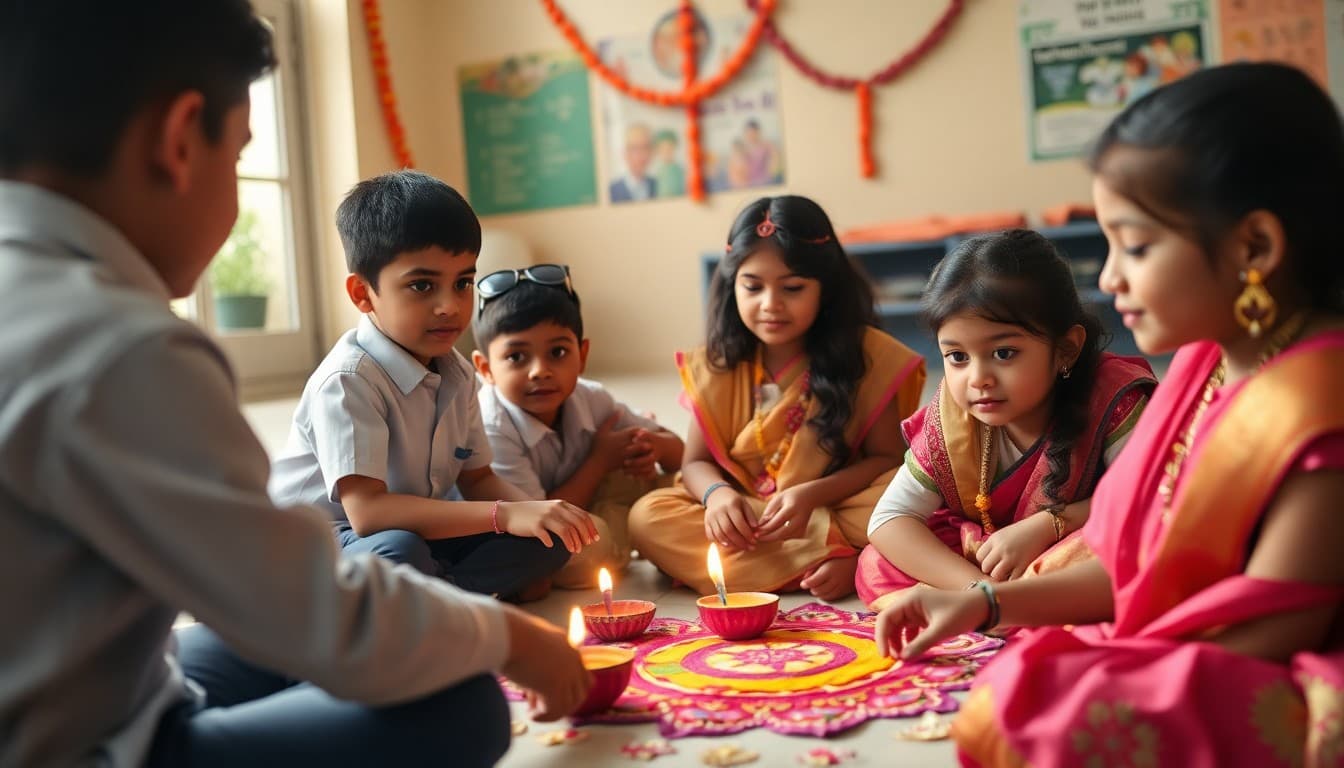
Diwali School Newsletter: Celebrating the Festival of Lights

Diwali is one of the most widely observed festivals in the world, celebrated by over a billion people across Hindu, Sikh, Jain, and some Buddhist traditions. For schools with South Asian students and families, it is a significant cultural moment. For schools without a South Asian student population, it is a valuable window into a major world tradition. Either way, a thoughtful newsletter can do something meaningful with it.
Introduce the Festival With Accuracy and Breadth
Begin your newsletter with a clear, accurate description of what Diwali is. "Diwali, or Deepavali, is a five-day festival observed by Hindus, Sikhs, Jains, and some Buddhists across South Asia and in diaspora communities around the world. It is celebrated in late October or early November, depending on the lunar calendar. While the specific stories and observances vary across traditions, the shared theme is the triumph of light over darkness and knowledge over ignorance." That introduction is accurate, inclusive, and educational.
The Stories Behind the Festival
Different communities celebrate Diwali through different narrative traditions. Hindus celebrate the return of Lord Rama and Sita to Ayodhya after 14 years of exile, lighting oil lamps (diyas) to guide their way home. In the Sikh tradition, Diwali marks Bandi Chhorh Divas, commemorating the release of Guru Hargobind Singh from Mughal imprisonment. Jains observe Diwali as the day of Mahavira's spiritual liberation. Connecting the story to the tradition it comes from shows families that your school did the research.
Classroom Activities That Educate
Describe the specific activities your school is running. Rangoli, the intricate pattern-making art created with colored powder, rice, or flowers at the entrances of homes, is one of the most visually compelling Diwali traditions and translates well into classroom art projects when the cultural context is explained. "This week students are learning about rangoli as a traditional art form and creating their own geometric patterns using colored chalk. We talked about where rangoli comes from, what patterns symbolize, and how different regions have their own traditions."
If your school library has set up a Diwali display, mention it. Book recommendations for students of different ages, from picture books like Festival of Colors by Surishtha Sehgal to middle-grade novels featuring South Asian characters, extend the learning beyond a single day.
Inviting Family Participation Thoughtfully
If you have South Asian families in your community who want to share their Diwali traditions, an open invitation is appropriate. Make it clear that participation is entirely voluntary and that you are not asking any family to be a representative of their culture. "We would love to hear from any family who celebrates Diwali and would like to share something with our community, whether that is a recipe, a family story, a craft, or a photo. Please contact [staff name] if you are interested." That invitation is warm, specific, and appropriately optional.
Food and the Festival
Diwali is closely associated with sweets, particularly mithai like barfi, ladoo, and gulab jamun. If your school has food allergy protocols that make shared food activities difficult, acknowledge this and offer an alternative. "We will not be sharing food at school, but families who want to explore Diwali sweets at home might try making barfi (a sweet made from condensed milk) or look for a local South Asian bakery that makes traditional mithai during the festival season." That kind of redirect keeps the learning alive without creating an access or allergy problem.
What Diwali Can Teach Every Student
For students who do not have a personal connection to Diwali, the festival offers a window into a major world tradition that shapes the lives of over a billion people. It is also an opportunity to think about universal themes: light in darkness, the return home, the celebration of family and community. Your newsletter can name these universal threads without reducing Diwali to a generic "lesson about light." Keep the cultural specifics in the foreground and draw the universal connections carefully rather than using them as the main frame.
After the Festival
A brief follow-up newsletter with photos from classroom activities, student artwork, and reflections on what students learned closes the loop on the celebration. Students who see their work acknowledged in a newsletter that goes home to families take the learning more seriously, and families who see photos of their children engaging with another culture's traditions feel proud of the school's approach.
Get one newsletter idea every week.
Free. For teachers. No spam.
Frequently asked questions
What is Diwali and how should a school newsletter describe it?
Diwali, also spelled Deepavali, is a major festival observed by Hindus, Sikhs, Jains, and some Buddhists across South Asia and in diaspora communities worldwide. It is a five-day festival that celebrates the victory of light over darkness, knowledge over ignorance, and good over evil. The stories and significance vary across traditions: Hindus celebrate the return of Lord Rama, Sikhs commemorate the release of Guru Hargobind from captivity, and Jains honor the spiritual liberation of Mahavira. A school newsletter that acknowledges this diversity is more accurate and more respectful than one that presents Diwali as a single, monolithic Hindu holiday.
How do I celebrate Diwali at school without being appropriative?
Focus on education over performance. Sharing accurate information about the festival's origins, significance, and practices is always appropriate. Inviting South Asian families who want to share their traditions is appropriate when the invitation is genuine and not an obligation. Art activities that teach rangoli as a craft form while explaining its cultural context are educational. Asking students to wear traditional clothing or perform religious rituals without their family's active participation is where schools most commonly overstep.
Should I acknowledge that not all Hindu families celebrate Diwali the same way?
Yes. Diwali is observed across dozens of South Asian regional traditions, each with different stories, practices, foods, and customs. A Diwali newsletter that says 'Hindu families celebrate Diwali by...' as if all Hindu families do the same thing misrepresents the diversity within the community. A sentence acknowledging this variation, 'Diwali is celebrated in many different ways across Hindu, Sikh, and Jain traditions, and across regional cultures from Punjab to Tamil Nadu,' shows cultural sophistication.
How do I handle students who do not celebrate Diwali in a classroom setting?
Frame the learning as cultural education, not religious participation. Students do not need to celebrate Diwali to learn about it, just as they do not need to be Christian to study medieval European history. Framing the newsletter as an opportunity to learn about a major world festival that more than a billion people observe sets inclusive expectations.
What tool works well for a Diwali school newsletter?
Daystage handles images beautifully, which matters for a visually rich festival like Diwali. Photos of student rangoli artwork or diyas created in class make the newsletter something families want to share. A platform that lets you embed high-quality images and format the newsletter attractively is worth using for a celebration this visually distinctive.

Adi Ackerman
Author
Adi Ackerman is a former classroom teacher and curriculum writer with 8 years in K-8 schools. She writes about school communication, parent engagement, and what actually works in real classrooms.
More for Diversity & Equity
Inclusive Holiday Communication Newsletter: Writing School Holiday Messaging That Welcomes Every Family
Diversity & Equity · 6 min read
Culturally Responsive School Newsletter: Inclusive Communication
Diversity & Equity · 7 min read
International Day School Newsletter: Celebrating Global Cultures
Diversity & Equity · 7 min read
Ready to send your first newsletter?
3 newsletters free. No credit card. First one ready in under 5 minutes.
Get started free