
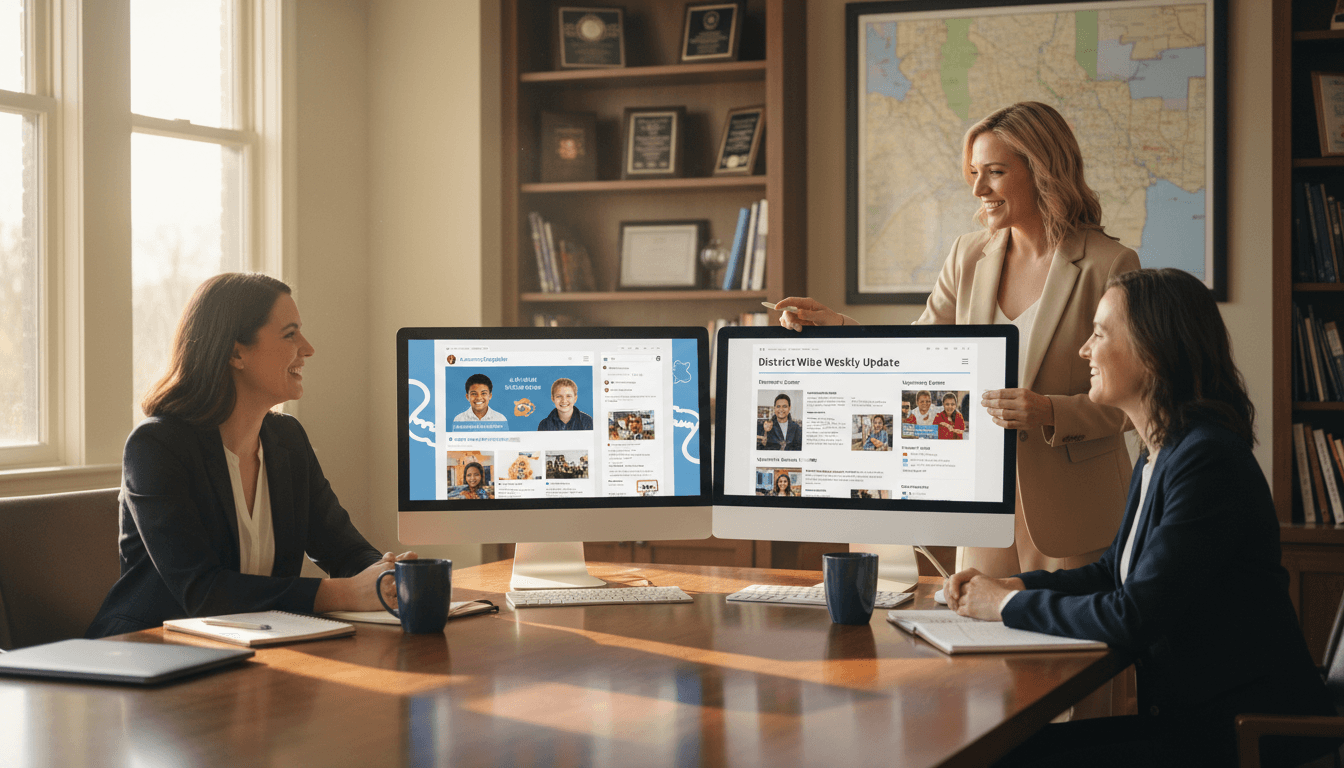
School District Social Media Newsletter: Coordinating Digital and Email Communication

Most school districts use both email newsletters and social media, but few have a deliberate strategy for how the two work together. The result is usually a fragmented communication landscape where the same story gets told differently on different channels, important updates go out on social but not in email, and families are left to piece together the full picture from multiple sources. Getting this coordination right does not require a large team or an expensive technology stack. It requires a clear understanding of what each channel does well and a simple workflow for keeping them aligned.
Understanding What Each Channel Does Best
Email newsletters and social media have fundamentally different strengths and weaknesses. Email is reliable: it reaches families who have no social media accounts, it creates a documentation trail for required notices, and it supports long-form content that families can read when they have time rather than when it happens to appear in a feed. Email open rates for school districts typically run between 35 and 55 percent, meaning a large majority of families who receive the newsletter read at least the subject line, and a strong majority of those read the content.
Social media is timely: it reaches families where they already spend time, it supports visual content that builds community and school pride, and it creates a public record of the district's life that prospective families and community members can see. Social media also has significant weaknesses: the algorithmic feed means not everyone who follows the account sees every post, families without accounts are excluded entirely, and social media is a terrible channel for detailed information that families need to understand and act on.
Building a Coordinated Content Calendar
The most practical way to coordinate email and social media is to build a single content calendar that covers both channels. Each major communication has a primary channel and secondary amplification. A required annual notice goes out in email first (because email creates the documentation trail), and a reminder goes on social media. A student achievement story starts as a newsletter feature and then gets adapted as a social post. A family event gets a newsletter calendar listing and a series of social posts in the week leading up to it.
The calendar does not need to be complex. A spreadsheet with columns for the week, the topic, the email plan, and the social media plan is sufficient for most districts. What matters is that the two channels are planned together rather than separately, which prevents the common failure mode of important updates going out on social but never making it into the newsletter, or newsletter content that never gets amplified on social because no one thought to post it.
Repurposing Newsletter Content for Social Media
Creating original content for both email and social every week is more work than most district communications teams can sustain. The solution is a repurposing workflow that treats the newsletter as the source of record and social media as the distribution amplifier.
After the newsletter sends, identify the two or three items with the most social potential: the student achievement story, the upcoming event with a strong photo, or the community spotlight. For each item, draft a platform-appropriate post: shorter text, a compelling image, and a clear call to action or link. Schedule those posts over the following week. This workflow means the communications team is writing one body of content per issue and adapting it, not creating separate content streams. Over a school year, that difference in workload is significant.
Managing Social Media Across Multiple School Accounts
Large districts often have dozens of social media accounts: the district account plus individual accounts for each school, and sometimes accounts for specific programs or sports. Managing this network requires a policy and a monitoring process, not just good intentions.
The district social media policy should cover what staff are authorized to post on behalf of schools, what content is prohibited, how to handle critical or hostile comments, what to do if an incident occurs that generates social media attention, and what the escalation path is when a school account posts something that creates a problem. Without a policy, individual schools make their own calls, and the district communications office learns about problems after they have already generated community reaction.
The policy should be paired with a social media kit for schools: brand assets, caption templates, approved hashtags, and a brief guide to photography and image standards. Schools that have the tools to post well will post well. Schools that are left to figure it out independently will produce inconsistent results.
What Belongs on Social vs. What Belongs in Email
A practical rule for deciding which channel a piece of content belongs in: if a family needs to read it, act on it, or reference it later, it belongs in email. If it is timely, visual, shareable, or primarily community-building in purpose, it belongs on social media. Most significant communications belong in both, starting in email and amplified on social.
Required legal notices belong in email only. A social post about a required annual notice does not satisfy the legal notification requirement. A social post about a student health update or a policy change is informational context, not the official notice. The district communications team needs to be clear about this distinction internally and ensure that legal and required communications always go through email, with social media playing a supporting role at best.
Crisis Communication Across Channels
When a crisis hits, every channel needs to be part of the response, but each plays a different role. Text and phone alerts handle immediate safety notifications. Social media handles real-time acknowledgment and brief updates. Email handles the detailed follow-up communication that families need to understand what happened and what the district is doing.
The most common crisis communication failure is inconsistency across channels: the social media account posts one version of events, the email says something slightly different, and the school website says nothing. Families notice these gaps immediately and interpret them as the district hiding something or not knowing what to say. The protocol must require that all channel content is reviewed and approved by the same person before it goes out, so that every channel tells the same story at the same level of detail appropriate to that channel.
Measuring Integrated Channel Performance
Measuring the performance of a coordinated email and social media strategy requires looking at data from both channels together. Email open rates tell you how many families are receiving and reading the newsletter. Social media reach and engagement tell you how the content performs with families who interact with it on those platforms. Together, the data tells you which content formats generate the most total family attention across both channels.
A piece of content that has low click-through in the newsletter but high social engagement might be better suited to social-first distribution. A topic that generates high email open rates but minimal social engagement is probably newsletter content that should not be pushed to social. Over time, this data helps communications directors make better decisions about where to invest content creation effort and which channel to lead with for different types of stories.
Keeping the Workflow Manageable
The goal of coordinating email and social media is not to double the communications team's workload. It is to get more reach out of the content they are already producing. The practical version of this is a simple weekly rhythm: newsletter production follows a set schedule, social amplification of newsletter content happens automatically in the days after each send, and original social content fills the gaps between newsletter issues with timely school life content that does not need to be email-worthy.
Districts that try to maintain both channels at full original content volume burn out their communications staff and produce inconsistent quality. Districts that treat email as the foundation and social media as the amplifier find a sustainable rhythm that keeps families informed across both channels without requiring heroic effort from a small team.
Get one newsletter idea every week.
Free. For teachers. No spam.
Frequently asked questions
Should a school district use email newsletters or social media as its primary communication channel?
Email newsletters and social media serve different purposes and should be used together rather than treated as alternatives. Email newsletters are the right channel for required notices, detailed information families need to act on, and any communication that needs to reach every family regardless of their social media use. Social media is better for timely updates, community building, celebrating school life, and reaching families who are active on those platforms but may not read every email. Districts that rely exclusively on social media for communication risk missing families who are not on those platforms and have no documentation trail for required notices. Email is the foundation; social media amplifies it.
How do you repurpose district newsletter content for social media?
The most practical repurposing workflow is to treat the newsletter as the source of record and social media as a distribution amplifier. After the newsletter sends, pull two or three of the most shareable items, create platform-appropriate posts (shorter text, strong image, clear call to action), and schedule them over the following week. A newsletter article about a student achievement initiative becomes a brief social post with a photo and a link to the full story. A family event announcement in the newsletter becomes a social post with a graphic and an RSVP link. The key is that social content derives from newsletter content, not the other way around, which keeps messaging consistent and reduces the total content creation burden.
How should districts manage social media accounts for multiple schools?
Districts with multiple schools typically face two models: a centralized model where the district office manages all social accounts, or a distributed model where each school manages its own account within district guidelines. Most districts end up with a hybrid: the district account handles district-level communications, and school accounts handle school-specific content under a shared brand standard and social media policy. The district communications office should set the policy (what can and cannot be posted, how to handle community comments, what to do in a crisis), provide templates and brand assets, and monitor school accounts for policy compliance. Without a clear policy and monitoring process, individual school accounts create brand and liability risks.
What does crisis communication look like across email and social media channels?
Crisis communication across channels requires a clear protocol that defines which channel goes first, what each channel covers, and who is authorized to post. For an immediate safety incident, text and phone alerts go first. Social media follows within minutes with a brief acknowledgment that the district is aware and responding. The email newsletter or detailed email communication follows within 24 to 48 hours with the full explanation, context, and next steps. Families check social media for real-time updates and email for detailed information. Districts that post conflicting information across channels, or that communicate on one channel and go silent on another, create confusion and amplify anxiety. The protocol must be rehearsed, not improvised during an actual crisis.
What is the best way to coordinate a school district email newsletter with social media?
Daystage handles the email newsletter side of this coordination, delivering district newsletters directly to the family inbox with open rate tracking that tells you what content is resonating. The coordination workflow is straightforward: build the newsletter in Daystage, send it on schedule, then use the top-performing content as the basis for social posts that week. For districts managing required notice documentation, Daystage's delivery records serve as the compliance trail that social media posts cannot provide. The combination of Daystage email delivery and a consistent social media calendar gives districts the coverage to reach families across both channels without doubling their content creation workload.

Adi Ackerman
Author
Adi Ackerman is a former classroom teacher and curriculum writer with 8 years in K-8 schools. She writes about school communication, parent engagement, and what actually works in real classrooms.
More for District
Ready to send your first newsletter?
3 newsletters free. No credit card. First one ready in under 5 minutes.
Get started free