
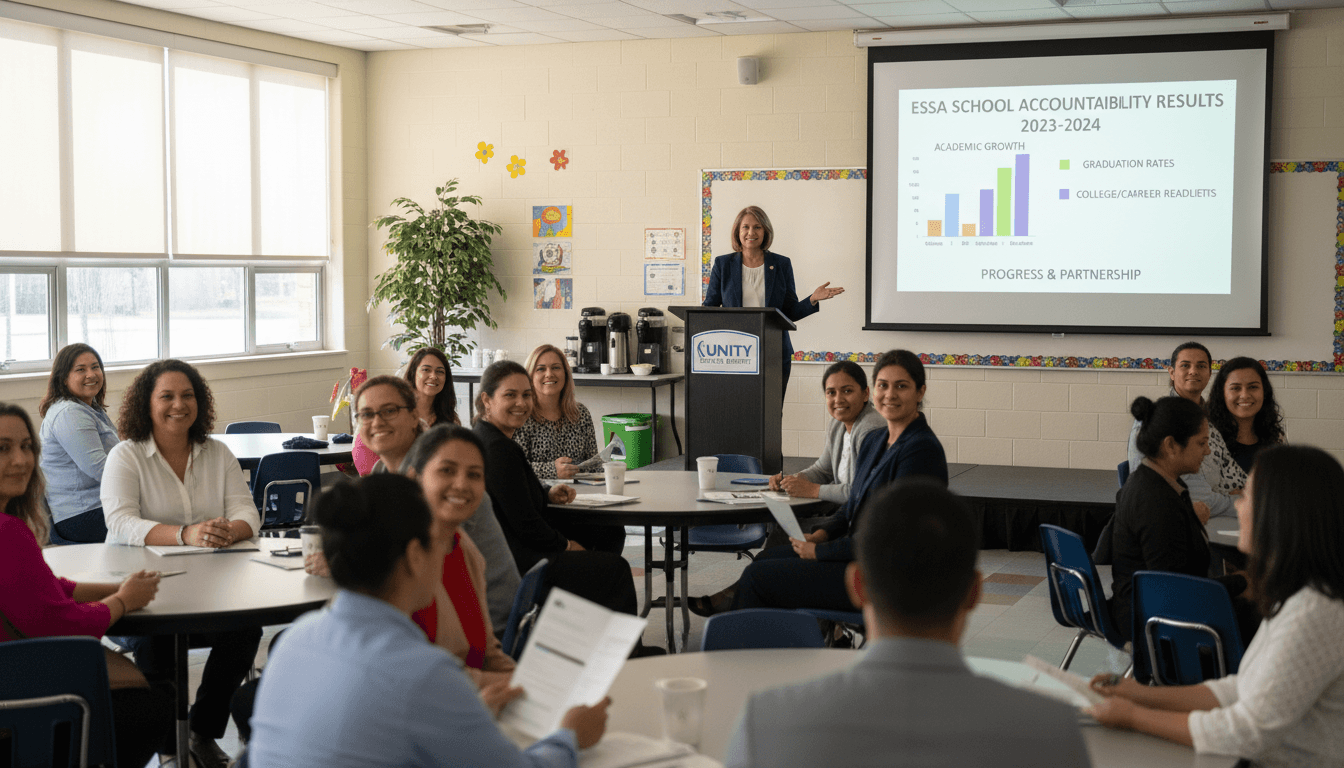
ESSA District Newsletter: How to Communicate Accountability Results and School Ratings to Families

Every fall, state education agencies publish school report cards required by the Every Student Succeeds Act. These reports contain more information about school and student performance than most families will ever read, sorted into accountability tiers, indicator scores, and subgroup breakdowns that require a policy background to interpret. Most families never look at them.
That is a problem for districts, because ESSA accountability results are the most transparent, standardized picture of how schools are performing that exists. When families do not see and understand those results, they fill the gap with rumors, secondhand impressions, and news coverage that may or may not reflect the full picture. A proactive district newsletter can do something the state report card website cannot: meet families where they are and explain what the numbers mean.
What ESSA Measures and Why It Matters
ESSA replaced No Child Left Behind in 2015 and gave states significantly more flexibility in how they define school quality. Most states now evaluate schools on a combination of indicators: math and English language arts proficiency, student growth over time, graduation rates, English learner progress, and a fifth indicator that varies by state but typically includes attendance, chronic absenteeism, or post-secondary readiness.
Schools receive ratings or summative scores based on these indicators. The specific labels vary by state (some use A-F grades, others use color systems or numerical scores) but the underlying purpose is consistent: to identify schools that are performing well across all student groups and schools where certain populations of students are being underserved.
For districts, communicating ESSA results means helping families understand not just the headline rating but which students the data reflects. A school with high overall proficiency scores can still have significant performance gaps for students with disabilities or English learners. ESSA requires states to disaggregate data by subgroup, and district newsletters should reflect that nuance without burying families in tables.
The Three Accountability Categories: What They Mean for Families
Under ESSA, schools can be identified for one of three levels of support. Each has a different meaning and a different implication for families:
- Comprehensive Support and Improvement (CSI): The lowest-performing schools in the state or schools with graduation rates below 67 percent. These schools must develop and implement a comprehensive improvement plan with community input.
- Targeted Support and Improvement (TSI): Schools where a specific subgroup of students (such as students with disabilities or English learners) is consistently underperforming. The school must develop a targeted improvement plan for that group.
- Additional Targeted Support and Improvement (ATSI): Schools where a specific subgroup is performing as poorly as the lowest-performing schools in the state. These schools face stricter intervention timelines.
Families of students in CSI or TSI schools deserve a direct explanation of what that means for their child's building, what improvement activities are planned, and how families can be involved in the process. ESSA actually requires family and community engagement in school improvement planning, and your newsletter is a direct path to that engagement.
Breaking Down the Report Card for Families
The state report card is the official record, but it is designed for accountability, not communication. Your district newsletter does not need to replicate it. What families need is a one-page equivalent that answers three questions: how did our school do, how does that compare to last year, and what is the district doing about it.
For schools that performed well, acknowledge the growth and name what contributed to it. For schools that showed decline, be specific about which indicators dropped and what you know about why. For schools in improvement status, describe the specific actions in the improvement plan and when families will see them implemented.
Include a link to the full state report card for families who want to dig into the data. But do not make the link the main event. The newsletter is the main event.
Communicating Subgroup Performance Without Stigma
ESSA's subgroup reporting is one of its most important features. It makes visible the performance gaps that aggregate scores can hide. But communicating subgroup performance requires care. Naming that "students with disabilities at Lincoln Elementary scored below the state average in math" is accurate and important information. It is also information that parents of students with disabilities will read as a statement about their children.
Frame subgroup data in terms of what the district is doing to close the gap, not in terms of the characteristics of the students themselves. "We identified a significant gap in math growth for our students receiving special education services, and we are expanding co-teaching models in three schools this year" is both honest and actionable. It tells families what the district found and what it is doing.
What ESSA School Improvement Plans Look Like
When a school is identified for CSI or TSI, it must develop a school improvement plan that includes a comprehensive needs assessment, evidence-based interventions, a timeline, and a process for family and community engagement. These plans are public documents, but they are often long, technical, and not widely read.
Your newsletter can provide a one-paragraph summary of what the improvement plan calls for at each identified school. What specific interventions are being implemented? Who is leading them? What will families see that is different this year? When will the district report back on progress? These questions frame the improvement plan as a commitment to families rather than a bureaucratic compliance document.
Timing ESSA Communications Effectively
State accountability results are typically published in the fall, often October or November. Plan your district newsletter communication for within two weeks of state publication. Early communication prevents the results from being framed entirely by media coverage or parent social media before the district has a chance to explain context.
Follow up with a second communication in the spring, when improvement plan progress updates are available. This creates an accountability loop that families can follow: here is what we found in October, here is what we implemented, and here is what the data shows through spring. That cadence builds credibility over time.
Making the Communication Accessible
ESSA report cards must be accessible to families with limited English proficiency. Your district newsletter should be translated into the primary languages spoken by families in your community. Keep the language plain and define any acronyms the first time they appear. Most families do not know what CSI stands for, and an acronym dropped without explanation signals that the communication was written for policymakers, not parents.
If your district has a communications team, ESSA results communication is a high-stakes use case that justifies their involvement. If you are relying on a principal or district office administrator to write and send these newsletters, a tool that makes formatting and distribution straightforward frees them to focus on getting the message right.
Get one newsletter idea every week.
Free. For teachers. No spam.
Frequently asked questions
What are ESSA accountability results and why should districts communicate them?
Under the Every Student Succeeds Act, every state must publish annual report cards showing how schools and districts are performing across multiple indicators: academic achievement, student growth, graduation rates, English learner proficiency, and school quality or student success measures. Districts are required to make these results publicly available and easy to understand. Communicating them proactively, rather than waiting for families to find the state website, builds trust and gives families context for what the data means for their children's school.
What does it mean when a school is identified for Comprehensive Support and Improvement?
Comprehensive Support and Improvement (CSI) is the federal label for the lowest-performing schools in the state, typically the bottom five percent. A school can also earn CSI status if its graduation rate falls below 67 percent. Identification triggers a required school improvement plan developed with family and community input. Districts should communicate CSI status directly rather than letting families discover it through news coverage or the state report card website.
How should districts explain test score data without overwhelming families?
Lead with the headline: whether performance improved, held steady, or declined. Then provide one or two specific data points that support that headline. Follow with what the district is doing in response. Most families do not need to know the difference between proficiency rates and growth percentiles in the same communication. Save the technical details for the linked report card and focus the newsletter on what changed, what it means, and what comes next.
What if the district's ESSA results are not good news?
Communicate them directly and quickly. Families who learn about poor accountability results from a news story before hearing from the district are significantly less trusting of subsequent communications. Acknowledge what the data shows, explain what factors may have contributed, and be specific about the response. Vague improvement language like 'we are committed to excellence' adds no information. Specific language like 'we are adding 40 minutes of literacy instruction per day starting in October' does.
How can Daystage help districts communicate ESSA results?
Daystage lets district communications teams build a clean, formatted newsletter with the key accountability findings, school-by-school highlights, and improvement plan summaries, then send it to every family across all schools at once. You can segment by school so families receive results relevant to their child's building, and link to the full state report card for those who want more detail.

Adi Ackerman
Author
Adi Ackerman is a former classroom teacher and curriculum writer with 8 years in K-8 schools. She writes about school communication, parent engagement, and what actually works in real classrooms.
More for District
School Improvement District Newsletter: How to Communicate CSI Status and Turnaround Plans to Families
District · 7 min read
McKinney-Vento District Newsletter: How to Communicate Homeless Student Rights and Services
District · 6 min read
Gifted Education District Newsletter: How to Communicate Identification, Programs, and Enrichment to Families
District · 6 min read
Ready to send your first newsletter?
3 newsletters free. No credit card. First one ready in under 5 minutes.
Get started free