

Health Careers Class Newsletter: Medical Pathways at School
Health careers programs produce students who may become the nurses, technicians, and healthcare administrators of the next decade. A newsletter that tracks their certification progress and career preparation tells a compelling story to families, colleges, and the community.
Current Simulation Lab Unit
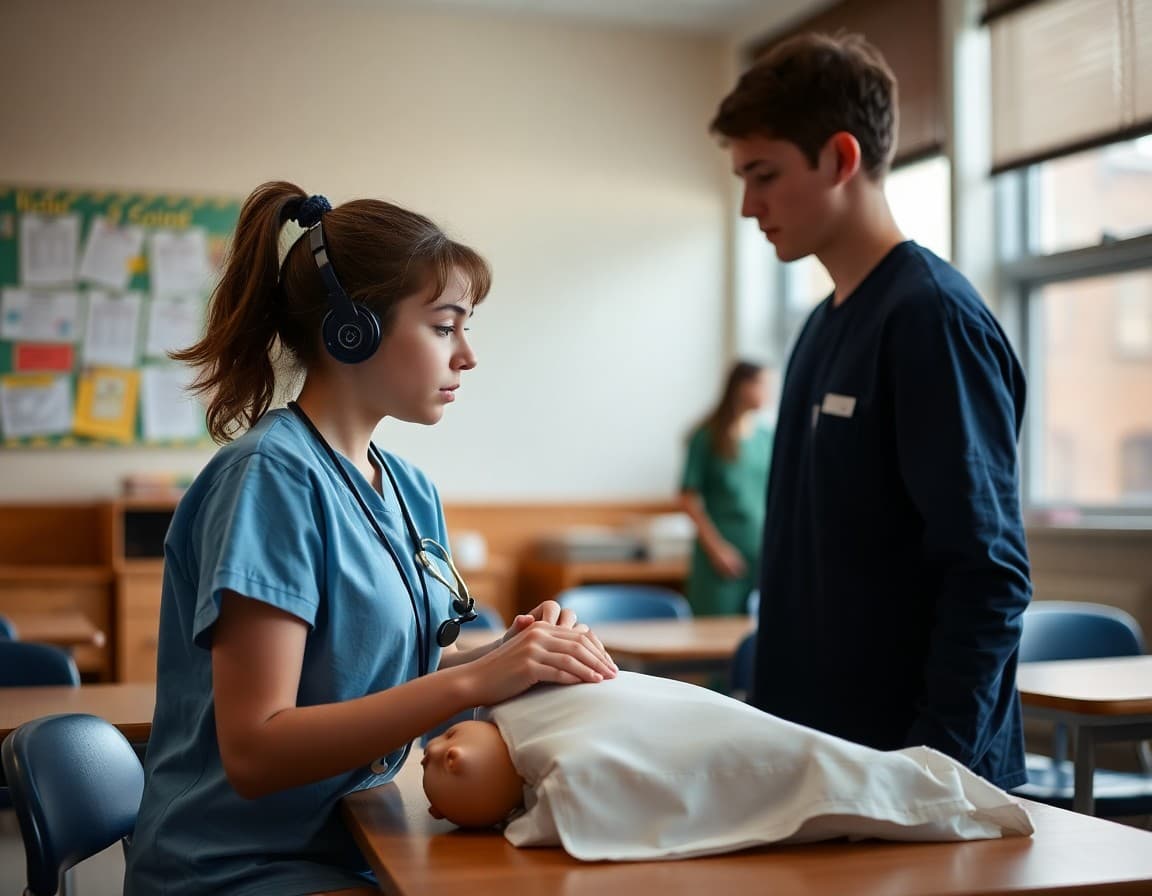
Describe what students are learning in the simulation lab this month with enough detail that families can picture the work: "This month we are in the Patient Care Fundamentals unit. Students are learning proper body mechanics for patient transfers, the three-point check for taking a radial pulse, orthostatic blood pressure measurement, and the head-tilt-chin-lift maneuver for unconscious patients. These are the same skills on the CNA state competency examination. We run each skill at least six times until it is procedurally automatic."
Certification Preparation Timeline
Include a clear certification timeline in each newsletter so families can track where their child stands: "CPR/AED certification class: November 14, 8:30 AM to 12:30 PM. All students must attend. The certification is valid for two years and is required for any clinical observation or hospital volunteer placement. Bring a water bottle and wear comfortable clothes you can do compressions in." A certification calendar at the start of each semester is even more useful for planning purposes.
Template Excerpt: Health Careers Monthly Newsletter
Allied Health Program - October Update
Week 6 and students are past the initial nerves that come with clinical simulation. The handwashing technique that seemed trivial in week one is now procedurally automatic, and that is exactly right. In healthcare, automatic compliance with hygiene protocols is not optional. It is the difference between a safe clinical environment and a preventable infection.
Simulation lab this month: Vital signs assessment complete. All 22 students can accurately measure blood pressure, pulse, respiration rate, oxygen saturation, and temperature within the clinical accuracy range. We moved into patient positioning and transfer this week. The transfer skills require both physical technique and communication skills with the patient: explaining what you're doing before you do it is a clinical requirement, not a courtesy.
Career spotlight: Ms. Nguyen, a Respiratory Therapist at Regional Medical Center, visited on October 9. She described her role managing ventilated patients in the ICU, her 2-year associate degree pathway, and her current salary ($68,000 at 3 years of experience). Three students came to me after class to ask how to get into respiratory therapy specifically. That kind of outcome is why guest speakers matter.
College prep note: Students planning to apply to nursing programs should note that most BSN programs require: Biology I and II, Chemistry, Anatomy and Physiology, and Microbiology. If you are completing these in high school, request official transcripts. Many schools accept dual-enrollment credits toward nursing prerequisites.
Community Health Service Opportunities
Health careers students who volunteer in clinical settings build experience that strengthens both their skills and their college applications. The newsletter should communicate available community service opportunities: hospital volunteer programs, senior center health fair assistance, school-based health fair participation, or CPR community training events. Many hospitals have formal high school volunteer programs. List the contacts and application processes so motivated students can act on the information.
Healthcare Career Range Beyond Medicine
Many students in health careers classes assume the pathway leads to nursing or medicine. The newsletter can broaden that picture periodically. Health careers encompass: respiratory therapy, physical therapy assistance, occupational therapy assistance, radiologic technology, laboratory science, health information management, healthcare administration, medical coding and billing, dental hygiene, and pharmacy technology. Including salary ranges and education requirements for two or three of these careers in each newsletter gives students a realistic picture of the breadth of opportunity in healthcare.
Get one newsletter idea every week.
Free. For teachers. No spam.
Frequently asked questions
What should a health careers class newsletter cover?
Current clinical simulation units, any certification exams students are preparing for (CPR/AED, First Aid, CNA), guest speaker or clinical observation schedules, college pre-med preparation advice, healthcare career pathways beyond medicine (nursing, therapy, radiology, health administration), and any community health service activities the class is involved in.
What certifications do high school health careers students typically pursue?
CPR and AED certification through the American Heart Association or Red Cross is the most universal. Many programs also offer First Aid certification, Certified Nursing Assistant (CNA) preparation, Phlebotomy, and basic EKG technician preparation. Certifications that can be completed in high school give students verifiable credentials that are recognized by employers and college health programs.
How do you connect health careers coursework to college application preparation?
Students planning to apply to nursing programs, pre-med tracks, or health administration degrees benefit from early guidance. The newsletter can flag application timeline milestones: when to begin volunteer hours in clinical settings, which science courses are required for specific health degree programs, and how certifications earned in the class strengthen a college application or college credit portfolio.
What clinical simulation activities are worth highlighting in a newsletter?
Simulation lab activities that mimic real clinical procedures are the most compelling newsletter content: vital signs assessment, patient transfer techniques, wound care basics, infant CPR, blood pressure measurement, and basic first aid scenarios. Photos or descriptions of students performing these skills on mannequins or each other make the program tangible to families.
Can Daystage support health careers program newsletters?
Yes. Daystage newsletters are used by CTE and health careers programs to communicate with enrolled families throughout the year. The platform handles photos of simulation lab activities, career pathway information, and certification updates in a clean, easy-to-read format that doesn't require technical skills to produce.

Adi Ackerman
Author
Adi Ackerman is a former classroom teacher and curriculum writer with 8 years in K-8 schools. She writes about school communication, parent engagement, and what actually works in real classrooms.
More for Department Newsletters
Counseling Department Newsletter: What to Include and How to Write It
Department Newsletters · 6 min read
Art Department Newsletter Guide: Sharing Student Work and Program Goals with Families
Department Newsletters · 5 min read
Math Department Newsletter Guide for K-12 Schools
Department Newsletters · 6 min read
Ready to send your first newsletter?
3 newsletters free. No credit card. First one ready in under 5 minutes.
Get started free