

ELL Department Newsletter: Language Acquisition Program Updates
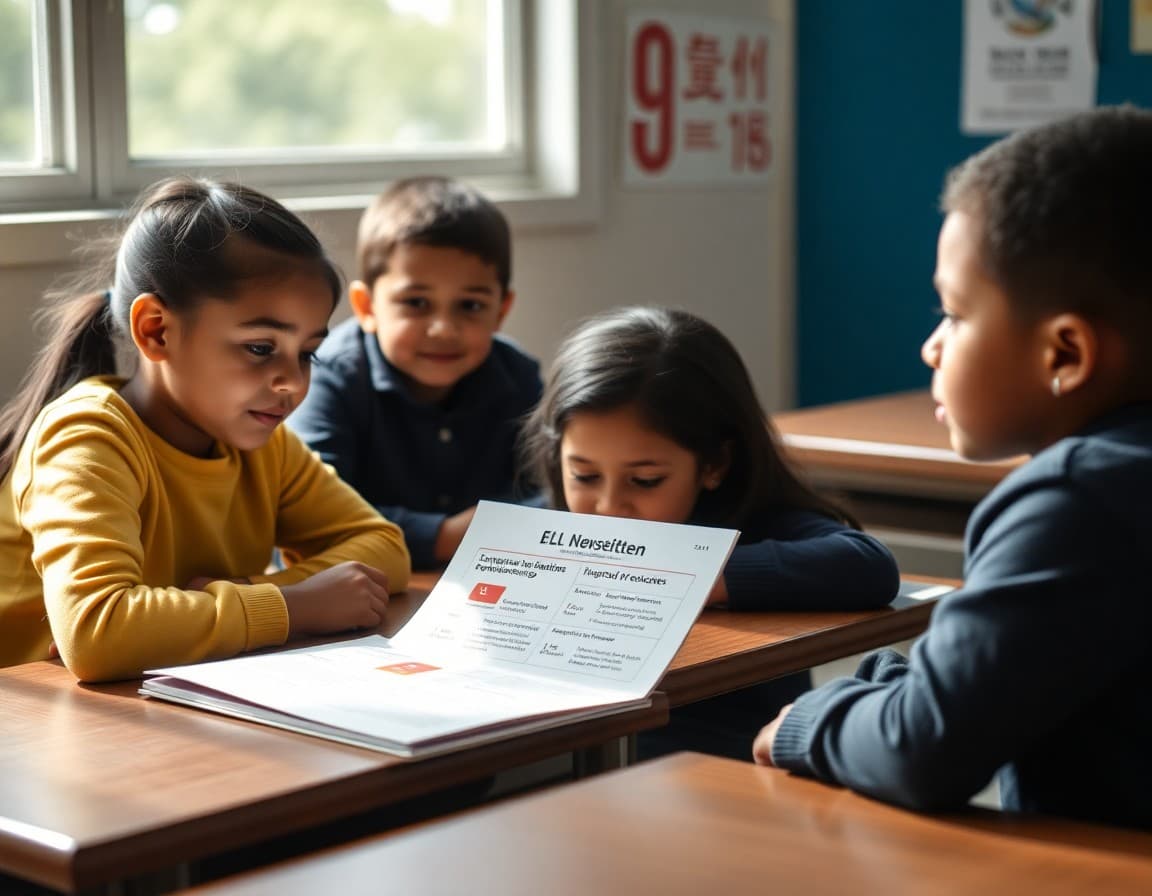
English learner families receive some of the most important and least accessible communications in any school system. Legal notices about language rights, proficiency assessment results, and program eligibility notifications often arrive in English that the families they are addressed to cannot fully read. An ELL department newsletter that communicates clearly, in families' home languages, about what the program offers and what families are entitled to is both a legal obligation and a genuine service to the families who most need the information.
Send the Newsletter in the Family's Language
This is not optional: ESSA requires that schools communicate with ELL families in a language they can understand. The ELL newsletter should be available in the primary languages of your school's ELL population. For most schools, Spanish translation is the minimum. For schools with significant Vietnamese, Somali, Mandarin, or Arabic-speaking populations, those languages need to be addressed as well. If your school does not have in-house translation capacity, the district office typically has translator resources, and some states provide state-funded translation services to school districts.
Explain the Program Before Testing Season
The annual WIDA ACCESS assessment (or the equivalent state test) is the single most important event in the ELL program calendar because it determines what services students receive. Families who understand what the test measures, when it happens, and what the results mean are better prepared to support their student through the experience. "The WIDA ACCESS for ELLs assessment measures your student's English proficiency across four areas: reading, writing, speaking, and listening. Assessment takes place in January and February. Results arrive by April and determine whether your student remains in the ELL program or is reclassified as English proficient."
Demystify Proficiency Levels
WIDA's six proficiency levels -- from Entering (Level 1) through Reaching (Level 6) -- are used to place students in appropriate services, but most families do not know what the levels mean or where their student falls. A newsletter that describes what each level looks like in practice gives families a concrete understanding: "Level 3 (Developing): Your student can participate in conversations about familiar academic topics with some support. They can read and write in English with teacher assistance. At this level, students receive 60 minutes of ELL instruction daily plus academic support in content classes."
A Sample ELL Department Newsletter Section
Here is a template for a fall newsletter:
"ELL Program Update, Fall 2025 -- Welcome to our ELL families. We serve 87 English learners in grades K-12 across three program models. Your student's proficiency level was determined by the WIDA Screener administered at enrollment. Annual assessment (WIDA ACCESS): administered January 6 through February 14. All current ELL students participate. Results available by April 1. Your rights: Within 30 days of the school year start, you received a letter describing your student's English proficiency level and the services they receive. If you did not receive this letter, contact Ms. Guerrero at mguerrero@school.edu. Interpreter services: Interpretation in Spanish, Somali, and Vietnamese is available for all school meetings. Request at least 48 hours in advance. Translation of written documents: contact the front office. Reclassification: Students who score at Level 5 or above on WIDA ACCESS and meet academic performance benchmarks may be reclassified. Families are notified before reclassification occurs and may request a meeting to discuss the decision. Questions: ms. Guerrero at ext. 218."
Communicate About Bilingual and Dual Language Options
If your school or district offers bilingual education or dual language immersion programs, the ELL newsletter is where families learn about them. Explain the difference between ELL pull-out or push-in services, sheltered English instruction, and dual language programs. Describe the research on bilingualism and academic achievement. Help families understand that maintaining their home language alongside English is an asset, not a liability, and that program options may exist that support both. Families who receive this information make more informed placement decisions than those who encounter the options only at enrollment.
Celebrate Bilingualism
A newsletter that only focuses on English proficiency acquisition without celebrating the languages students already speak sends an implicit message that those languages are problems to be overcome. Explicitly acknowledge the value of bilingualism and multilingualism: "Our ELL students collectively speak 14 languages. Their ability to communicate in multiple languages is a strength, not a deficit. Our program's goal is to add English as a powerful tool while preserving and honoring the languages students bring." That statement of values matters to families navigating a system that often treats their home language as an obstacle rather than an asset.
Connect ELL Families to School Resources
Many ELL families do not access school resources -- parent education nights, counseling, after-school programs, food and clothing assistance -- because they do not know they are available or because language barriers make accessing them feel too difficult. Your ELL newsletter can serve as a gateway to the school's full family support system by listing these resources in the family's language with a note that interpretation is available for all. A family that receives a bilingual resource list is significantly more likely to attend a family engagement event than one that only receives English-language communications.
Get one newsletter idea every week.
Free. For teachers. No spam.
Frequently asked questions
What should an ELL department newsletter include?
The language program structure and which services each proficiency level receives, the annual language proficiency assessment schedule (typically WIDA ACCESS in most states), family rights under Title III and ESSA, how families are notified of their student's English proficiency level, how ELL students are reclassified as English proficient, program options families can choose from, and resources available to ELL families including translation and interpretation services.
How should an ELL newsletter communicate in multiple languages?
The ESSA requirement to communicate with ELL families in a language they can understand means the ELL newsletter itself should be available in the primary languages spoken in the school community. If Spanish speakers make up 60 percent of the ELL population, the newsletter should be available in Spanish. For languages with smaller populations, a summary in the family's language with a full version in English is an acceptable approach. Document your translation efforts for compliance purposes.
How does an ELL department communicate about the reclassification process to families?
Explain what reclassification means (the student is determined to be sufficiently proficient in English to succeed in general education without language support services), what data is used to make the reclassification decision (typically WIDA ACCESS scores plus academic performance), what families' rights are in the process (families are notified and can request a meeting), and what services remain available after reclassification. Families who understand the process are more supportive of both the services and the exit from services.
What Title III rights should ELL families understand through newsletter communication?
Under ESSA, ELL families have the right to be informed of their child's English proficiency level within 30 days of the start of school (10 days for students who enroll mid-year), to understand what language instruction program their child is receiving, to know how the program will meet their child's needs, and to remove their child from ELL services through a waiver. These rights should be communicated in the family's home language, not only in English.
Can Daystage support an ELL department newsletter in multiple languages?
Yes. Daystage lets ELL coordinators build a newsletter in English and then duplicate and translate it for distribution to families who speak other languages. Each language version can be sent to the appropriate subscriber group. The platform archives all newsletters, which supports documentation of language access compliance required under ESSA Title III.

Adi Ackerman
Author
Adi Ackerman is a former classroom teacher and curriculum writer with 8 years in K-8 schools. She writes about school communication, parent engagement, and what actually works in real classrooms.
More for Department Newsletters
Special Education Department Newsletter: Inclusion and Support Updates
Department Newsletters · 6 min read
World Language Department Newsletter: Language Learning Updates
Department Newsletters · 6 min read
Counseling Department Newsletter: What to Include and How to Write It
Department Newsletters · 6 min read
Ready to send your first newsletter?
3 newsletters free. No credit card. First one ready in under 5 minutes.
Get started free