
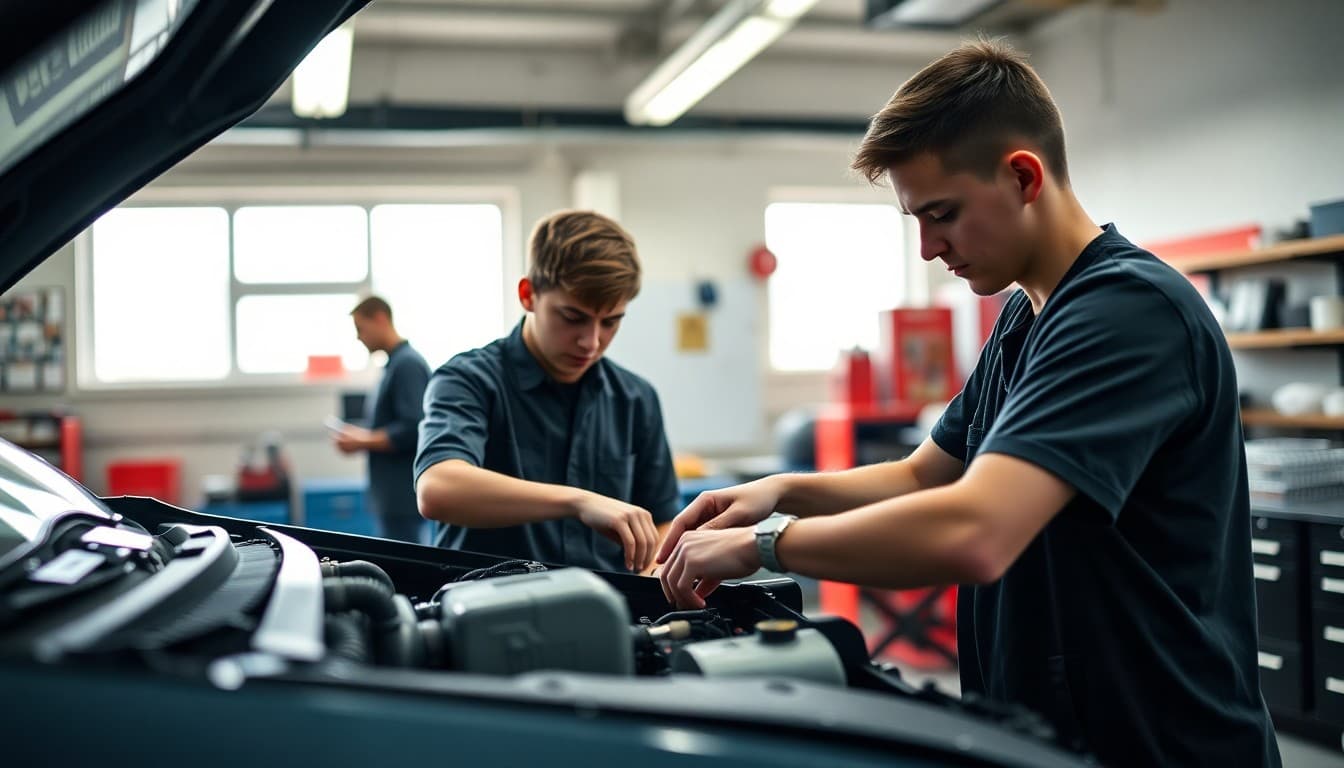
Auto Mechanics Class Newsletter: Cars and Career Skills

Auto mechanics is one of the most career-direct courses in the high school curriculum. Students leave with skills that translate immediately into employment. A newsletter that communicates this clearly to families and the community is an investment in the program's reputation and enrollment.
Current Curriculum Unit
Automotive technology follows a structured curriculum through major vehicle systems. Tell families where you are in that sequence: "We are currently in the braking systems unit, our most safety-critical topic of the year. Students learn to inspect brake pads and rotors, measure pad thickness, check rotor runout with a dial indicator, and bleed hydraulic brake systems. By the end of this unit, every student will have performed a complete brake inspection on one of our shop vehicles." This specificity helps families understand the real-world relevance of what their child is learning.
ASE Certification Timeline
For programs that prepare students for ASE Student Certification, the newsletter should include a clear exam timeline: "Students taking ASE Student Exam A6 (Electrical/Electronic Systems) should register by October 15 for the November testing window. Study guides are available in the shop office. We have three students from last year's class who passed A6 with top-25-percentile scores nationally. The exam fee is $36; we have a fund to cover the cost for students who need assistance."
Template Excerpt: Auto Mechanics Monthly Newsletter
Auto Tech Shop - October Update
October is the semester when everything starts to click for new students. They've covered basic theory and safety. Now they're actually diagnosing problems on real vehicles and seeing the connection between classroom knowledge and shop work.
This month's highlight: Student Jordan Martinez diagnosed an intermittent stall condition on our 2018 Honda that three certified technicians had been unable to resolve during a summer training exercise. Jordan isolated a faulty crankshaft position sensor using a lab scope, a diagnostic technique we spent three hours on in class. The car runs perfectly. That kind of success doesn't happen by accident.
Community oil change day: Saturday, November 2 from 9 AM to 12 PM. Students will perform free oil changes for school staff and community members in the shop lot. 20 slots available. Sign-up link in the school newsletter. Students work under direct supervision; this is real shop work for a real customer.
Career connection: We have three dealerships in the area with active relationships with our program. Students who complete the two-year sequence and pass two ASE student exams are eligible for paid co-op positions in the spring semester of their senior year.
Safety Standards in the Automotive Shop
Automotive shops involve chemicals, heavy equipment, and elevated vehicles. Parents whose children are new to the program deserve clear communication about safety practices: "All students complete OSHA 10-hour Safety and Health training in the first four weeks of class. This covers hazardous material handling, personal protective equipment requirements, proper jack stand usage, and emergency procedures. No student works under a vehicle without verified jack stand support. Eye protection is mandatory inside the shop at all times."
Electric and Hybrid Vehicle Technology
The automotive industry is shifting rapidly. A newsletter that acknowledges this trend and describes how the program is adapting demonstrates forward-thinking program leadership: "We added a hybrid vehicle systems module this year using a donated 2020 Toyota Prius hybrid. Students are learning high-voltage system safety, battery management diagnostics, and regenerative braking systems alongside traditional internal combustion training. Hybrid and EV technicians earn a significant premium over traditional technicians in most markets. We want our graduates ready for both."
Graduate Outcomes Worth Sharing
Real alumni outcomes are more persuasive than any curriculum description. Include one or two graduate outcomes per semester: "Marcus Williams, class of 2026, completed his ASE A1 through A4 certifications within 18 months of graduation. He is now a service technician at Riverside Toyota earning $24 per hour with full benefits at age 20. Students considering this career path should see Mr. Torres before the end of the semester."
Get one newsletter idea every week.
Free. For teachers. No spam.
Frequently asked questions
What should an auto mechanics class newsletter include?
Current curriculum units and what systems students are learning to diagnose and repair, ASE Student Certification exam schedule and preparation timeline, community service oil change events or similar outreach, career pathway information including local dealership and fleet employer relationships, shop safety protocols, and recognition of student skill milestones.
What is ASE Student Certification and why does it matter for families?
The National Institute for Automotive Service Excellence offers a student certification program for high school and college automotive technology students. Passing ASE student exams demonstrates verified competency to employers and can earn college credit at many institutions. A student who graduates with three or four ASE student certifications is immediately competitive for entry-level technician positions paying $18 to $22 per hour.
How do you explain automotive technology concepts to families in a newsletter?
Avoid technical jargon without translation. Instead of saying 'students completed OBD-II diagnostic scanning,' say 'students used electronic diagnostic scanners to read trouble codes from a car's computer, the same process a technician uses when your check engine light comes on.' Connecting classroom work to familiar consumer experiences makes the curriculum accessible.
What community service opportunities make good newsletter features for auto mechanics programs?
Many automotive technology programs offer community oil change days, safety inspection events for school staff, or partnerships with local nonprofits that provide vehicle maintenance to low-income residents. These events give students real-world supervised work experience and generate positive community visibility for the program. Cover them in the newsletter with photos and specifics.
Does Daystage work for career-technical education newsletters?
Yes. Daystage is used by career-technical programs across all trades. The platform is straightforward enough that a CTE instructor without technology experience can build and send a professional newsletter in under 30 minutes. The visual layout works particularly well for newsletters that include photos of student work and shop equipment.

Adi Ackerman
Author
Adi Ackerman is a former classroom teacher and curriculum writer with 8 years in K-8 schools. She writes about school communication, parent engagement, and what actually works in real classrooms.
More for Department Newsletters
Art Department Newsletter Guide: Sharing Student Work and Program Goals with Families
Department Newsletters · 5 min read
Counseling Department Newsletter: What to Include and How to Write It
Department Newsletters · 6 min read
Math Department Newsletter Guide for K-12 Schools
Department Newsletters · 6 min read
Ready to send your first newsletter?
3 newsletters free. No credit card. First one ready in under 5 minutes.
Get started free