
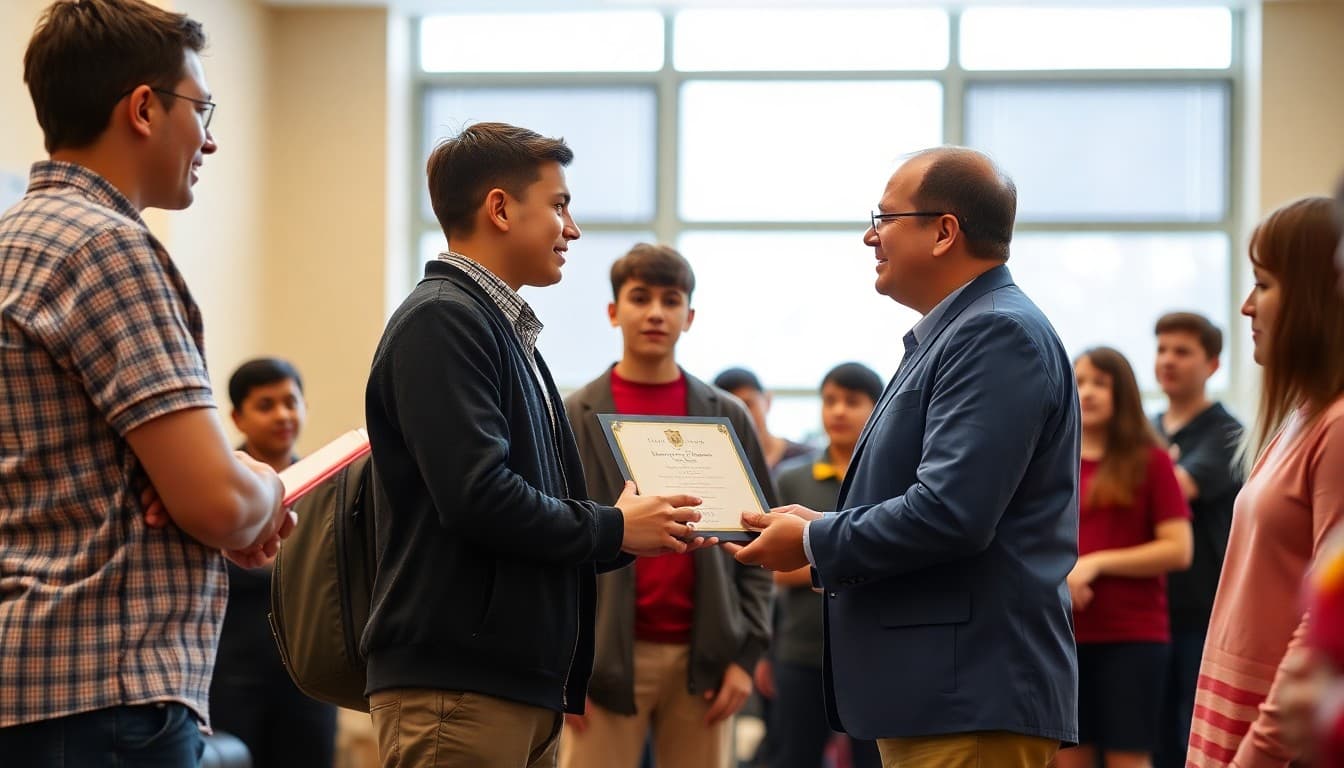
Community Service Award School Newsletter Template

Community service awards are one of the few school recognitions that connect student achievement to something visible in the broader community. When you announce these awards in a newsletter, you are not just celebrating students. You are documenting the impact the school community had on the town or city around it.
A well-written community service award newsletter does more than list names. It describes the work, quantifies the impact when possible, and invites the broader community to take notice.
Define What You Are Recognizing
Before writing anything, confirm what criteria qualified students for the award. Hours completed? A specific project? A combination of both? The newsletter should state this plainly so families understand what the recognition represents.
Some schools run tiered awards: bronze for 20 hours, silver for 50, gold for 100 or more. Others give a single award at year's end to all students who met the threshold. Either format works. The newsletter just needs to reflect which system you are using.
Opening with Impact, Not Process
Lead with what students actually did, not how the award program works. "This year, 38 students from Riverside Middle School contributed more than 1,400 hours of community service across 22 organizations in our city" is a much stronger opener than "We are pleased to announce our annual community service award recipients."
Numbers create credibility and weight. Even rough estimates like "more than 1,400 hours" or "serving more than 300 families at local food pantries" anchor the recognition in something real.
Sample Newsletter Template Excerpt
Here is an adaptable version you can use:
Subject line: Riverside Students Contributed 1,400+ Hours to Our Community This Year
Opening: We are proud to celebrate the 38 Riverside Middle School students who earned Community Service Awards this year. Together, they contributed more than 1,400 hours of service to 22 organizations in our community from September 2025 through May 2026.
Gold Award (100+ hours): [Student Name] - tutoring at Lincoln Elementary; [Student Name] - food bank distribution, 112 hours
Silver Award (50-99 hours): [Student Name], [Student Name], [Student Name]
Bronze Award (20-49 hours): [List continues]
Closing: We are proud of what these students accomplished. If your family is interested in service opportunities for next year, contact [Coordinator Name] at [email].
Spotlighting One or Two Students in Depth
Beyond the recognition list, a brief profile of one or two students who did particularly meaningful or unusual work adds depth. Keep each profile to four to five sentences. Describe what they did, where they did it, and what they said about the experience.
These profiles are the part of the newsletter that families read most carefully. They transform an abstract list of names into real stories, and they give the recognized students a moment of genuine visibility.
Connecting Service to Curriculum
If any recognized service was part of a classroom service-learning project, note the connection. "A group of eight seventh graders conducted an oral history project with seniors at Greenview Assisted Living as part of their social studies curriculum" gives teachers and curriculum directors visibility alongside students and shows families that service and academics are connected at your school.
Organizations Worth Thanking
The organizations that hosted student volunteers often have no direct connection to the school newsletter distribution list. But including a brief thank you to the organizations by name acknowledges the partnership and may strengthen it. A short paragraph listing the organizations where students served, with a line of thanks, costs you almost nothing to write and builds goodwill in the community.
Distribution and Follow-Up
Send this newsletter to all school families, not just those with award recipients. Post it on the school website and share with the district communications office. If your community has a local newspaper, this is an announcement worth submitting. Schools that document community impact consistently build stronger relationships with local organizations, which leads to better placements and more opportunities for students in future years.
Get one newsletter idea every week.
Free. For teachers. No spam.
Frequently asked questions
What types of service should count for a community service award newsletter?
Any service performed outside the student's own household counts: volunteering at food banks, tutoring younger students, organizing donation drives, participating in environmental clean-ups, or completing service learning projects tied to class curriculum. Hours are the most common metric, typically 20 to 100 hours depending on the award level. Be consistent in what you count and communicate the criteria clearly before the award cycle begins.
How do you verify service hours for the newsletter?
Most schools require a supervisor signature from the organization where the student served, along with a brief description of the work. Some schools also require a student reflection. Before publishing names in the newsletter, verify that paperwork is complete. Recognizing a student whose hours were not properly documented creates problems if another student's legitimate hours were declined.
Should the newsletter describe what each student did, or just list names?
Brief descriptions add significant value when you can manage them. Even one sentence per student makes the recognition feel personal and gives readers a concrete picture of what service looked like. For large lists, a summary by service category works well: food security, environmental, education support, and health services.
Can the newsletter be used to recruit future volunteers?
Yes, and this is worth including intentionally. A short section at the end connecting interested students and families to volunteer opportunities converts a recognition newsletter into a community outreach tool. Include two or three specific organizations that welcome student volunteers, with links or contact information.
What makes a community service newsletter easy to send well?
Daystage lets you structure a community service recognition newsletter with sections for individual spotlights, service summaries by category, and a resources section for families interested in future service opportunities. You can include student photos and send to your full parent and community list from one place.

Adi Ackerman
Author
Adi Ackerman is a former classroom teacher and curriculum writer with 8 years in K-8 schools. She writes about school communication, parent engagement, and what actually works in real classrooms.
More for Community Outreach
Adult Education Program Newsletter at School: Communicating Learning Opportunities for Parents and Caregivers
Community Outreach · 5 min read
Alumni Community Newsletter: How Schools Can Engage Graduates as Community Partners and Mentors
Community Outreach · 5 min read
Business Partnership Newsletter: How Schools Can Engage Local Businesses as Educational Partners
Community Outreach · 6 min read
Ready to send your first newsletter?
3 newsletters free. No credit card. First one ready in under 5 minutes.
Get started free