
Teacher Newsletter for Probability Unit: Making Math Relevant for Families

Probability is one of the most immediately applicable math units you teach. Students encounter it every time they hear a weather forecast, play a board game, or watch sports analysis. A newsletter that connects the classroom content to these everyday experiences transforms a unit that can feel abstract into something students and families recognize as directly relevant to their lives.
Explain what probability is in plain terms
Probability is the mathematical study of chance. It tells us how likely an event is to happen, expressed as a fraction, decimal, or percent between zero and one. An event with probability zero is impossible. An event with probability one is certain. Most events fall somewhere in between. That simple framework, plus a few vocabulary terms, is all most families need to follow the unit.
Name the key vocabulary students are learning
Tell families the specific terms in the unit: probability, outcome, event, sample space, theoretical probability, experimental probability, favorable outcome. A brief definition of each in plain language is worth including. Students who hear these terms at home as well as at school absorb the vocabulary much faster.
Describe the experimental activities students are doing
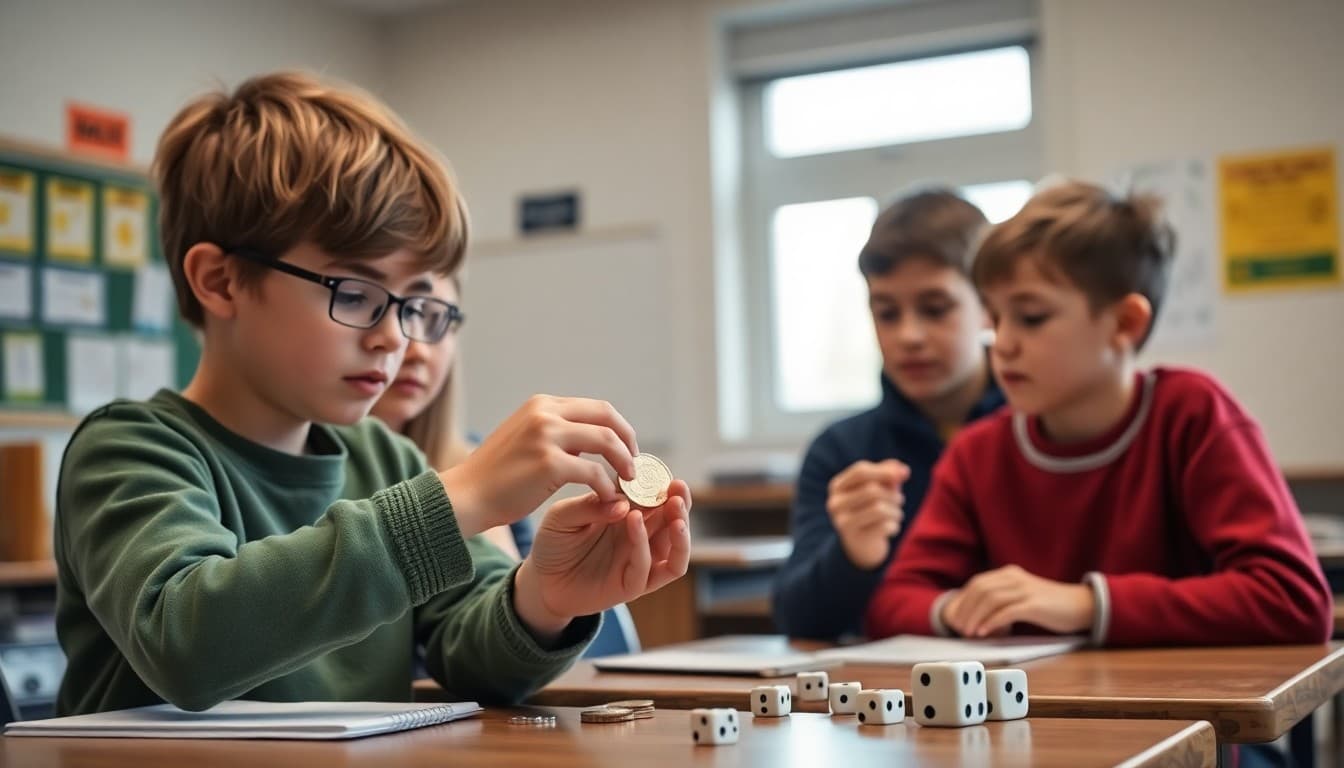
Probability makes the most sense when students experience it physically before they calculate it theoretically. Tell families what hands-on experiments students are running: coin flips, dice rolls, spinner activities, card draws. Describing these experiments helps parents understand what is happening in class and gives them a model for home practice.
Connect probability to weather forecasts
A 70% chance of rain is probability. Most families check the weather daily without thinking about the mathematics behind it. Pointing this out in the newsletter gives families an immediate daily touchpoint for probability discussion. "When you see a weather forecast, ask your student what that percentage actually means and how confident it should make you." This makes the math conversation a natural part of the morning routine.
Suggest a home coin flip experiment
A simple home experiment reinforces the unit powerfully. Ask families to flip a coin twenty times together, record the results, and calculate the experimental probability of heads. Then compare it to the theoretical probability of one-half. Why are they not exactly equal? What would happen with fifty flips? One hundred? This conversation introduces the law of large numbers in a completely accessible way.
Connect probability to sports and games
Batting averages, shooting percentages, odds in a board game: sports and game contexts make probability tangible for students who are otherwise indifferent to abstract calculations. Give families a specific example related to whatever sport or game their student cares about. A single well-chosen connection often unlocks the whole unit for a previously reluctant student.
Address the common misconception about streaks
Many students and adults believe that after a long streak of heads, tails becomes more likely. This is the gambler's fallacy and it is false. Each flip is independent of the last. Address this misconception in the newsletter so families do not reinforce it at home. "Ask your student why past coin flips do not affect future ones. If they can explain it, they understand probability deeply."
Get one newsletter idea every week.
Free. For teachers. No spam.
Frequently asked questions
What should I cover in a probability unit newsletter?
Explain what probability is and the vocabulary students are learning, what activities students are doing to explore probability experimentally, how theoretical and experimental probability relate, real-world applications of probability, and how families can explore probability concepts together at home.
How do I explain the difference between theoretical and experimental probability?
Theoretical probability is what we predict based on equal outcomes. Flipping a coin should land heads half the time. Experimental probability is what actually happens when you try it. Flip a coin ten times and you might get seven heads. With enough trials, experimental probability approaches theoretical probability. This distinction is central to the unit.
What real-world examples of probability can families discuss?
Weather forecasts, sports statistics, game odds, insurance, election polling, and medical test accuracy all involve probability. Point families toward the examples most relevant to their student's interests. A student who loves sports has immediate access to probability in batting averages and winning percentages.
How can families practice probability at home without special materials?
A coin, a standard die, a deck of cards, and a bag of colored items are enough for all basic probability experiments. A coin flip is the simplest probability experiment possible. Ten minutes of flipping and recording produces real data and real mathematical conversation.
Can Daystage help me share probability unit updates with families in an engaging format?
Yes. Daystage lets you include real examples, relevant data, and practical activities alongside your classroom update in one clean newsletter format.

Adi Ackerman
Author
Adi Ackerman is a former classroom teacher and curriculum writer with 8 years in K-8 schools. She writes about school communication, parent engagement, and what actually works in real classrooms.
More for Classroom Teachers
Teacher Newsletter for Math Problem Sets: Helping Families Support Math Practice
Classroom Teachers · 6 min read
How to Share Classroom Data Collection With Families in Your Teacher Newsletter
Classroom Teachers · 6 min read
Teacher Newsletter for Math Talk: How to Explain Mathematical Discourse to Families
Classroom Teachers · 6 min read
Ready to send your first newsletter?
3 newsletters free. No credit card. First one ready in under 5 minutes.
Get started free