

Using Your Teacher Newsletter to Build Excitement for Math Club
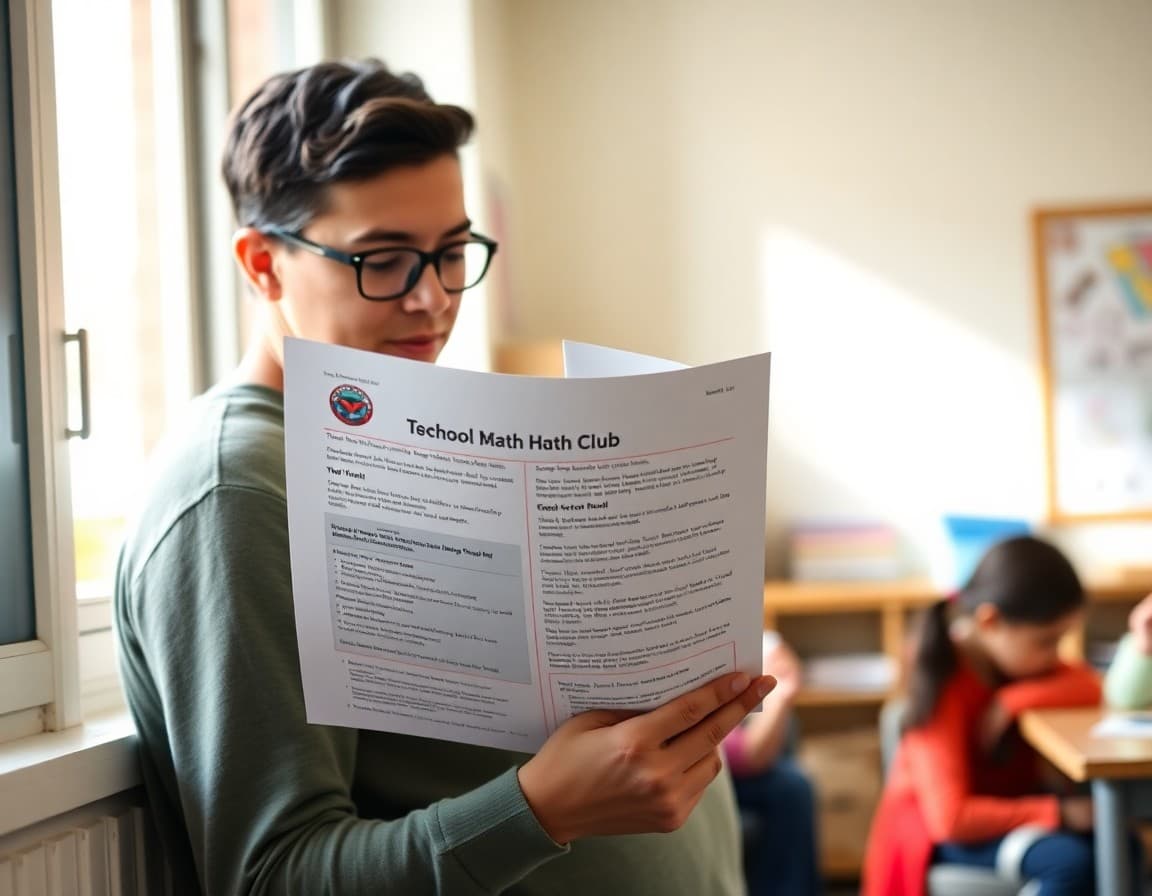
What Math Club Offers That Classroom Math Does Not
Math club is where students explore the playful side of mathematics: puzzles that have no obvious path, problems that reward creative thinking over memorized procedures, and challenges that feel more like games than assessments. Your newsletter is how you communicate that distinction to families who might otherwise assume math club is extra homework for high achievers.
Frame Math Club Around Curiosity, Not Performance
The most effective math club announcements do not lead with achievement. They lead with fun. "If you like a problem that stops you cold and makes you think for five minutes, math club is your place." That framing reaches the student who loves puzzles but never shows up on the honor roll as much as it reaches the student who does. Both are exactly who you want in your club.
Include a Puzzle in the Announcement Newsletter
Put a single, accessible puzzle in the newsletter alongside your announcement. Keep it short: two sentences at most. A logic puzzle, a number pattern, a riddle with a mathematical answer. Families and students who try it arrive at the sign-up conversation already engaged. The puzzle does the recruiting work better than any description of the club can.
List the Logistics Families Need to Act
A family who wants to sign their child up for math club will not do it if the newsletter leaves them with unanswered questions. When does it meet? Where? Who supervises? How do they sign up? Is there a deadline? Is there any cost? Answering all of those questions in the announcement newsletter removes every barrier between interest and enrollment.
Connect Math Club to Competitions If Applicable
If your math club prepares for competitions like Math Olympiad, AMC, or local district challenges, mention it in your newsletter. Competition context gives students a tangible goal and gives families a reason to invest time in transportation and preparation. Even families who are skeptical of competition value the focused practice and the sense of working toward something real.
Update Families on What the Club Is Exploring
Once a month, include a brief math club update in your newsletter. What problem type are students working on? What did a recent session look like? Was there a breakthrough moment? These updates serve the students in the club, who see their work valued publicly, and they serve the students still deciding whether to join, who get a preview of what they would experience.
Celebrate Results Without Overemphasizing Scores
When math club students participate in a competition or complete a major challenge, celebrate the effort and the growth in your newsletter alongside any results. "Our math club worked for six weeks on competition preparation and placed in the top half of the district. More importantly, I watched students tackle problems they would have given up on in October." That framing honors both results and process, which is exactly the message that keeps students coming back.
Get one newsletter idea every week.
Free. For teachers. No spam.
Frequently asked questions
How do I recruit students for math club through my newsletter?
Focus on the fun and the puzzle-solving, not the computation. 'If you love cracking a challenge that seems impossible at first, math club is where you want to be.' That language reaches students who are curious but might not describe themselves as math people.
What activities should I mention in the math club announcement?
Name specific activities: logic puzzles, math olympiad preparation, math games, pattern challenges, or escape room problems. Concrete examples are more compelling than 'we explore interesting math.'
How do I address the stereotype that math club is only for top performers?
Say it directly in your newsletter. 'Math club is not an advanced class. It is a place to explore math in a way that is different from what we do in the classroom. Curiosity and persistence matter more than speed or grades.'
Should I share math club problem examples in the newsletter?
Yes. Including a single accessible puzzle in your newsletter creates immediate engagement. Families and students who try it are primed for the conversation about joining. Even if they don't solve it, they are intrigued.
How does Daystage help teachers communicate about math club with families?
Daystage lets you embed rich content including puzzles, photos, and event details in your newsletter. Families who engage with a math puzzle in the newsletter are already one step closer to signing their child up for the club.

Adi Ackerman
Author
Adi Ackerman is a former classroom teacher and curriculum writer with 8 years in K-8 schools. She writes about school communication, parent engagement, and what actually works in real classrooms.
More for Classroom Teachers
Ready to send your first newsletter?
3 newsletters free. No credit card. First one ready in under 5 minutes.
Get started free