
How to Explain Concept Mapping to Families in Your Teacher Newsletter

Concept mapping is one of those strategies that looks simple and turns out to be cognitively demanding in exactly the right way. Creating a concept map requires students to identify the most important ideas in a topic, decide how those ideas relate to each other, and label those relationships precisely. That process is deeper learning than listing definitions. A newsletter that introduces concept mapping to families gives them both a study strategy to use at home and a window into how students are processing the content they are learning.
Describe the structure of a concept map
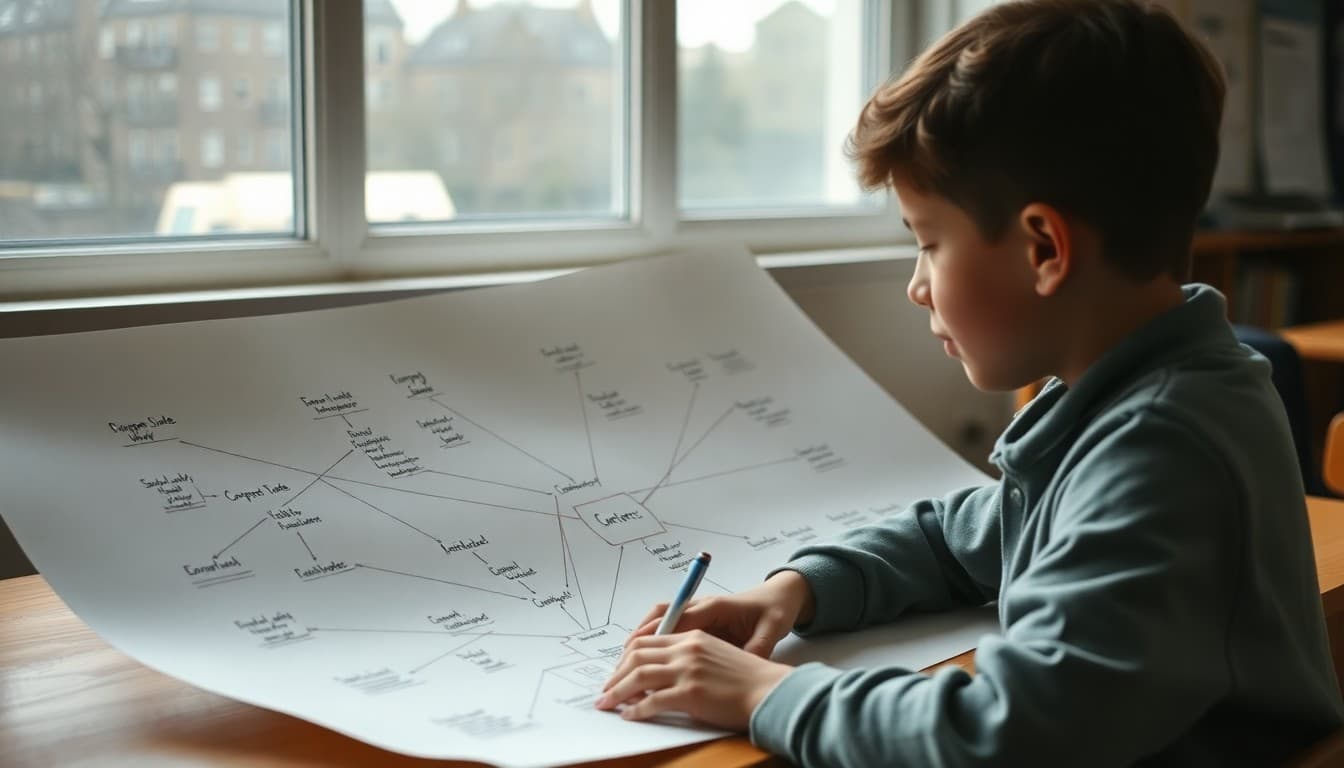
"A concept map consists of concept nodes connected by labeled linking lines. Each concept goes in a box or circle. The lines between concepts are labeled with a short phrase that describes the relationship: 'photosynthesis produces oxygen,' 'mitosis is a type of cell division,' 'the legislative branch creates laws.' The labels are what distinguish concept maps from mind maps and make them a rigorous thinking tool rather than just a visual organizer."
Connect concept mapping to what students are studying
"We are currently using concept maps in our ecosystems unit. Students are mapping the relationships between producers, consumers, and decomposers, with specific organisms filling each role. The concept map shows the food web relationships more clearly than a list of vocabulary words because the connections between organisms are the content, not the organisms themselves."
Show families what to ask when reviewing a concept map
Families who know how to engage with a concept map can use it as a study tool. "When your student shows you a concept map, ask: 'Can you explain this connection to me? Why does this line say this? What would happen in this section if this concept changed?' Those questions prompt the kind of explanation that reveals whether the student understands the map or just copied it."
Explain how concept mapping supports writing
Concept mapping is often used as a pre-writing strategy in our class. "Before students write an explanatory or argumentative essay, they create a concept map of the topic. The map shows them where their knowledge is strong and where it has gaps. A gap in the map is a signal to go back to the notes or reading. Students who write from a complete concept map produce more logically organized essays than students who write from an incomplete outline."
Offer a simple home version families can try
"At home, ask your student to create a concept map for anything they are studying. Give them a blank piece of paper and a pen. Start by writing the main topic in the center. Then ask: what are the important parts or ideas connected to this? Draw lines and label them as you go. You do not need to know the content yourself to facilitate the process."
Note digital concept mapping tools available
"Students who prefer digital tools can use Canva, Lucidchart, or the free version of Coggle to create concept maps on a computer or tablet. The digital versions are easier to revise and can be submitted electronically. I will accept both paper and digital concept maps for assessed work."
Daystage newsletters that include concept map examples and family engagement prompts turn a classroom strategy into a home learning practice that multiplies the impact of the original instruction.
Get one newsletter idea every week.
Free. For teachers. No spam.
Frequently asked questions
What is a concept map and how is it used in the classroom?
A concept map is a visual diagram that shows how ideas relate to each other. Central concepts are connected to related ideas through labeled lines that describe the relationship. Students use concept maps to organize knowledge before writing, to show understanding after a unit, and to think through complex topics that have multiple interacting parts.
How is a concept map different from a mind map?
A mind map typically radiates from a central topic outward in a branching structure, with no labeled connections. A concept map labels the connections between ideas with linking phrases that specify the relationship: 'is a type of,' 'causes,' 'requires,' 'is part of.' The labeled connections make concept maps more explicit about the nature of relationships between ideas.
What subjects benefit most from concept mapping?
Science, social studies, and reading comprehension benefit significantly from concept mapping because the content involves multiple interacting concepts. A water cycle concept map, a government structure concept map, or a character relationship map for a novel all help students see systemic connections rather than isolated facts.
How can families help students create concept maps at home?
Ask the student to teach you the topic by drawing the connections rather than explaining in a list. 'Show me how the three branches of government connect to each other on paper.' The act of drawing the map while explaining it reinforces understanding more than simply answering questions.
Can Daystage help teachers share concept mapping strategies with families?
Yes. A Daystage newsletter with a concept map example and step-by-step instructions for families to try at home is an effective way to extend the classroom strategy to the home environment.

Adi Ackerman
Author
Adi Ackerman is a former classroom teacher and curriculum writer with 8 years in K-8 schools. She writes about school communication, parent engagement, and what actually works in real classrooms.
More for Classroom Teachers
Explaining Graphic Organizers to Families in Your Teacher Newsletter
Classroom Teachers · 6 min read
How to Introduce Sketchnoting to Families in Your Teacher Newsletter
Classroom Teachers · 6 min read
How to Explain Visual Thinking Strategies to Families in Your Newsletter
Classroom Teachers · 6 min read
Ready to send your first newsletter?
3 newsletters free. No credit card. First one ready in under 5 minutes.
Get started free