
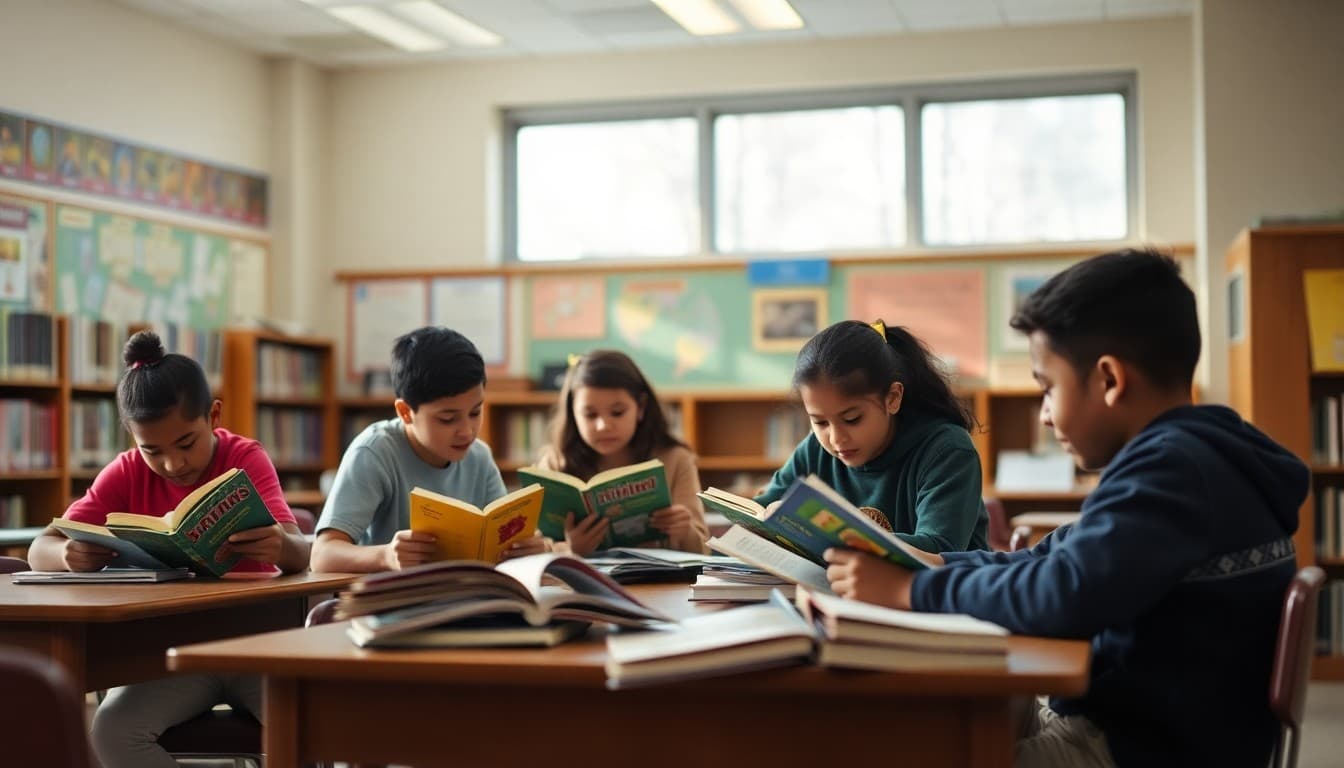
New Jersey Literacy Newsletter: Local Resources and Reading Guide
New Jersey has one of the most educated and engaged parent populations in the country. Families in Bergen County, Mercer County, and other suburban areas bring high expectations to school communication. Meanwhile, families in Newark, Trenton, Camden, and other urban districts face different economic realities but often equally high aspirations for their children. A literacy newsletter that serves both needs is worth building carefully.
New Jersey Student Learning Standards for Reading
New Jersey's NJSLS for ELA align with Common Core and set rigorous grade-level expectations. In your newsletter, translate the standard you are currently teaching into one clear, practical sentence. "We are working on analyzing how the central idea of an informational text is developed through specific details. Ask your child to summarize the main point of the last nonfiction article they read and to identify two details that support it."
NJSLA and Reading Preparation
New Jersey students take the NJSLA for ELA beginning in grade 3. The assessment includes reading comprehension, literary analysis, and written response tasks. Before testing season, your newsletter should frame the NJSLA in terms of the skills students practice every day. "The NJSLA tests reading and writing skills we build every day. The best preparation is consistent reading and practice explaining thinking with evidence." That framing reduces anxiety and keeps the focus on the real work.
New Jersey's Library Resources
New Jersey has outstanding public library resources. Newark Public Library, Jersey City Free Public Library, and Trenton Free Public Library serve urban communities with extensive programming. Suburban counties including Middlesex, Morris, Somerset, and Monmouth have well-funded library systems. The New Jersey State Library provides digital lending through Libby for all residents. Include a library resource in every newsletter, especially before summer.
New Jersey's Extraordinary Linguistic Diversity
New Jersey is one of the most linguistically diverse states in the country. Spanish, Portuguese, Gujarati, Korean, Chinese, Hindi, Arabic, and many other languages are spoken in New Jersey homes. Your newsletter can reach those families by affirming home language reading. "Reading in Gujarati, Spanish, or Korean at home develops the same comprehension and vocabulary skills that support English literacy. Please keep going." The Newark Public Library and Jersey City Free Public Library both have extensive multilingual collections.
A Template for Your New Jersey Literacy Newsletter
Reading focus this month: [skill or strategy the class is working on]
NJSLS standard: [plain-language description of the relevant benchmark]
NJSLA connection: [brief note on how this skill appears in the spring assessment]
For multilingual families: [home language literacy note or multilingual resource]
New Jersey resource: [one library, digital tool, or program available to families]
Home practice: [one specific reading activity with a clear time commitment]
New Jersey Authors and Literary Culture
New Jersey has produced remarkable writers. Walt Whitman edited a newspaper in Newark. Joyce Carol Oates has deep NJ connections. Junot Diaz grew up in Parlin. Philip Roth wrote Newark into American literary history. More recently, NJ-connected authors have contributed to children's and young adult literature. Including NJ-connected authors in your reading recommendations connects literacy to the state's identity.
Urban New Jersey Reading Access
Families in Newark, Trenton, Paterson, and Camden sometimes face more barriers to library access than suburban families. Digital lending through the New Jersey State Library removes that barrier. "The NJ digital library is free for any New Jersey resident and works on a phone. No library trip needed." That one sentence makes the resource accessible to families who might not otherwise use it.
Engaging New Jersey's High-Expectation Families
New Jersey families with high educational expectations respond to substantive communication. Do not talk down to them. Give them real information about what you are teaching, why it matters, and a specific, intellectually meaningful way to reinforce it at home. "Ask your child to explain the difference between what the author said directly and what they had to infer from the text." That kind of specific, skills-based prompt is what high-expectation New Jersey families actually want from a teacher newsletter.
Get one newsletter idea every week.
Free. For teachers. No spam.
Frequently asked questions
What literacy standards does New Jersey use?
New Jersey uses the New Jersey Student Learning Standards (NJSLS) for English Language Arts, which align with Common Core. These set grade-level expectations for reading literature, informational text, foundational skills, writing, speaking, and listening. In your newsletter, describe the standard you are currently teaching in plain language that parents can use.
What reading assessments are used in New Jersey schools?
New Jersey uses the NJSLA (New Jersey Student Learning Assessment) for ELA in grades 3 through 10. The NJSLA aligns with the Smarter Balanced consortium. Before testing season, your newsletter should explain the assessment and connect daily reading habits to the skills it tests.
What free literacy resources are available in New Jersey?
New Jersey State Library provides digital lending through Libby for all NJ residents. Newark Public Library, Jersey City Free Public Library, Camden Free Public Library, and many county and municipal libraries offer strong children's programming. New Jersey has some of the best-funded library systems in the country.
How do I support New Jersey's multilingual families in literacy communication?
New Jersey is one of the most linguistically diverse states in the country. Spanish, Portuguese, Gujarati, Korean, Chinese, Hindi, and many other languages are spoken in New Jersey homes. Affirming home language literacy in your newsletter and linking to multilingual library resources reaches more families and builds trust across language communities.
Can Daystage help New Jersey teachers create literacy newsletters for families?
Yes. Daystage is a school newsletter platform NJ teachers can use to create professional, consistent literacy communication. With New Jersey's highly educated and engaged parent communities, a well-organized newsletter meets the high expectation families have for school communication.

Adi Ackerman
Author
Adi Ackerman is a former classroom teacher and curriculum writer with 8 years in K-8 schools. She writes about school communication, parent engagement, and what actually works in real classrooms.
More for Classroom Teachers
Ready to send your first newsletter?
3 newsletters free. No credit card. First one ready in under 5 minutes.
Get started free