
May Newsletter Ideas for First Grade Teachers: What to Send This Month
May in first grade is a month of genuine celebration and real transition work. Students who came in still learning to decode simple words can now read chapter books, write multi-sentence stories, and solve two-digit addition problems. Parents who were uncertain about how first grade would go are watching their child thrive. Your May newsletter captures that progress and gives families everything they need for the summer and into second grade.
Celebrate what the class accomplished this year
Start the newsletter with a clear summary of the year's academic achievements. First graders covered a lot of ground: they moved from emergent reading to independent chapter books, from writing simple sentences to multi-paragraph stories, from counting to 20 to adding and subtracting two-digit numbers. Name the specific milestones so parents understand the scope of what their child learned.
A class-level milestone summary is more useful than general praise. Families who read "your child has mastered 200 sight words, can read level J books independently, and writes organized personal narratives with a beginning, middle, and end" know what their child has achieved. Families who read "what a great year!" do not.
Name the end-of-year reading benchmark
Tell parents specifically where first graders should be with reading by the end of the year and where the class stands. In most districts, the end-of-first-grade benchmark is reading at a level J or K, which corresponds to books with short chapters, some figurative language, and basic inference questions.
If most students have met the benchmark, say so. If a portion of the class is still working toward it, name that the summer is a critical time for those students to maintain the skills they have and close remaining gaps with consistent reading practice. Parents who understand the benchmark can choose the right summer books.
Prepare parents for second grade expectations
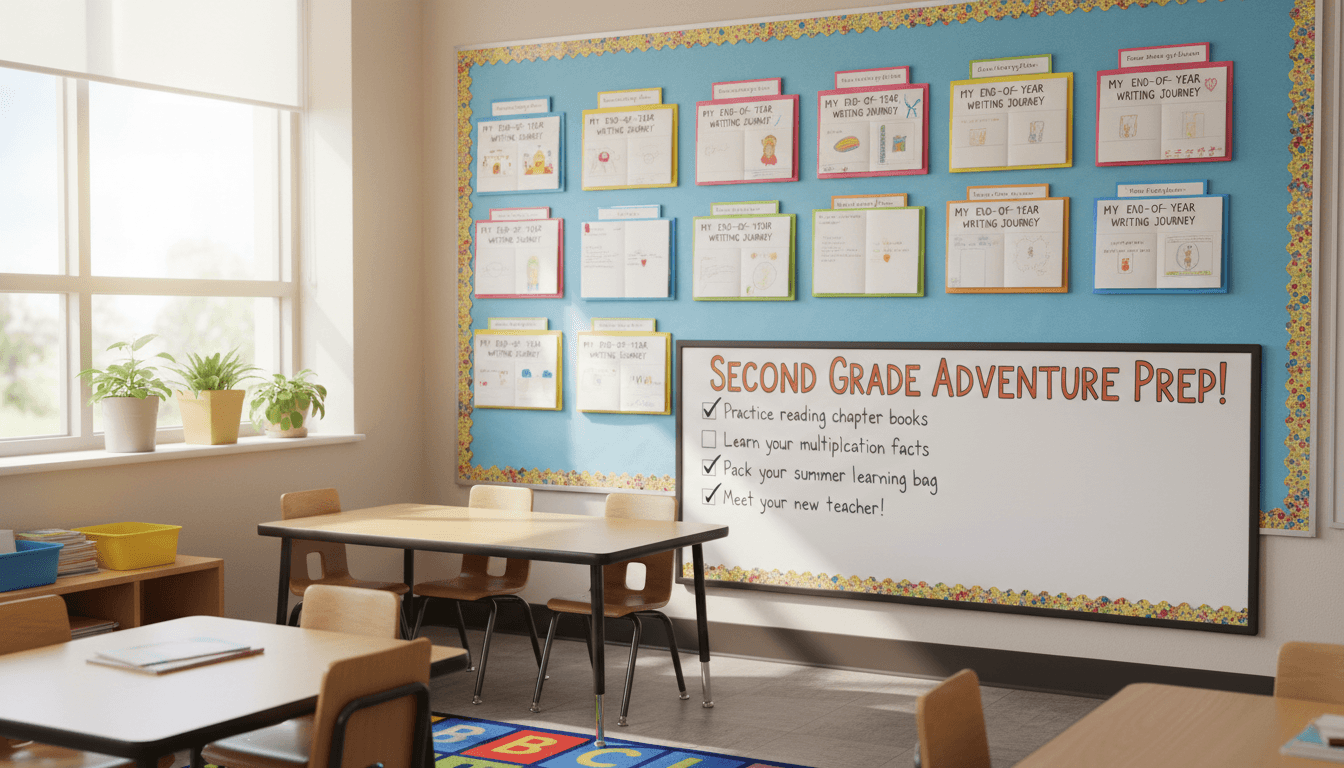
Second grade is a significant step up from first. Students are expected to read longer texts with chapter structures and answer comprehension questions with written evidence. Writing moves from sentences to multi-paragraph responses with a clear topic, supporting details, and a conclusion. Math covers place value to 100, measurement with standard units, and early fraction concepts.
The social pace also shifts. Second grade transitions between activities more quickly and expects students to work independently for longer stretches. A brief heads-up in the May newsletter gives parents a chance to talk with their child about what is coming rather than being surprised by it in September.
Include field day details
Field day is a highlight of May for first graders. Give parents the date, schedule, what to wear, whether sunscreen and a refillable water bottle are needed, and whether parents can join as spectators or volunteers. Clear logistics communicated in advance eliminate the day-before scramble and make the event go smoothly for students and families alike.
Give summer reading suggestions
A short summer reading section in the May newsletter is one of the most useful things you can include. Give parents five to eight book titles at the right level for first graders moving into second grade: Mo Willems' Elephant and Piggie series for building fluency with dialogue, the Frog and Toad series for early chapter book stamina, the Magic Tree House series as a stretch goal, or any Scholastic Level 2 or 3 reader.
The key message for parents: twenty minutes of reading every day through the summer maintains fluency and closes gaps. Two or three times a week is the minimum to avoid summer slide. Children who arrive in second grade having read all summer start the year ahead of where they ended first grade.
Suggest summer math habits
Reading gets most of the attention in summer learning conversations, but math skills also fade without practice. Suggest low-effort habits: counting change at the store, reading recipe measurements while cooking, practicing addition and subtraction facts as a quick game in the car, or measuring things around the house with a ruler. These activities take minutes and keep the mental math circuits active.
Close with a warm, specific ending
End the newsletter with a genuine acknowledgment of the year. Name something specific about this class: what made them memorable, what they worked hard on, what you will remember. Parents keep end-of-year newsletters in a way they do not keep October newsletters. A specific, warm closing reflects the care that went into the whole year.
Daystage makes it easy to send a May first grade newsletter that covers milestones, second grade transition, field day, and summer reading in one clean, readable message that parents save rather than delete.
Get one newsletter idea every week.
Free. For teachers. No spam.
Frequently asked questions
What should a first grade May newsletter cover that other months skip?
May is the month for transition communication. First grade parents need to understand what second grade will require academically and what they can do over the summer to prepare their child. They also want to celebrate the progress made over the year. A May newsletter that does both, acknowledges the year's milestones and gives families a clear roadmap for the summer and into second grade, is one of the most valuable communications you send all year.
How should the May newsletter handle the first grade end-of-year reading benchmark?
Be specific. Tell parents what the end-of-year reading benchmark is for first grade, where most students in the class are, and what it means. If the benchmark is reading at a level J or K independently, explain what that looks like: a student who can read an early chapter book with fewer than five errors per page and retell the story with key details. Parents who understand the target can support summer reading with the right kinds of books.
What second grade transition information should appear in the May first grade newsletter?
Give parents a clear picture of what second grade expects. Second graders are expected to read longer books with chapter structures, write multi-paragraph responses with a main idea and supporting details, and handle math concepts like place value to 100, measurement, and early fractions. The social expectation is also higher: second grade moves faster and requires more independent work stamina. Parents who know this can frame the summer's practice accordingly.
Should the May newsletter include a summer reading list?
Yes, even a short one is valuable. Give parents five to eight book titles at the reading level their child is at or slightly above, including a mix of fiction and nonfiction. The goal over the summer is to maintain fluency and comprehension, not accelerate far beyond grade level. A child who reads independently every day for twenty minutes through the summer arrives in second grade in much stronger shape than a child who reads twice in three months.
What newsletter tool works best for first grade teachers?
Daystage is built for teachers who want to send a complete end-of-year newsletter covering reading benchmarks, second grade transition, and summer suggestions in one clean message. The platform handles text, images, and links without formatting work. Most teachers write their Daystage newsletter in about fifteen minutes, and parents receive something readable rather than a text-heavy email they skip.

Adi Ackerman
Author
Adi Ackerman is a former classroom teacher and curriculum writer with 8 years in K-8 schools. She writes about school communication, parent engagement, and what actually works in real classrooms.
More for Classroom Teachers
Ready to send your first newsletter?
3 newsletters free. No credit card. First one ready in under 5 minutes.
Get started free