
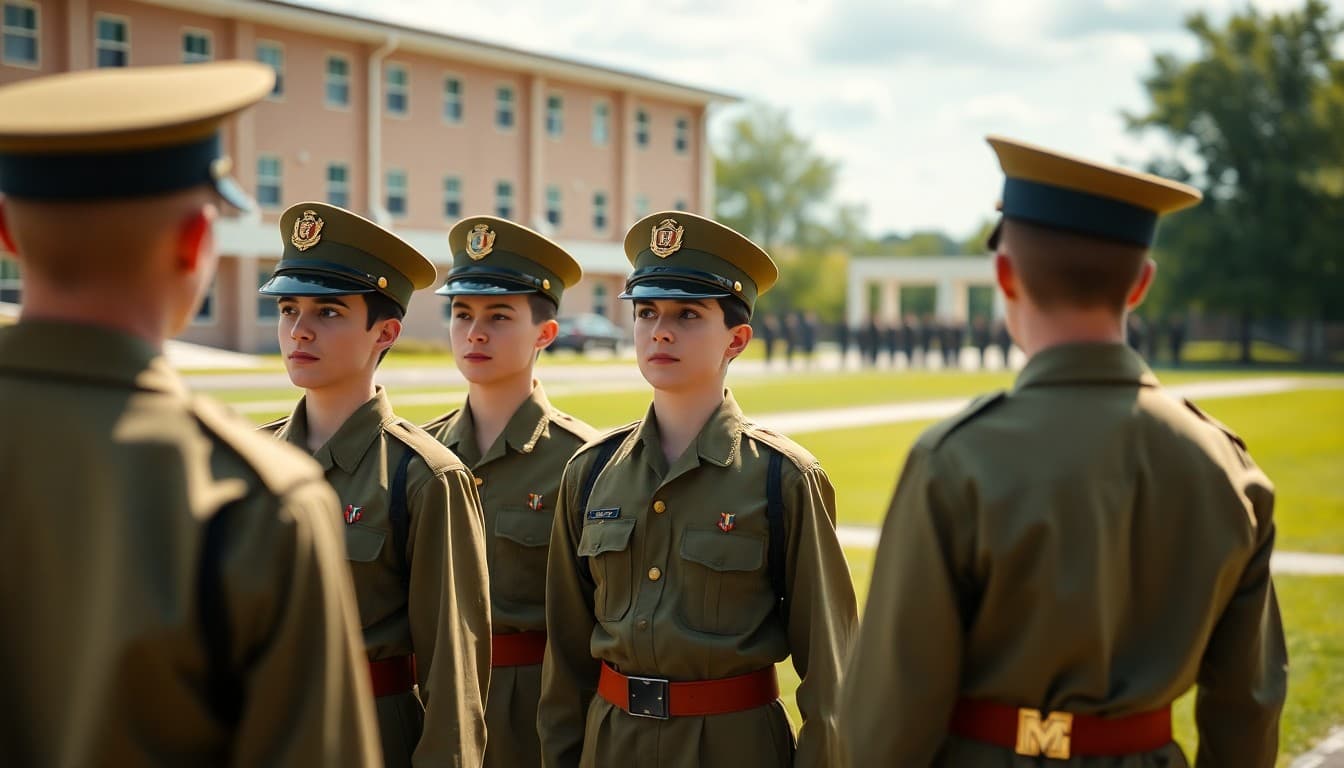
Military School Newsletter: Discipline and Achievement Communication

Military school families made a deliberate choice for structure, discipline, and leadership development. They enrolled their child because they believe in the formation that a military school provides, and they expect the school's communication to reflect that formation in its own discipline and precision. A military school newsletter that is vague, inconsistently published, or light on substance sends a signal that contradicts the school's identity. A newsletter that is specific, well-organized, and consistently delivered reinforces it.
Report on Leadership Development Specifically
Leadership development is the central promise of military education. Your newsletter should report on it in specific, observable terms. What leadership responsibilities did students take on this month? What decisions did they make? What challenges did they navigate? "Cadet Second Lieutenant Marcus Wilson commanded a platoon of 22 cadets during October's field exercise. He was responsible for navigation, communication with the battalion commander, and maintaining the unit's timeline over four hours of terrain navigation. He made two significant decisions under time pressure that required departing from the original plan and he will debrief those decisions formally next week." That report shows a specific student doing a specific leadership task with real stakes.
Explain the Rank Advancement System
Families who did not attend a military school may not understand what ranks mean or what advancement requires. A brief explanation at the start of the year, and a quick reference in each newsletter when advancements are announced, gives all families a common framework. Here is a compact format:
Rank Advancement: October
Promoted to Corporal: [Name], [previous rank]. Requirements met: [List of what was required: physical fitness score, academic standing, leadership evaluation].
Promoted to Sergeant: [Name]. Requirements met: [List].
Why rank matters: Rank advancement in our JROTC program reflects a combination of physical performance, academic standing, and demonstrated leadership. No student advances without meeting requirements in all three areas.
Cover the Academic Program Alongside the Military Program
Families chose a military school, but they are also paying for an academic education. Your newsletter should cover both with equal depth. Academic content that only appears when there is a problem signals that academics are secondary. Academic content that appears every month alongside military program news signals that the school takes both seriously. A section reporting on what students are studying in the core academic subjects, with the same specificity you bring to military program coverage, demonstrates the integrated educational seriousness that distinguishes a good military school from a purely disciplinary environment.
Communicate the Honor Code and Conduct System
Military schools operate under explicit codes of conduct that are educational in themselves. Your newsletter should explain the honor code and conduct system at the program level at least once per year and reference specific aspects of it when they are relevant. "Our honor code has three provisions: I will not lie, I will not steal, and I will not tolerate those who do. These are not school rules. They are the foundation of the trust that makes military service possible. Every cadet signs the honor code at enrollment and reviews it at the start of each semester." Families who understand the honor code understand the school's character formation philosophy.
Report on Physical Fitness and Athletics With Specifics
Physical development is a core part of military school education. Cover it with the same specificity you bring to academic or JROTC coverage. Share fitness assessment results in aggregate form, cover athletic competitions with depth rather than just scores, and report on physical training milestones. "Our battalion ran its semi-annual physical fitness assessment this month. Fifty-two percent of cadets improved their score from the spring assessment. Eight cadets achieved the maximum score in all events. Our average score improved by 4.2 points across the battalion."
Highlight Community and Service
Military tradition includes a strong ethic of service, and military schools typically require community service as part of cadet development. Cover service initiatives with specificity: what cadets did, who they served, and what the experience required of them that was different from classroom learning. "Cadets from Charlie Company spent Saturday at the Veterans Memorial, greeting families during the annual Veterans Day ceremony and providing honor guard service. For the 11 cadets who participated, standing at attention for two hours in cold weather while families expressed grief and gratitude was described as the most meaningful hour of their semester."
Communicate Upcoming Events and Family Weekends Precisely
Military school communication should match the school's culture: precise, well-organized, and complete. When publishing event information, include every logistical detail families need. Date, time, formation or ceremony location, dress expectations for cadets, dress expectations for families attending, parking instructions, and the name of the point of contact for questions. A family who arrives underprepared for a formal review experienced the school as disorganized. Clear, complete event communication is itself a form of institutional discipline.
Get one newsletter idea every week.
Free. For teachers. No spam.
Frequently asked questions
What do military school families specifically want to see in a newsletter?
They want evidence that the structured environment is producing the leadership development, character growth, and academic progress they enrolled their child for. Military school families made a deliberate choice for structure and discipline. Your newsletter should show how that structure is working in specific, concrete terms: rank advancement, leadership responsibilities taken on, character challenges navigated, and academic outcomes alongside the military program.
How do we communicate about discipline and consequences in the newsletter?
Cover the discipline system at a program level rather than discussing individual students. Explain what the school's conduct framework involves, how it is applied, and what the educational intent behind consequences is. Families who understand the system trust it more than families who only hear about it when their child is involved. A newsletter explanation of the honor code or conduct standards demonstrates that the school is transparent about how it operates.
How do we write about JROTC programming for families who are not military-connected?
Translate military terminology and explain what JROTC teaches in terms of civilian-applicable outcomes. 'Cadets completed land navigation this month, learning to read topographic maps and use compass bearings to identify locations. These skills develop spatial reasoning, precision, and the ability to execute a plan under time pressure, which are valuable regardless of whether a student ultimately pursues military service.' That framing works for military-connected families and civilian families equally.
How do we communicate rank advancement and military milestones?
Announce rank advancements with specificity: the student's name, previous rank, new rank, and one sentence about what the advancement reflects. 'Cadet Elena Park was promoted to Sergeant First Class this month after demonstrating consistent leadership in her platoon and earning the academic excellence ribbon for the second consecutive semester.' That recognition honors the student, explains what the rank means, and shows civilian families how the military structure recognizes achievement.
Can Daystage support a military school's newsletter with the formality and consistency the school's culture requires?
Yes. Daystage lets you build a newsletter template with a consistent, formal structure that matches the institutional presentation military school families expect. You can schedule newsletters to publish on a predictable cadence, which aligns with the structure-oriented culture of the school. The platform's open-rate tracking also helps you understand which communications are reaching families who may be geographically dispersed if the school has a boarding population.

Adi Ackerman
Author
Adi Ackerman is a former classroom teacher and curriculum writer with 8 years in K-8 schools. She writes about school communication, parent engagement, and what actually works in real classrooms.
More for Private & Charter
Ready to send your first newsletter?
3 newsletters free. No credit card. First one ready in under 5 minutes.
Get started free