
Halloween School Newsletter Template: Inclusive Communication for All Families
Halloween is one of the most communication-intensive school days of the year. Costumes, parties, candy, food allergies, and families with different relationships to the holiday all require a thoughtful newsletter. Get this communication right and the day runs smoothly. Skip it and you will be answering individual questions until October 31.
This template covers the logistics, the inclusive framing, and the exact information your Halloween newsletter needs to include.
When to send
Send your Halloween newsletter two weeks before October 31. Families need time to arrange costumes, prepare treats if they are sending any, and make sure their child knows the school's costume guidelines. A newsletter that arrives October 28 is not useful for the families who need it most.
Addressing different family relationships to Halloween
Some families celebrate Halloween enthusiastically. Others, for religious, cultural, or personal reasons, do not. A school newsletter that acknowledges both groups without singling anyone out is more effective than one that assumes universal enthusiasm.
Practical ways to handle this: frame the day around a fall celebration that includes Halloween elements rather than centering the holiday itself. Use "fall celebration" or "costume day" alongside "Halloween" so families who prefer that framing feel included. If your school offers an alternative activity for students who are not participating in Halloween traditions, mention it matter-of-factly without drawing extra attention to it.
What to include in your newsletter
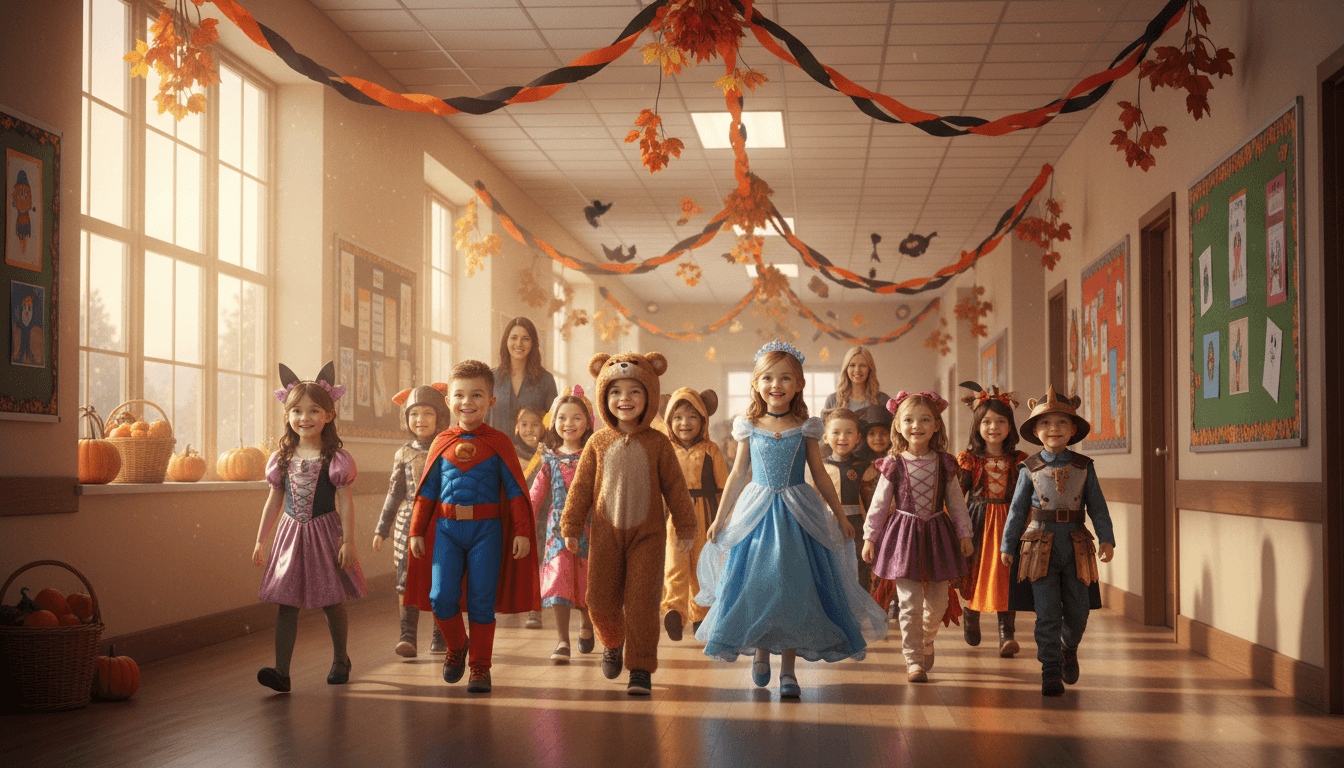
Costume policy. This is the number one thing families need to know. What is allowed? What is not? Common school policies: no weapons, real or toy. No masks that cover the face completely. No costumes that are scary, violent, or culturally appropriative. No costumes that restrict movement or are difficult to manage in a classroom. Be specific. "Age-appropriate costumes only" is not a policy; it is a request for interpretation.
What if a student is not wearing a costume? Make clear that costume participation is not required. Students who do not wear a costume should not feel out of place. A simple note: "Students who are not wearing a costume are welcome to come dressed in their school clothes as usual. There is no requirement to participate in costume day."
Party details. Date, time, what is planned, whether there is a parade or costume walk, and whether parent volunteers are invited. Families with flexible schedules may want to come. Give them enough notice to decide.
Food allergy guidelines. If treats are being distributed, specify your classroom allergy policy. Store-packaged items with visible ingredient lists are safer than homemade treats for classrooms with allergy restrictions. If your school participates in the Teal Pumpkin Project (non-food items alongside candy), mention that.
Classroom logistics for costume day. Can students arrive in costume or should they change at school? Where should they leave their regular clothes? Will costumes interfere with PE or other activities that require specific clothing?
Candy and treats policy. How much candy is coming home? Are there guidelines about how treats are distributed? Some schools collect treats and send them home at dismissal. Others allow eating during the party. Families who monitor sugar intake or have specific food rules want to know what to expect.
Sample newsletter copy
Subject line: Costume day and fall celebration. October 31 details
Opening: "Our fall celebration and costume day is coming up on October 31. Here is everything you need to know to help your child prepare."
Costume guidelines: "Students are welcome to wear a costume to school. Please make sure costumes follow these guidelines: no weapons of any kind (toy or real), no full-face masks, no costumes that reference violence, and nothing that needs to be managed during class time. Students who are not wearing a costume are completely welcome in their regular school clothes."
The celebration: "We will be celebrating from [time] to [time]. Our class will have a costume parade through the hallway at [time], followed by our classroom party. If you would like to volunteer to help at the party, please email me by [date]."
Treats: "If you would like to send a treat for the class, please send store-packaged items with visible ingredient lists. Our classroom is nut-free. Please no homemade treats. All treats will be sent home with students after the party."
What to avoid
- Sending the newsletter the week of Halloween when families cannot act on it
- Vague costume policies that require interpretation
- Forgetting to address students who will not be wearing costumes
- Leaving food allergy information out of a party communication
- Not specifying whether treats go home or are consumed at school
- Using language that makes opt-out students feel left out
Using Daystage for October newsletters
October newsletters tend to be some of the highest-opens of the year because families are eagerly reading about fall events and celebrations. Daystage lets you see that engagement data directly. If you notice a cluster of families who have not opened the Halloween newsletter by October 25, you know who might need a personal follow-up before the day arrives. That kind of targeting is not possible with a mass BCC email.
Communication that makes the day work
Halloween is one of those days where every minute of the day you did not spend communicating clearly beforehand becomes a problem to manage on the actual day. A well-written newsletter two weeks out handles the costume question, the allergy question, the volunteer question, and the opt-out question before any of them arrive as an email at 8 PM on October 30. Put the work in early and the day takes care of itself.
Get one newsletter idea every week.
Free. For teachers. No spam.
Frequently asked questions
When should schools send a Halloween newsletter template?
Send it at least one week before October 31. Families preparing costumes or treats need enough notice, and families who do not celebrate Halloween need to know what alternatives you are offering so they can make an informed decision.
What should a Halloween school newsletter template include?
Cover what the school day will look like, whether costumes are allowed and any restrictions, what classroom activities are planned, alternatives for families who opt out, and any food allergy guidelines for treats. Inclusive framing keeps all families informed without singling anyone out.
How should teachers customize a Halloween newsletter template?
Adjust the costume guidelines section to match your school's actual policy, and replace generic activity descriptions with your specific classroom plan. If you are doing a fall-themed celebration instead of a Halloween party, name it clearly so families set the right expectations.
What makes a school newsletter template ineffective for Halloween communication?
Ignoring families who do not celebrate Halloween is the most avoidable problem. A newsletter that only addresses costume details without acknowledging that some students will not participate puts those families in an awkward position and generates individual questions.
Where can teachers find a good Halloween school newsletter template?
Daystage has Halloween newsletter templates with inclusive language that addresses both participating and non-participating families, plus logistics sections for costume policies and classroom activities.

Adi Ackerman
Author
Adi Ackerman is a former classroom teacher and curriculum writer with 8 years in K-8 schools. She writes about school communication, parent engagement, and what actually works in real classrooms.
More for Templates
December Newsletter Template for Teachers: Holiday Season, Winter Break, and Year Reflections
Templates · 7 min read
Lunar New Year School Newsletter Template: How to Celebrate the Holiday in Your Classroom Communication
Templates · 6 min read
Read Across America Day Newsletter Template: How to Get Families Reading Before and After March 2
Templates · 6 min read
Ready to send your first newsletter?
3 newsletters free. No credit card. First one ready in under 5 minutes.
Get started free