
Student Newspaper vs. Student Newsletter: What Is the Difference and Which Should Your School Use?
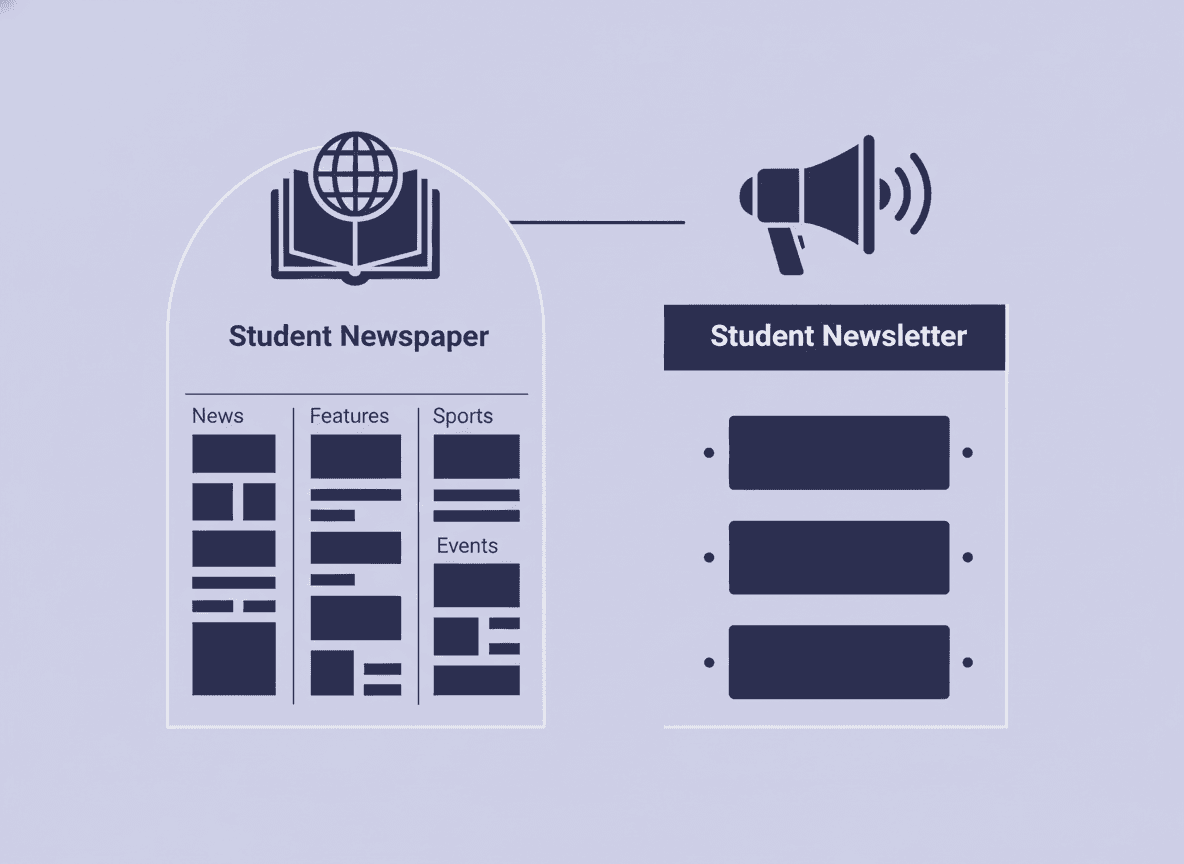
Teachers and advisors trying to start a student publication often face the same question early on: should we start a student newspaper, or would a student newsletter serve us better? The terms are sometimes used interchangeably, but they refer to different things, with different purposes, different resources required, and different relationships to the school community.
Getting this choice right at the start saves significant time and frustration later. Here is what you need to know.
What is a student newspaper?
A student newspaper is a journalism publication. Its purpose is to inform the school community through reporting: news stories, features, opinion pieces, investigative reporting, and editorial content. The journalism tradition places the student newspaper at arm's length from school administration. The best student newspapers operate with editorial independence, meaning student editors make publication decisions rather than administrators approving content.
Student newspapers typically publish on a schedule tied to production cycles: weekly, biweekly, or monthly. They require a dedicated staff with distinct roles: editors, reporters, photographers, layout designers, and a faculty advisor. They have a style guide, an editorial process, and often a structure modeled on professional journalism.
Student newspapers are vehicles for student voice. They report on what matters to students, including stories that might not always be comfortable for the administration to see covered. That tension is, in journalism traditions, a feature rather than a bug.
What is a student newsletter?
A student newsletter is a community communication tool. Its purpose is to share information about the school with families, classmates, and the broader school community. It celebrates events, highlights student work, shares upcoming dates, and keeps the community connected.
Student newsletters are typically produced on behalf of the school or a class rather than as an independent journalistic enterprise. A class newsletter might be produced by student reporters but reviewed by the teacher before publication. A school-wide student newsletter might be student-produced but follows the school's communication guidelines.
The audience for a student newsletter is broader than just the school community. Many classroom newsletters go home to parents. Many school-wide newsletters are distributed to families across grade levels. This broader audience shapes what kind of content is appropriate.
The key differences side by side
Purpose is the clearest distinction. A student newspaper's purpose is journalism. A student newsletter's purpose is community communication. Everything else flows from this.
Editorial independence works differently in each format. Student newspapers at their best have editorial independence from school administration. Student newsletters, particularly those that go to families, typically operate with teacher or administrator oversight.
Content types differ. A student newspaper includes news reporting, investigation, opinion, and editorial. A student newsletter includes event coverage, student spotlights, calendar updates, classroom highlights, and community news.
Resources required differ. A student newspaper requires students with journalism skills or training, time for reporting and editing, and often a faculty advisor with journalism background. A student newsletter requires students who are organized and can write clearly, a teacher to guide the process, and a publishing tool.
Publication frequency differs. Student newspapers typically publish on a fixed schedule with a longer production cycle. Student newsletters can be published more frequently and often have a shorter production timeline.
Which is right for your school?
Start with the question of purpose. What does your school actually need?
If the goal is to develop student journalism skills, foster independent student voice, and create a forum for school news and opinion, a student newspaper is the right format. This works best at the middle school and high school level, where students have the developmental maturity for the editorial complexity of journalism and where a journalism or media literacy curriculum can support the work.
If the goal is to connect the school community, share student work with families, keep parents informed about classroom learning, and give students experience with writing and communication, a student newsletter is the right format. This works at all grade levels, including elementary school, and requires significantly less infrastructure than a newspaper.
Resource constraints are a practical reality. A student newspaper requires substantial ongoing investment from a knowledgeable advisor. A student newsletter can be started by any classroom teacher with a good communication tool and a few motivated students.
Can a school have both?
Yes, and many schools do. A classroom or school-wide student newsletter handles regular community communication. A student newspaper, if the school has the capacity, handles journalism and independent student voice. These serve different audiences and different purposes and do not need to compete.
The newsletter keeps families informed. The newspaper keeps the school community engaged in discussion and accountability. Both build student skills, but different skills.
Starting small and building
Most schools are better served by starting with a student newsletter rather than trying to launch a full student newspaper from scratch. The newsletter requires less infrastructure, produces immediate community value, and lets students develop writing and communication skills before taking on the more complex demands of journalism.
A student newsletter that runs successfully for a year builds the organizational infrastructure, the student experience, and the community appetite that can support a student newspaper later.
How Daystage supports student-produced newsletters
Daystage is well-suited for student-led newsletter programs. The block-based editor is straightforward enough for student reporters to use without extensive training. Students write their sections in the block editor, the teacher advisor reviews and approves, and the newsletter is sent from the school's branded account.
The structured format helps students focus on writing quality rather than design decisions. The subscriber management handles the distribution to family audiences. Analytics show students whether families are reading what they produced, which is genuinely motivating feedback for young writers.
The right format serves the right goal
Neither a newspaper nor a newsletter is inherently better. They are different tools for different purposes. Be clear about what your school needs, what resources you have, and what skills you want to develop in students. Start with that, and choose the format that fits.
Get one newsletter idea every week.
Free. For teachers. No spam.
Frequently asked questions
When should a school choose a student newsletter instead of a student newspaper?
Choose a newsletter when you want consistent, predictable communication with families on a weekly or biweekly basis. Choose a newspaper when the goal is investigative or long-form journalism with less frequent publication.
What is the key difference between a student newspaper and a student newsletter?
A newspaper is built around editorial independence and public accountability journalism. A newsletter is built around community communication and connection. Both can involve student writers, but they serve different goals and require different structures.
How should schools decide which format fits their goals?
Ask what problem you are trying to solve. If the problem is that families do not know what is happening at school, a newsletter solves it. If the problem is that student voice and investigative reporting are absent from the school culture, a newspaper addresses that.
What mistakes do schools make when choosing between a newspaper and a newsletter?
Trying to make one publication do both jobs produces something that does neither well. A newsletter with editorial independence claims and a newspaper with a consistent weekly family update frequency will both underperform.
How does Daystage support student-produced newsletters specifically?
Daystage is built for consistent, community-facing communication, which makes it a strong fit for student newsletter programs that publish regularly to family audiences rather than investigative newspapers that publish when stories are ready.

Adi Ackerman
Author
Adi Ackerman is a former classroom teacher and curriculum writer with 8 years in K-8 schools. She writes about school communication, parent engagement, and what actually works in real classrooms.
More for Student-Led
Using the School Newsletter to Launch and Promote a Student Podcast
Student-Led · 5 min read
Student Journalism in Elementary School: Starting a Newsletter with Young Reporters
Student-Led · 6 min read
Student-Led Peer Recognition Newsletter: How Students Spotlight Fellow Students
Student-Led · 5 min read
Ready to send your first newsletter?
3 newsletters free. No credit card. First one ready in under 5 minutes.
Get started free