
How to Run a Class Newsletter with Student Reporters

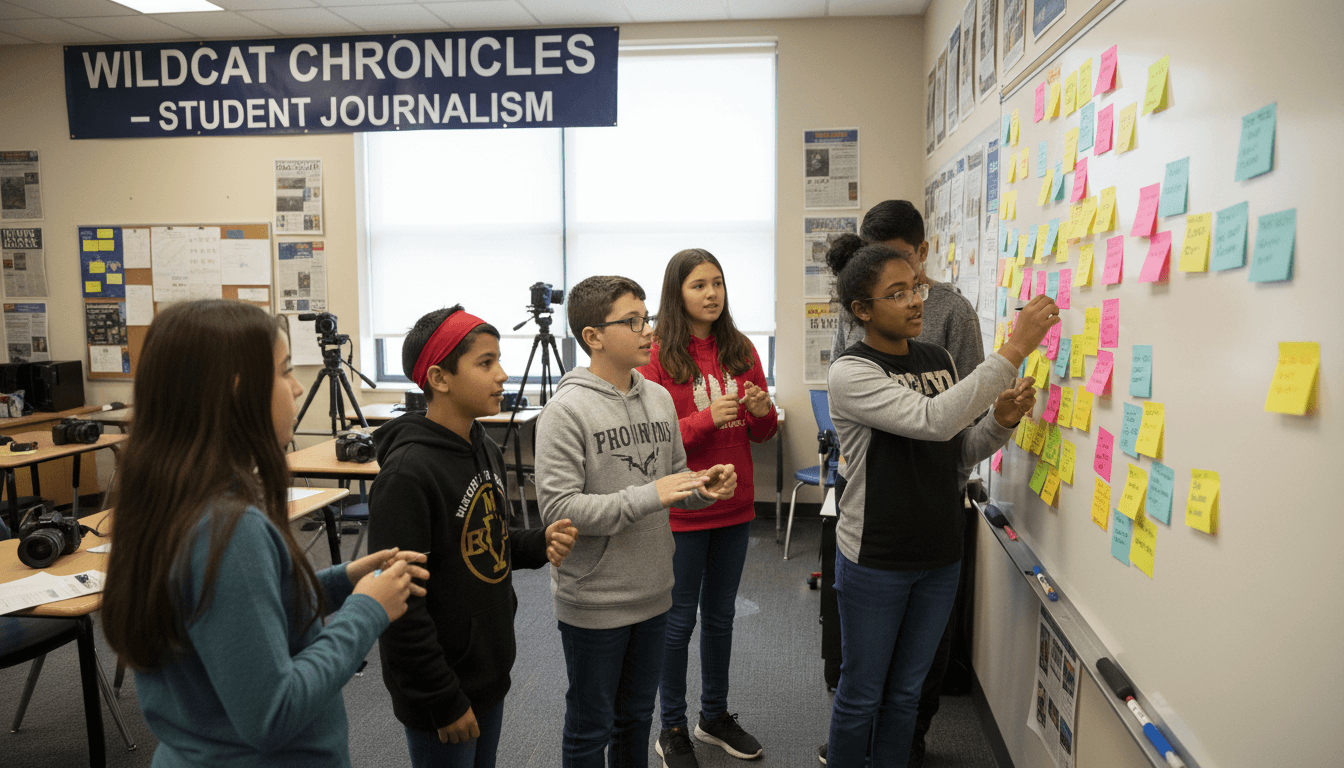
The editorial meeting is the moment a student newsletter project becomes real. Students sit down not to receive an assignment from a teacher, but to decide together what the newsletter will cover. That shift in ownership is what makes the project work.
Here is how to structure the classroom logistics so that the editorial meeting, the reporting, and the publication cycle can happen without requiring the teacher to manage every step.
Setting Up Beats
Beats are the foundation of a student newsletter operation. Each reporter owns a topic area and is responsible for finding stories in it each cycle.
Elementary beat options: classroom news, school events, sports and PE, arts and music, community/service, fun facts or science.
Middle school beat options: academics, athletics, arts, student life, administration and policy, community service, student opinion.
Assign beats for six to eight weeks at a time, then rotate. Students who hold a beat for a full term develop real expertise in their area and start finding stories proactively instead of waiting to be assigned one.
The Editorial Meeting
The editorial meeting happens once per newsletter cycle, typically 20-30 minutes. The lead editor runs it with teacher support available.
Agenda:
- Each beat reporter pitches one or two story ideas from their area.
- The group briefly discusses each pitch: is it newsworthy? Do readers care? Is it doable in this cycle?
- Stories are approved or deferred.
- Assignments are confirmed and deadlines stated explicitly.
The teacher's role in this meeting is to ask questions the student editors have not thought to ask: "Who would you interview for that?" "How do you know that number is accurate?" "How is this different from the story we ran two weeks ago?" Not to veto stories, to push the editorial thinking further.
The Reporting Window
Give reporters two to four class days to do their reporting and write their first draft. This is the period when classroom management matters most.
Reporters need: time to do interviews (which may mean brief absence from the classroom to find sources), access to whatever database or archive they need for factual claims, and enough quiet time to actually write.
Stagger interview permissions: no more than two reporters out of the room at once. Keep a sign-out board. Reporters who are not out interviewing are writing, not waiting. The expectation is that quiet time in the classroom is drafting time, not phone time.
The Draft Review
When drafts come in, the lead editor reviews them first with a specific checklist:
- Does the first sentence tell you what the story is about?
- Are all names spelled correctly?
- Is every factual claim accurate and sourced?
- Is there at least one direct quote?
- Is the length appropriate (not too short to be useful, not so long it will be skipped)?
The editor returns stories that fail the checklist to the reporter with a note, not a rewrite. "The first sentence is just context. What is the actual news?" The reporter makes the fix. The editor re-reviews.
The teacher reviews the final round of drafts before publication. Anything that requires more work than the cycle allows gets held for the next issue. Publish what is ready. A newsletter with four strong stories is better than one with six uneven ones.
When a Story Is Not Ready
Every newsletter cycle, at least one story will not be ready on deadline. The editorial response matters: hold the story, fill the space, and have a clear conversation with the reporter about what happened.
The goal is not punishment. It is a real-world lesson: in professional publishing, stories that are not ready do not get published. The reporter learns to protect more time, to ask for help sooner, to communicate earlier if they are stuck. A missed deadline in a student newsletter is a much safer place to learn this than a job.
Keeping It Going
Student newsletter projects fade mid-year when the initial excitement wears off and the cycle starts to feel like a grind. A few practices that sustain momentum:
- Share audience response in class. Every positive comment from a reader goes to the reporter who wrote the piece. Real feedback from real readers is the most powerful motivator there is.
- Hold a mid-year editorial retrospective. Pull up three past issues together and ask: what are we proud of? What would we do differently? What have we gotten better at? Looking at the work as a body of work changes how students see the project.
- Introduce a new format element mid-year, a Q&A interview, a photo essay, a data visualization, a student editorial, to refresh the product and give students new skills to practice.
Get one newsletter idea every week.
Free. For teachers. No spam.
Frequently asked questions
When should teachers introduce student reporter roles in a class newsletter?
Introduce beats and reporter roles after the class has published two or three newsletters together as a group. Students need to see the full cycle before taking ownership of individual sections.
What should student reporters cover in a class newsletter?
Assign beats based on recurring class content: a classroom news reporter, a learning update writer, an events previewer, and a question-of-the-week interviewer. Defined beats give students a clear scope and reduce overlap.
How should teachers run editorial meetings for a student-reporter newsletter?
Keep editorial meetings short, 10 to 15 minutes, with a clear agenda. Students should arrive knowing their beat and having at least one story idea. The meeting is for selecting and assigning, not for brainstorming from scratch.
What mistakes do teachers make when running a student reporter system?
Allowing the same students to dominate the same beats every issue limits both skill-building and participation. Rotate beats on a four to six week cycle so every student writes in different formats and covers different content.
How does Daystage support student reporter workflows?
Teachers use Daystage to give each student reporter a section to contribute to, then review and publish the combined newsletter without requiring students to work in a separate editing tool, which keeps the workflow accessible at any grade level.

Adi Ackerman
Author
Adi Ackerman is a former classroom teacher and curriculum writer with 8 years in K-8 schools. She writes about school communication, parent engagement, and what actually works in real classrooms.
More for Student-Led
Student Newsletter Headline Writing Guide: How Student Journalists Write Headlines That Get Read
Student-Led · 5 min read
Student-Run School Store Newsletter: How Student Managers Communicate Operations and Sales
Student-Led · 5 min read
Student-Led Community Service Reporting Newsletter: How Student Journalists Cover Service and Volunteering
Student-Led · 5 min read
Ready to send your first newsletter?
3 newsletters free. No credit card. First one ready in under 5 minutes.
Get started free