

Third Grade Science Newsletter: Sections That Get Read
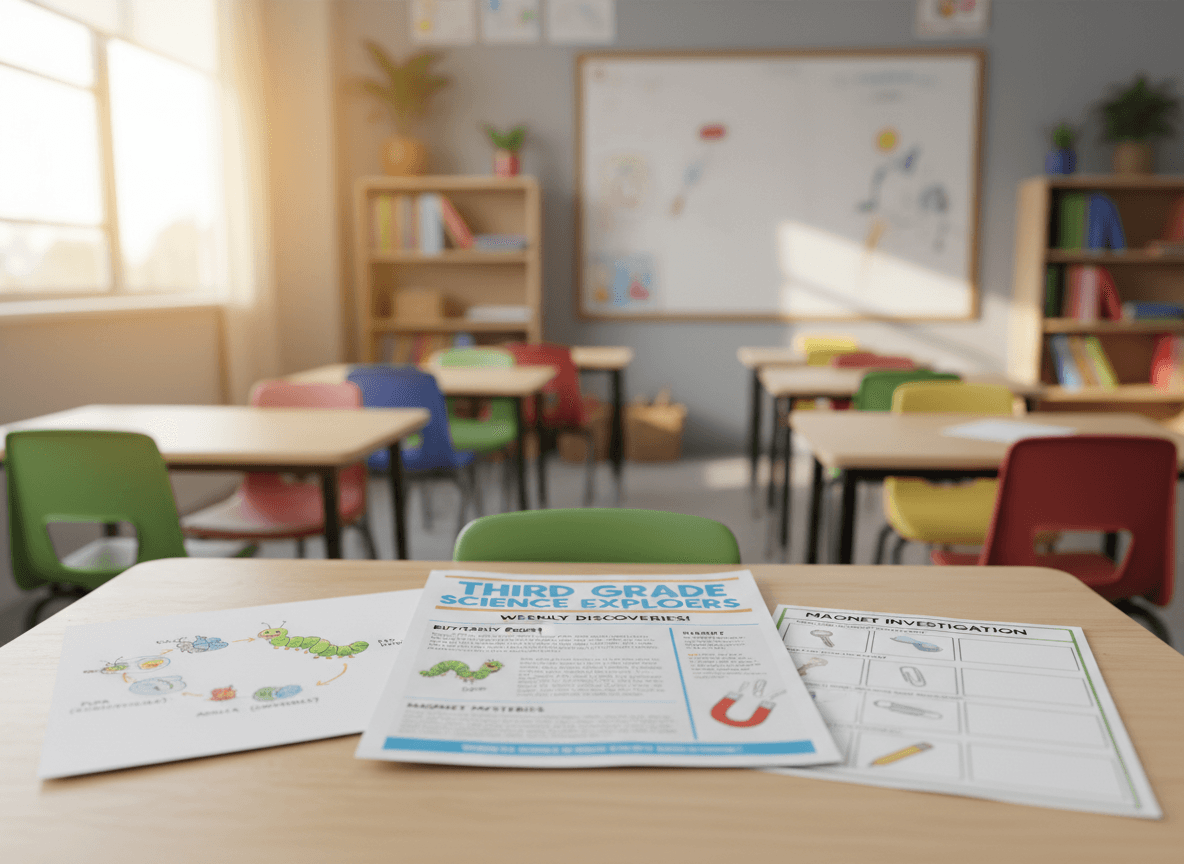
Third grade is where science starts to look like science. Students run their first controlled tests, draw labeled diagrams, and argue about why a magnet stuck to one cabinet door but not the other. Your newsletter is the bridge between what they did at school and what they can talk about at dinner. Five sections, written for a parent reading on a phone between dishes and bedtime.
Section 1: What we investigated
Two sentences. The question students answered, and one specific moment. "This week we tested which materials magnets pull through. Most of the class was surprised that magnets work through water and cardboard but not through aluminum foil." That is the section. Specific enough that a parent can ask "tell me about the aluminum foil." For a properties unit, the same shape works. "We tested 8 objects to see which would float in a tub of water. The cork floated, the penny sank, the bar of soap surprised half the class by sinking after one minute." Name the object, name the surprise. A. argued for ten minutes that the soap was floating, just slowly. That is the moment that ends up at the dinner table.
Section 2: Vocabulary we are using
Three to five words. Plain definitions tied to what students are doing. For a life cycle unit: "Larva (the second stage, like a caterpillar), Pupa (the stage inside the chrysalis), Metamorphosis (a big change in shape during a life cycle)." Parents who see these words at home start using them, which doubles the instructional time.
Section 3: Photo of the week
One real image. Student work, a magnet investigation in progress, or a chrysalis on its tank lid. Not a stock photo. Real classroom photos signal real learning. Parents respond to them and forward them to grandparents, which extends your reach for free.
Section 4: Ask at home
One question. Not five. "Ask your student to explain how a magnet works and why it does not stick to a soda can." Three things happen. The parent learns what was taught. The student gets to teach, which cements the concept. Gaps surface. If the student cannot answer, the parent emails you, which is exactly what you want. For the life cycle unit, the question gets concrete. "Ask your student to name the four butterfly stages in order and tell you what is happening in each one." Or "Look in the freezer with your student. Find one frozen food and ask if it is a solid, liquid, or gas, and why." Specific questions get specific answers. Three sentences from a third grader at the dinner table is the win.
Section 5: Coming up
Two or three lines. Field trip dates, supply requests, permission slips. Same place every issue, so parents learn to scan it. Predictable location beats fancy formatting every time. Put the dates in this order every issue: field trip date, then supply ask, then permission slip due date. By issue three, parents know exactly where to look.
Template excerpt: a real third grade butterfly unit issue
Here is what the template looks like in the third week of a butterfly life cycle unit:
What we investigated: Our caterpillars formed chrysalises this week. Students drew labeled diagrams of each stage so far and predicted how many days until the butterflies emerge. The class average prediction was 11 days.
Vocabulary: Chrysalis (the stage where the caterpillar is changing inside a hard shell), Metamorphosis (a big change in shape), Adult (the final life cycle stage).
Ask at home: Ask your student to name the four stages of a butterfly life cycle in order, and what is happening in each one.
Coming up: Butterfly release on Friday at 1pm. Families welcome to attend. Permission slip for the spring nature walk in folders.
Why this template works for third grade
Third grade parents want to know their child is doing real science, not coloring worksheets. Photos of actual investigations and student diagrams answer that question without you having to say it. The ask-at-home prompt does the heaviest lift. One specific question turns a passive newsletter into a conversation starter. Third grade is also the year traits and inheritance show up. A two-week unit on family traits, where each student charts eye color, attached earlobes, and hair texture across two generations at home, becomes a newsletter favorite. Parents reply with photos of their own grandparents. That is free engagement. It also surfaces real-world examples of dominant and recessive patterns without you assigning a worksheet.
How Daystage helps with third grade science newsletters
Daystage gives third grade teachers a five-section template ready to drop content into. You build it once at the start of the unit and duplicate every two weeks. The formatting stays clean every time. It sends as a real email to your class roster, parents do not need to download an app, and you can write the next issue from your phone while your students are at lunch.
Get one newsletter idea every week.
Free. For teachers. No spam.
Frequently asked questions
What science does third grade actually cover?
Third grade NGSS covers forces and motion (magnets, pushes and pulls), properties of materials (states of matter), and life cycles plus inherited traits. Most third grade teachers build the year around one big life cycle unit (butterflies, frogs, or plants from seed) because students remember it for the rest of elementary.
How often should I send a third grade science newsletter?
Every two weeks. Third grade science usually moves in two-week investigation cycles, so the cadence lines up naturally. Weekly is too much when students are doing the same observation routine. Monthly is too sparse during a quick magnet unit.
How do I write about an experiment without sounding like a procedure document?
Pick one student moment and describe it in two sentences. 'When we tested if magnets pull through water, Maya predicted no and was surprised when the paperclip moved. That led to a 10 minute conversation about magnetic fields.' That is what parents repeat at dinner. Procedures belong in your lesson plan, not your newsletter.
Should the newsletter include life cycle photos?
Yes, especially with butterflies or chicks. Parents and grandparents share life cycle photos more than any other classroom photo. Get a media release at the start of the year so you can include them without per-issue permission scrambles.
Does Daystage have a third grade science newsletter template?
Yes. Daystage gives third grade teachers a five-section template (what we investigated, vocabulary, photo, ask-at-home, coming up) that you duplicate every two weeks. It sends to your class roster as a real email and works from your phone if you are writing during a prep period.

Adi Ackerman
Author
Adi Ackerman is a former classroom teacher and curriculum writer with 8 years in K-8 schools. She writes about school communication, parent engagement, and what actually works in real classrooms.
More for Science Newsletter
Ready to send your first newsletter?
3 newsletters free. No credit card. First one ready in under 5 minutes.
Get started free