

Science Newsletter for State Test Prep: What to Include Now
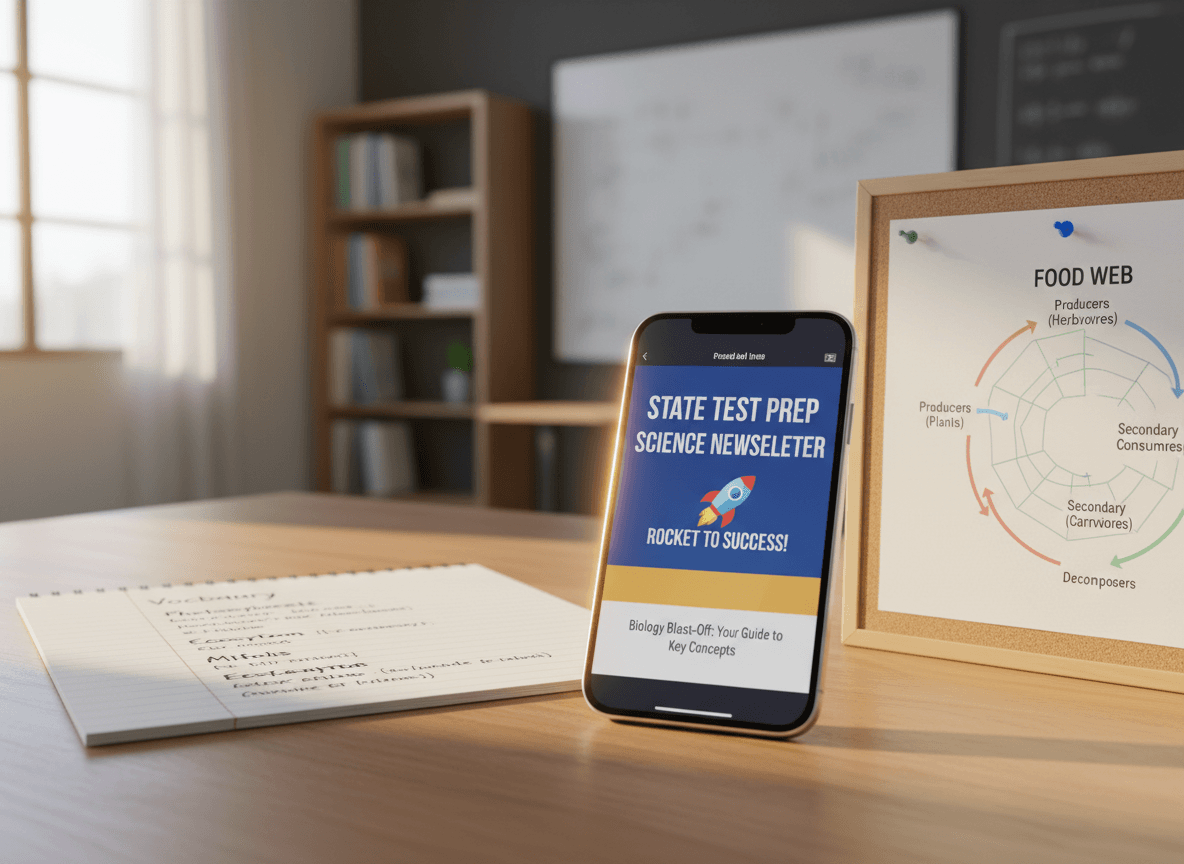
State science testing is mostly a vocabulary, diagram, and reading stamina event. Students who know the words and can read a labeled diagram quickly score higher than students who studied the wrong content the wrong way. Your newsletter four weeks out is the place to translate that into something parents can actually do. Five sections, calm tone, no panic.
Section 1: What is on the test
Two or three sentences. Name the broad content areas in plain English. "The fifth grade science test covers ecosystems, the water cycle, forces and motion, and space patterns. About a third of the questions require reading a labeled diagram and answering based on it." That framing helps parents calibrate.
Section 2: Top vocabulary to review
Eight to ten words. Kid-friendly definitions. For fifth grade: "Producer (makes its own food), Consumer (eats other living things), Decomposer (breaks down dead material), Evaporation (water turning to gas), Condensation (gas turning to liquid water), Force (a push or pull), Gravity (the force that pulls things down), Orbit (the path around another object), Phase (the shape of the lit part of the moon)." Parents can quiz over breakfast. Five minutes a day for seven days. The vocabulary fluency that comes from a parent saying the word at the kitchen table is faster than any worksheet. State tests are written to a 4th-grade reading level for fifth graders, which means knowing the word is half the question. Students who know "producer" and "consumer" cold can solve a food-web question even when the diagram is unfamiliar.
Section 3: Diagram practice at home
One activity. "Pull up any labeled diagram from a science book or online. Cover the labels and ask your student to name as many parts as they can. Then check. Two minutes. Three times this week." That builds diagram fluency, which is the most valuable skill on most state science tests. Warn parents about one specific trap: the test-trap question. State tests routinely include questions with one extra piece of information, or a double negative ("which of these is NOT a decomposer"), or two graphs side by side where only one applies. Students who slow down and underline the verb in the question gain 5 to 10 points on average. That tip lives in the newsletter two weeks out.
Section 4: The week of the test
Three short lines. "Bed by 9pm the night before each test day. Real breakfast on test mornings. No appointments scheduled during testing windows." That is the full list. Resist the urge to add a practice-quiz item. Tired students do not score better, no matter how much they studied. The three-day countdown of habits is worth its own callout the Friday before testing. Day -3: regular bedtime, one favorite breakfast trial run. Day -2: pack the supply bag, sharpened pencils and a water bottle. Day -1: 30 minutes outside, lights out by 9. Day 0: a real breakfast with protein, walk to school the normal way. Predictability beats preparation in the last 72 hours.
Section 5: What students should NOT do
Two short lines. "No cramming the night before. No new apps or practice programs that we have not used in class. Stick with the routines that have worked all year." Parents who see this exhale. Many were already worried about whether they should buy a study program. You just saved them the search.
Template excerpt: a real fifth grade test prep issue, two weeks out
Here is what the template looks like two weeks before testing:
What is on the test: Fifth grade science covers ecosystems, the water cycle, forces and motion, and moon phases. About a third of the questions ask students to read a labeled diagram.
Top vocabulary: Producer, consumer, decomposer, evaporation, condensation, force, gravity, orbit, phase, ecosystem.
Diagram practice: Find any food web online. Cover the labels. Ask your student to name the producers, consumers, and decomposers. Two minutes, three times this week.
The week of the test: Bed by 9pm the night before each test day. Real breakfast on test mornings. No appointments scheduled Tuesday or Thursday morning.
What NOT to do: No cramming the night before. No new practice apps. Stick with what has worked all year.
Why this template works for test prep
State testing makes parents anxious, and anxious parents create anxious students. The five-section structure does the opposite. It gives parents specific, calm, low-effort actions and an explicit list of what to skip. That tone matters more than any single content item. Calm parents on test morning are worth more than three weeks of flashcards.
How Daystage helps with state test prep newsletters
Daystage gives teachers a state test prep template with vocabulary, diagram practice, week-of routines, and a what-not-to-do section. You build it once and duplicate weekly for the four weeks leading into testing. It sends as a real email to every parent, so the night-before and week-of items land in front of the people who need them at the time they need them.
Get one newsletter idea every week.
Free. For teachers. No spam.
Frequently asked questions
When should I start sending state test prep newsletters?
Four weeks out. Earlier than that and parents tune out. Later and they cannot make schedule adjustments for sleep, snacks, or appointments. Four weeks gives one focused newsletter per week leading into testing, which is the right cadence.
What should NOT go in a test prep newsletter?
Test anxiety language. Long study schedules. Threats about not passing. Anything that signals stress to a fifth grader will get read by their parent and amplified. Keep it calm, concrete, and structured around what is in the student's control.
What do parents actually do to help during test week?
Three things. Get the student to bed by 9 (8 for younger). Send a real breakfast on test days. Avoid scheduling appointments during the testing window. That is it. Anything beyond that, like flashcards or practice quizzes the night before, usually hurts more than it helps.
How should I review vocabulary in a test prep newsletter?
Pull the eight to ten most useful vocabulary words from the year and put them in a list with kid-friendly definitions. Parents who quiz students on this list over breakfast for a week before testing will move scores more than any flashcard app.
Does Daystage have a state test prep science newsletter template?
Yes. Daystage gives teachers a state test prep template with vocabulary review, diagram fluency, the night-before checklist, and parent-only logistics. You send it weekly for the four weeks leading into testing. It goes out as a real email so parents actually open it.

Adi Ackerman
Author
Adi Ackerman is a former classroom teacher and curriculum writer with 8 years in K-8 schools. She writes about school communication, parent engagement, and what actually works in real classrooms.
More for Science Newsletter
Ready to send your first newsletter?
3 newsletters free. No credit card. First one ready in under 5 minutes.
Get started free