

Science Newsletter on the Scientific Method: Sections That Help at Home
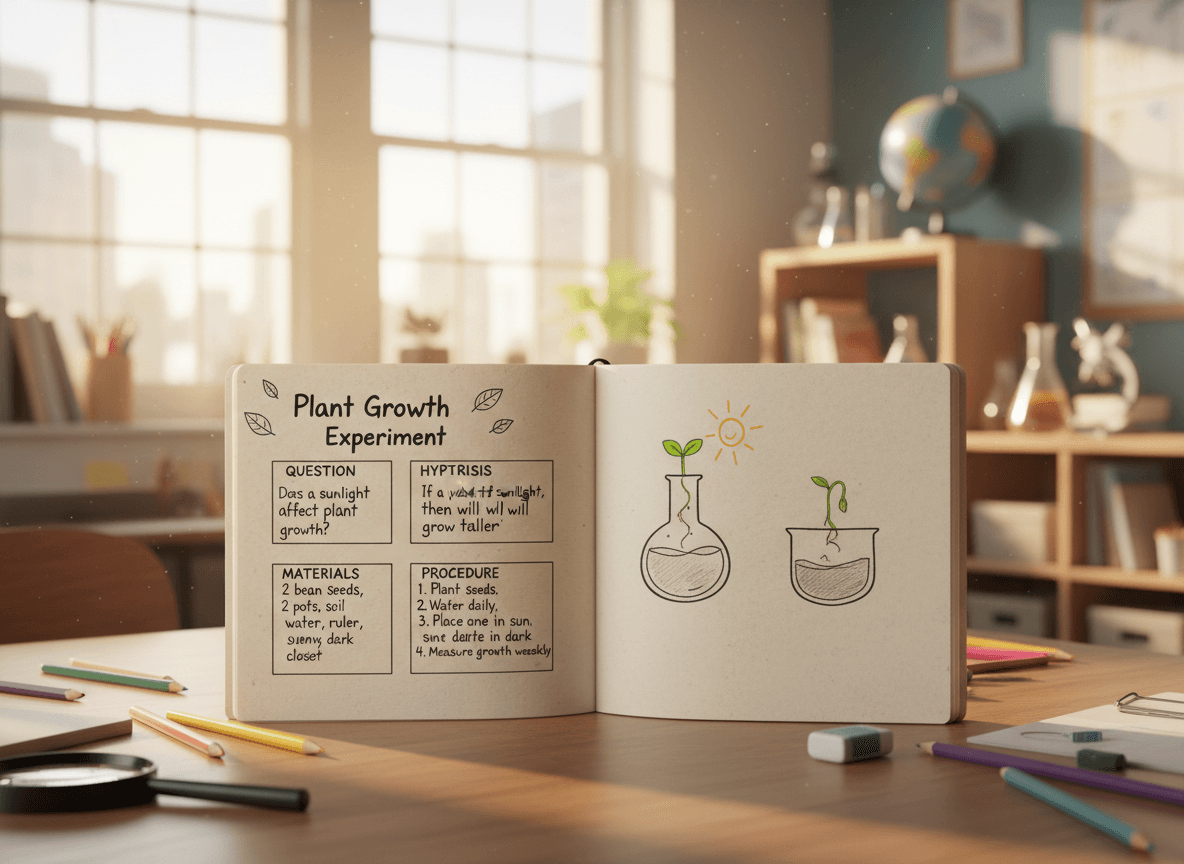
The scientific method unit is the moment when science class shifts from "what we know" to "how we know it." Parents who understand the shift can help at home. Parents who do not will tell their kid that a wrong hypothesis is a bad grade. One newsletter at the start of the unit fixes the language gap and turns dinner-table conversations into actual reinforcement. Six short sections, no jargon, kid-friendly throughout.
Lead with the five steps in plain words
Five lines. "Ask a question. Make a guess (hypothesis). Test it (experiment). Look at what happened (data). Decide what it means (conclusion)." That is the whole framework. Parents who only read the first paragraph still leave with the five words. Bold the word "hypothesis" because it is the one parents always ask about.
Say that a wrong hypothesis is fine
One paragraph, plain. "Your student will make hypotheses that turn out to be wrong. That is the point. A hypothesis is a guess you test. The test is what matters, not whether the guess was right." Parents who hear this once stop telling their kid they got it wrong on a homework that was never meant to be right.
Explain controlled and uncontrolled variables
Two sentences. "A good experiment changes one thing on purpose (the variable you are testing) and keeps everything else the same (the controlled variables). If you change two things, you cannot tell which one caused the result." That is the whole rule. Use a real example: same cup, same water, same temperature, different amount of sunlight.
Give one experiment families can run together
One short paragraph. "Try this at home. Cut three slices of apple. Put one in the fridge, one on the counter, one in a sealed bag. Check them after 24 hours. What was your guess? What actually happened? Why?" That is the whole assignment. Parents who run it once see what the unit is doing.
Sample paragraph: the talking points section
Here is what a tight talking points section looks like in practice:
Use these phrases at dinner this week. "What is the question your class is investigating?" gets a better answer than "what did you learn?" "What was your hypothesis?" gets a guess. "What did the data show?" gets a real answer. "Was your hypothesis right or wrong, and why?" gets the conclusion. Four questions, in order, match the five steps the kid is learning. Use them all week and you have done my job for me.
Close with the unit calendar
Three lines. "Week 1: questions and hypotheses. Week 2: designing and running experiments. Week 3: data and conclusions. End-of-unit assessment is Friday October 11." Parents who know when the assessment falls help their kid review. Parents who do not get blindsided by a grade.
How Daystage helps with scientific method newsletters
Daystage lets you send the scientific method newsletter at the start of the unit, attach the class anchor chart as a content image, and reuse the same newsletter every year by swapping the assessment date. The talking points land in parent inboxes the same week kids are using them in class, which is the only timing that turns the newsletter into actual at-home practice.
Get one newsletter idea every week.
Free. For teachers. No spam.
Frequently asked questions
What are the five steps of the scientific method in kid words?
Ask a question. Make a guess (hypothesis). Test it (experiment). Look at what happened (data). Decide what it means (conclusion). Five short steps. We use these exact words in class so parents can use them at home.
Why is it OK if the hypothesis turns out wrong?
Because a wrong hypothesis is the most useful kind. The point of an experiment is to test the guess, not to confirm it. Students who learn that 'wrong' is just information start making better guesses. Parents who hear this stop saying 'you got it wrong' and start saying 'what did you learn?'
What is the difference between a controlled and an uncontrolled variable?
Controlled variable: something you keep the same across every test (same cup, same amount of water, same room temperature). Uncontrolled variable: what you change on purpose to see what happens (amount of sunlight). A good experiment changes one thing at a time. That is the whole rule.
How can parents reinforce the scientific method at home?
Use the five-step language during normal moments. Cooking: 'what is the question? does adding more baking powder make the bread rise more? what is your guess?' That is a real experiment. Kids who hear the words at home use them better in class.
Can Daystage send a scientific method newsletter?
Yes. Daystage lets you send the scientific method newsletter at the start of the unit, attach a photo of the class anchor chart, and reuse the same newsletter every year. The talking points land in parent inboxes before the unit ends, which is when kids most need the at-home reinforcement.

Adi Ackerman
Author
Adi Ackerman is a former classroom teacher and curriculum writer with 8 years in K-8 schools. She writes about school communication, parent engagement, and what actually works in real classrooms.
More for Science Newsletter
Ready to send your first newsletter?
3 newsletters free. No credit card. First one ready in under 5 minutes.
Get started free