

Science Newsletter for a Science Fair: A Working Template
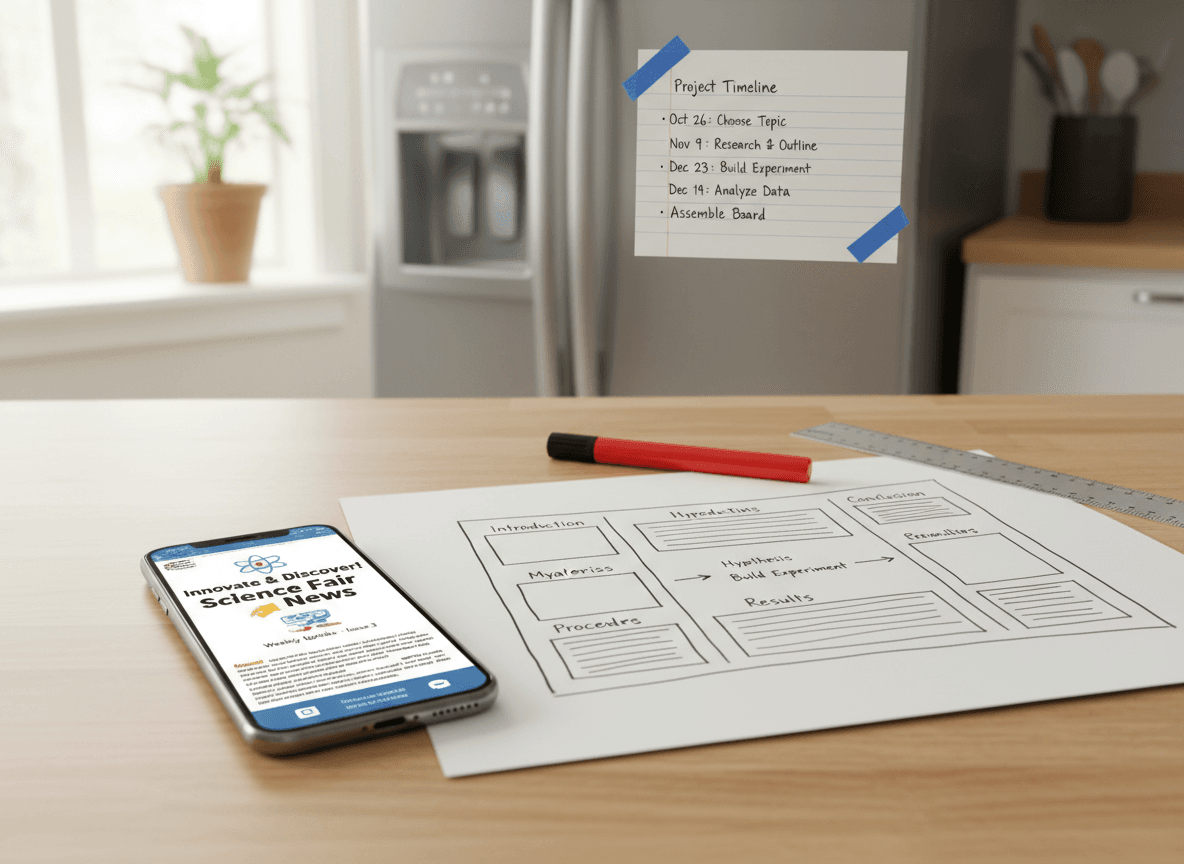
A science fair is mostly a logistics problem with a science problem inside it. Students who succeed at the fair tend to be students whose parents got accurate, calm, week-by-week information eight weeks in advance. Your newsletter is the logistics engine. Five sections per issue, eight issues across the countdown, with a fixed structure so parents know exactly where to look.
Section 1: This week's milestone
One sentence. The single thing students should finish this week. "Week 1: pick your question. Week 4: run your first three trials. Week 7: build the display board." Specific, time-boxed, hard to miss. Full eight-week milestone map looks like this. Week 1: pick a testable question. Week 2: write a hypothesis and materials list. Week 3: get teacher approval and gather supplies. Week 4: run three trials. Week 5: run three more trials, plot the data. Week 6: write the report. Week 7: build the board. Week 8: practice the explanation out loud and bring the board in. Put one of these in each issue and the project stops feeling like a mystery to families.
Section 2: Parent rule for this week
One rule. The help-vs-do line shifts by phase. In the question phase: "You can ask probing questions, you should not pick the question." In the experiment phase: "You can drive to buy supplies, you should not run the trials." In the board phase: "You can hold the ruler, you should not glue anything." Same theme, weekly variation. The rule of thumb to repeat across all eight issues: the kid does the work, the parent buys the supplies. If a parent ends up writing one sentence of the report, the project loses. Judges spot a parent-built board within 20 seconds. The child freezes, cannot answer the simple follow-up, and the experience becomes a memory of an adult performing for them. Spell this out plainly in week one and again in week four.
Section 3: Common mistake this week
One item, written calmly. "Common mistake this week: students pick a question they cannot test in two weeks with stuff at home. Best to pick something testable with three trials in one afternoon." That sentence saves three families a redo on week three. The list across eight weeks reads as a parent guidebook in disguise. Week 2: a hypothesis that is not testable ("which paper towel is best?" is too vague, "which paper towel absorbs the most water in 30 seconds?" is testable). Week 5: not labeling the data table with units. Week 7: font too small to read from three feet. One mistake per week, named, calm, no shame.
Section 4: Supplies and dates
A short list. "Tri-fold board, glue stick, ruler, markers. Boards available at the office for $5 starting Monday." Or "Bring three clean data tables to class Wednesday for a check-in." Concrete, actionable, dated.
Section 5: What is coming next week
Two lines. The next milestone and any deadlines. "Next week: design your data table and run your first trial. Bring your question approval form signed by Friday." Parents add this to the family calendar.
Template excerpt: a real week 7 science fair issue
Here is what the template looks like one week before fair night:
This week's milestone: Build your display board. Title at the top, question and hypothesis on the left, procedure and data in the middle, results and conclusion on the right.
Parent rule this week: You can hold the ruler and steady the board. You should not cut, glue, or write any of the text. Judges can tell.
Common mistake this week: Tiny text. Use a minimum 14 point font. Judges read boards from three feet away.
Supplies and dates: Bring completed boards to the cafeteria on Thursday between 2:30 and 3:30pm for setup. Fair night Friday, 5:30 to 7:30. Judging 5:30 to 6:30, viewing 6:30 to 7:30.
Coming next week: Fair night Friday. Awards Monday morning. Boards come home Monday afternoon.
Why this template works for a science fair
Eight weeks is a long time to maintain attention. The fixed five section structure makes each issue scannable in 30 seconds. The parent rule section does the heaviest cultural lift. Most science fair pain comes from parents who want to help and end up doing. A weekly reminder, framed positively, shifts that pattern without confrontation. The common mistake section saves real time. Each one prevents three to five families from a week three rework.
How Daystage helps with science fair newsletters
Daystage gives teachers an eight-week science fair template you build once at the start of the countdown. Each week has the same five sections, so you only update the milestone, rule, mistake, supplies, and next-week lines. It sends as a real email to your full parent list, parents do not need to download an app, and the structure carries the cadence for you. You can write each week's issue in five minutes from your phone.
Get one newsletter idea every week.
Free. For teachers. No spam.
Frequently asked questions
When should I send the first science fair newsletter?
Eight weeks before fair night. That gives families two weeks to pick a question, two weeks to gather materials and start the investigation, two weeks of data collection, and two weeks for the report and display board. Less than eight weeks and you get rushed boards. More than ten and the project goes stale before fair night.
What is the most important parent rule for a science fair?
Help, do not do. Parents can hold the camera, drive to the hardware store, and ask probing questions. They should not write the report, build the board, or run the experiment. Students who present a project a parent built freeze at the judges' table. Spell this out in week one and again in week four.
What goes on a science fair display board?
Six sections in a fixed layout. Title at the top. Left panel: question, hypothesis, materials. Center panel: procedure, data table, graph. Right panel: results, conclusion, what would I do differently. That layout reads top-left to bottom-right and matches how judges scan. Send a labeled layout sketch in the newsletter.
How do parents handle fair night logistics?
Three things they need to know. Drop-off time and location for the board. Setup time. Judging window vs viewing window. Most science fair stress on the actual night is logistics, not science. Get the times right in the newsletter and the night runs smoothly.
Does Daystage have a science fair newsletter template?
Yes. Daystage gives teachers an eight-week science fair countdown template with one issue per week. Each issue has the same five sections: this week's milestone, parent help-vs-do reminder, common mistake to avoid, supply list, and what is coming. You build it once and the cadence runs itself.

Adi Ackerman
Author
Adi Ackerman is a former classroom teacher and curriculum writer with 8 years in K-8 schools. She writes about school communication, parent engagement, and what actually works in real classrooms.
More for Science Newsletter
Ready to send your first newsletter?
3 newsletters free. No credit card. First one ready in under 5 minutes.
Get started free