

Science Newsletter on Mixtures and Solutions: What to Cover
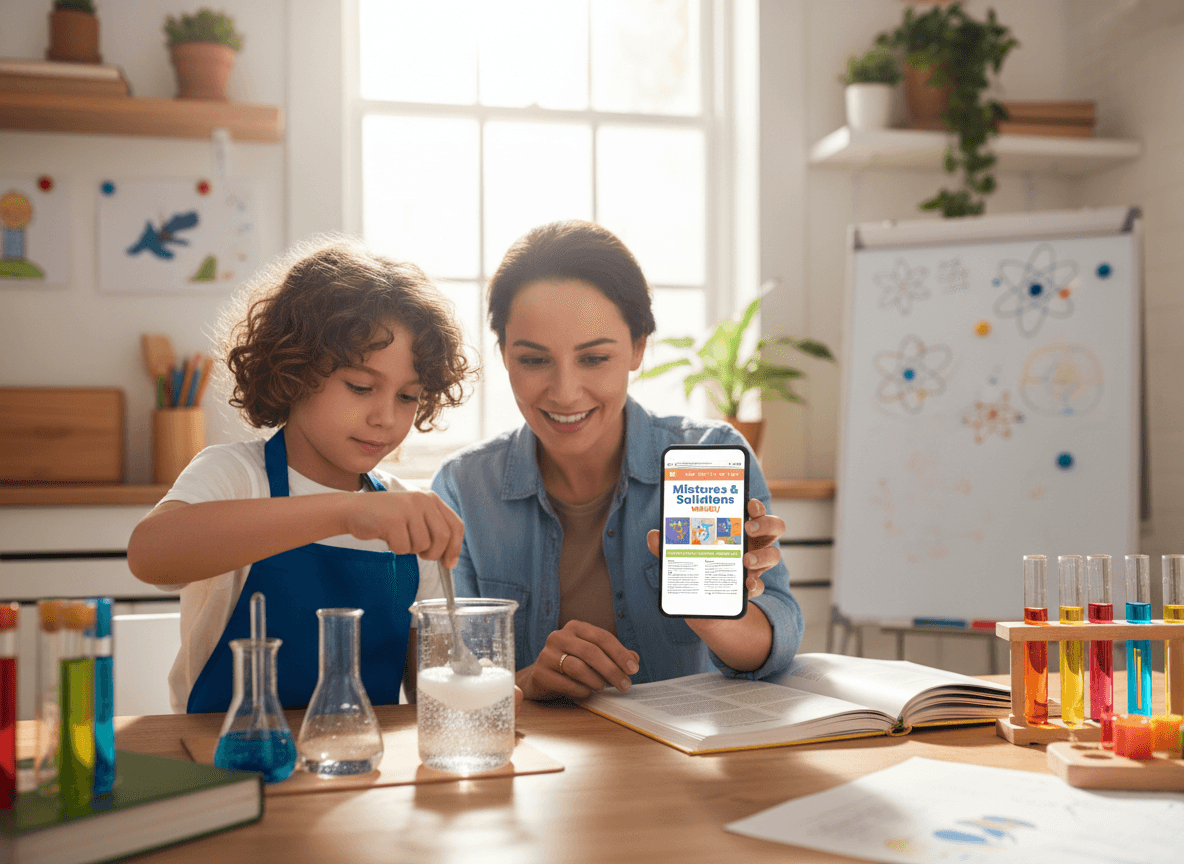
Mixtures and solutions is the first unit where elementary kids do real chemistry. They predict, they stir, they filter, they evaporate. The newsletter that goes home should mirror that hands-on feel without turning into a glossary. Five short sections, one specific question to ask at home, and one investigation a parent can run with a spoon and a cup. That is the whole job.
Open with the question the unit answers
"This unit, students are figuring out which things mix together, which dissolve, and which stay separate." That is the unit in one line. Parents get it. They do not need the standard code. If a parent wants more, link the standard at the bottom in a small note.
What we did this week
Pick the moment that surprised a student. "When we mixed oil and water, third period asked why the oil floats on top instead of sinking. That led to a discussion on density we are picking up next week." Specific. Real. Names a moment a kid will mention at dinner.
Vocabulary that earns its place
Four words, plain definitions. Solute (the thing being dissolved). Solvent (the thing dissolving it). Mixture (you can still see the parts). Solution (the parts are spread out evenly and invisible). Drop "heterogeneous" and "homogeneous" unless your district requires them. The four above carry the whole unit at this grade.
Show separation methods with kitchen examples
Filtering is a coffee filter. Evaporation is a puddle in the sun. Magnetism is sorting nails from sawdust with a fridge magnet. Give parents one sentence on each. The point is not that they teach the method. The point is that when their kid says "we filtered a mixture today," the parent has a picture in their head.
At-home extension: the three-cup test
Three clear cups of water. Add one teaspoon of salt to the first, sand to the second, oil to the third. Stir. Wait two minutes. Look. The salt dissolves (solution). The sand sinks (mixture). The oil floats (mixture). Ask the student to label each one and explain why. Ten minutes, zero setup, exactly aligned with the unit.
Template excerpt: a fifth grade mixtures issue
Big idea: Some things dissolve in water (solutions), and some things stay separate (mixtures). Knowing which is which lets us decide how to separate them.
What we did: Students tested six substances (salt, sugar, sand, baking soda, oil, food coloring) to see which dissolved in water. We then filtered the mixtures and evaporated one solution to get the solute back.
Vocabulary: Solute, solvent, mixture, solution, dissolve.
Ask at home: If you spill salt water on the counter and let it dry, what is left behind? Why?
Coming up: Density investigation next Tuesday. Bring a clean, empty water bottle.
The misconception to head off in the newsletter
Kids (and many parents) think "dissolved" means "disappeared." Use the newsletter to head it off. One line: "When salt dissolves in water, the salt is still there. We can prove it by tasting the water, or by letting the water evaporate and watching the salt come back." That single sentence prevents the most common confusion in the unit and turns a parent question into reinforcement at home.
How Daystage helps with mixtures and solutions newsletters
Daystage gives you the five-section science template ready to drop content into. You build it once at the start of the unit, duplicate it for the second issue, and replace only the activity and vocabulary. It sends to your class roster as a real email, parents read it on their phone, and you can write the next one in five minutes between fourth period and lunch.
Get one newsletter idea every week.
Free. For teachers. No spam.
Frequently asked questions
What is the difference between a mixture and a solution in plain words?
A mixture has stuff in it that you can still see and separate. Sand in water is a mixture. A solution has stuff dissolved in it that you cannot see anymore. Salt water is a solution. That is the whole distinction you need for fifth grade.
Should the newsletter use the words solute and solvent?
Yes, with a one-line definition each. Students will use them in class, so parents need them at home. 'Solute: the thing that gets dissolved (like salt). Solvent: the thing doing the dissolving (usually water).' Put them in once, then use them naturally in the recap.
What is a good at-home extension for a mixtures unit?
Three cups on the counter. Put a spoon of salt, a spoon of sand, and a spoon of oil into separate cups of water. Predict which will dissolve, then watch. That is a 10 minute investigation, costs nothing, and it lines up exactly with what students did in class.
How do I explain separation methods (filter, evaporate) to parents?
Tie each method to a real example. 'A coffee filter is the same idea as the filter paper we used in class. The water evaporating off a wet sidewalk is the same idea as how we got salt back from salt water.' Parents have done these things without naming them. Name them and the concept lands.
Does Daystage have a science newsletter template for this unit?
Yes. Daystage gives you a five-section template you build once and reuse every two weeks. It sends as a real email to your full class roster, parents read it on their phone without downloading anything, and the formatting stays clean every time.

Adi Ackerman
Author
Adi Ackerman is a former classroom teacher and curriculum writer with 8 years in K-8 schools. She writes about school communication, parent engagement, and what actually works in real classrooms.
More for Science Newsletter
Ready to send your first newsletter?
3 newsletters free. No credit card. First one ready in under 5 minutes.
Get started free