

Science Newsletter Explaining Claim-Evidence-Reasoning
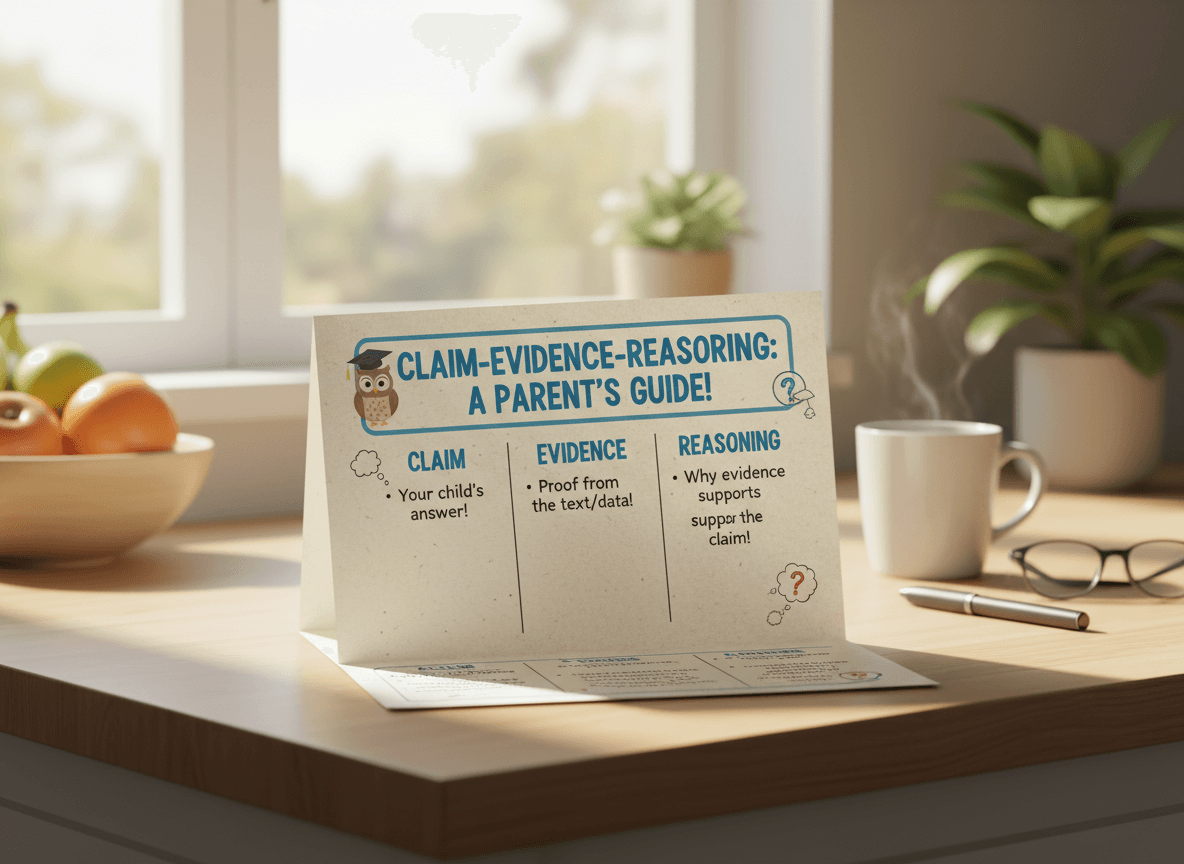
Claim-Evidence-Reasoning is the writing frame most science classes use to teach scientific argument. Parents who see a CER response come home wonder why it is so short, why there is no introduction, and what the 'reasoning' part is supposed to do. This template explains it in one newsletter, with examples and the exact sentence stems students use in class.
Section 1: What CER is, in three sentences
Claim: a one-sentence answer to a science question. Evidence: the data or observation that supports the claim. Reasoning: the explanation of why the evidence supports the claim, using a science concept the class has learned. Three parts. That is the whole frame.
Section 2: Why scientists never just claim
Two sentences. "A claim with no evidence is an opinion. Real science needs both the data and the explanation of why the data means what you say it does, so other people can check your thinking." Parents see this and the short, specific format starts to make sense.
Section 3: A real example
Walk through one CER end to end. "Question: which spoon will feel hotter after sitting in warm water? Claim: the metal spoon will feel hotter. Evidence: in our lab, the metal spoon measured 41 degrees Celsius and the wooden spoon measured 28 degrees Celsius after two minutes. Reasoning: metal conducts heat more efficiently than wood because its particles are packed closer and can transfer thermal energy faster." Four sentences. Whole CER.
Section 4: The sentence stems we use in class
Three stems, written out. "My claim is that... The evidence I have is... This evidence supports my claim because (science concept)..." Parents can use these at home as well, when their child is stuck. By spring, students drop the stems on their own and write in their own voice.
Section 5: What to look for when your child shows you a CER
Three short checks. "Did they make a specific claim, not a general one? Did they use data with numbers or specific observations, not 'because it looked hot'? Did the reasoning name the science concept by name?" Parents can give useful feedback in 60 seconds without re-teaching the unit.
Example: a CER newsletter sent at the start of a chemistry unit
Opens with the three-sentence definition of CER. Notes why scientists do not just state a claim. Walks through the metal spoon example end to end in four sentences. Lists the three sentence stems used in class. Closes with the three checks parents can use when their child shows them a CER response. Total length: 470 words. A parent reads it once and recognizes every CER they see for the rest of the year.
Why this template works
Parents who do not know CER look at a six-sentence response and worry their child wrote too little. Once they understand the frame, they see the structure and know how to give feedback. They also stop asking 'where is the introduction?', which eliminates one of the most common parent emails of the year.
How Daystage helps with CER explainer newsletters
Daystage has a parent-explainer template you can drop the CER content into. You send it the first time a unit asks students to write a CER. The newsletter is archived so a parent who joined the class later in the year can read it on their own and catch up.
Get one newsletter idea every week.
Free. For teachers. No spam.
Frequently asked questions
What is Claim-Evidence-Reasoning?
A three-part writing frame students use to answer a science question. The Claim is the answer in one sentence. The Evidence is the data or observation that supports it. The Reasoning explains why the evidence supports the claim, usually using a science concept they learned.
Why do scientists not just state a claim?
Because a claim with no evidence is an opinion. The whole point of science is that other people can check your work and decide if your reasoning holds. CER trains students to think like that from the start. It is also the same structure that shows up in essays, history papers, and most adult arguments.
What are sentence stems and why do they help?
Pre-written sentence starters that lower the barrier for writing. 'My claim is that...', 'The evidence I have is...', 'This evidence supports my claim because...'. Students who freeze on a blank page can start with the stem and have a real response in five minutes. By spring, most do not need the stems anymore.
What does a strong CER look like in middle school?
Three to six sentences total. Claim: one sentence. Evidence: one or two specific data points or observations. Reasoning: one or two sentences that name the science concept and connect it to the evidence. Strong is short, specific, and accurate, not long.
Can Daystage send a CER explainer at the start of a unit?
Yes. Daystage has a parent-explainer template you can drop the CER content into and send the first time a unit asks students to write one. Parents read it once, recognize the structure when their child shows them a paper, and stop asking 'where is the introduction?'.

Adi Ackerman
Author
Adi Ackerman is a former classroom teacher and curriculum writer with 8 years in K-8 schools. She writes about school communication, parent engagement, and what actually works in real classrooms.
More for Science Newsletter
Ready to send your first newsletter?
3 newsletters free. No credit card. First one ready in under 5 minutes.
Get started free