

Fourth Grade Science Newsletter: A Template With Real Sections
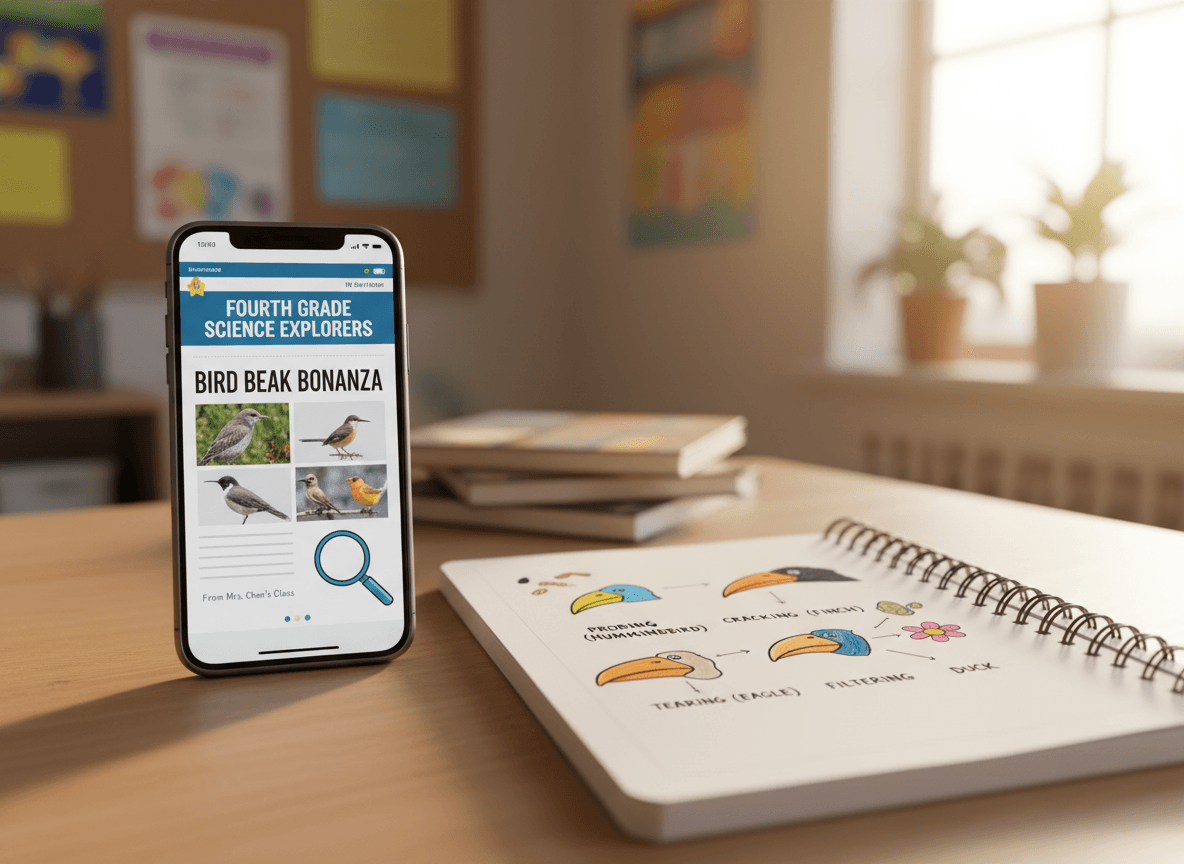
Fourth grade is the year science gets hands-on in a way parents recognize. Circuits light up. Bird skulls come out of a box. Students argue about whether sound travels faster through water or through air. Your newsletter should reflect that energy. Five sections, focused on what students built or noticed, written for a parent who is reading on the bus home from work. The energy and electricity unit usually runs six weeks. Students start with a single battery, a single bulb, and two wires. By week three they are building parallel circuits with switches. By week five they are designing a working flashlight from a cardboard tube and a paper clip. Every step belongs in a newsletter.
Section 1: What we built or investigated
Two sentences. Name what students did with their hands. "This week students built series circuits with one battery and two bulbs. The bulbs were dimmer than in a single-bulb circuit, which led us into a conversation about how a circuit splits its energy." That is the section. Concrete, specific, repeatable at dinner. For the rocks unit, the same pattern works: "Students tested 12 rock samples for hardness using a steel nail and a copper penny. Three samples scratched the penny but not the nail, which put them at hardness 3 on the Mohs scale." A parent reads that and can ask "which rocks scratched the penny?" That is the bar.
Section 2: Vocabulary we are using
Four words tied to the unit. For energy and electricity: "Circuit (a loop that electricity flows through), Conductor (a material electricity can pass through), Insulator (a material that blocks electricity), Switch (a part that opens or closes the loop)." Parents who see these start using them when something at home breaks, which is exactly the connection you want.
Section 3: Photo of the week
One image. A student-built circuit, a labeled bird beak diagram, or a wave investigation in progress. Real student work, not stock photos. Photos of kids holding their work get more parent replies than any other section. A photo of K. with the working flashlight she built from a paper towel tube, two AA batteries, and a 3 volt bulb gets forwarded to four grandparents on average. Stock images get archived in 8 seconds. Spend the 30 seconds on a real photo. Take a media release at back-to-school night so this section runs friction-free the whole year.
Section 4: Ask at home
One question. "Ask your student to draw a circuit that lights one bulb and label the parts." Or "Ask your student to explain why a bird with a long thin beak eats different food than a bird with a short thick one." Specific prompts get specific answers. Vague ones get "fine."
Section 5: Coming up
Two or three lines. Field trip, supply request, science fair sign-up, permission slip. Same place every issue. Parents check this section to update the family calendar.
Template excerpt: a real fourth grade circuits issue
Here is what the template looks like in the second week of a circuits unit:
What we built: Students built parallel circuits with two bulbs on separate paths. When we unscrewed one bulb, the other stayed lit, which surprised most of the class. We compared this to series circuits from last week, where unscrewing one bulb turned off both.
Vocabulary: Series circuit (one loop, all parts in line), Parallel circuit (separate paths from the battery), Open circuit (a break that stops the flow), Closed circuit (a complete loop).
Ask at home: Ask your student which kind of circuit is in the holiday lights at home, and how they know.
Coming up: Circuit design challenge on Thursday. Students bring one cardboard tube from home if you have one (paper towel roll is perfect). No purchase needed.
Why this template works for fourth grade
Fourth grade parents want proof that science class is more than reading a textbook. Photos of student-built circuits and labeled diagrams do that work for you. The vocabulary section pulls double duty because fourth grade is also a year of heavy reading instruction, and content vocabulary in a newsletter reinforces what reading teachers are doing. A parent who saw "conductor" in the Tuesday newsletter is the parent who points at the metal spoon at dinner and asks "is this a conductor?" That conversation happens in maybe 20 percent of homes when you skip the vocabulary section, and in 60 percent when you keep it. The numbers come from a small informal survey I ran with my own families in 2026, but the pattern is real.
How Daystage helps with fourth grade science newsletters
Daystage gives fourth grade teachers a five-section template you build once and duplicate every two weeks. The structure stays clean. The photo, vocabulary, and ask-at-home sections sit in the same place every issue, so parents learn where to look. It sends to your full class list as a real email. You can write the next one from your phone during your prep period.
Get one newsletter idea every week.
Free. For teachers. No spam.
Frequently asked questions
What does fourth grade science cover under NGSS?
Three big units: waves and information (sound, light, codes), energy and electricity (circuits, energy transfer), and plant and animal structures (how a bird's beak fits its diet). Most fourth grade teachers spend the longest stretch on circuits because it gives students the most lab time and the clearest 'aha' moment.
How do I explain a circuit unit to parents who have not thought about electricity since high school?
Lead with what students built. 'This week each student built a circuit that lights an LED using a battery, a switch, and two wires.' That sentence tells the parent more than a paragraph about electron flow. The science is in what the kids did, not what you taught.
What at-home extension works for a fourth grade circuits unit?
A scavenger hunt. 'Walk through your home with your student and count how many things plug in. Pick three and ask what would happen if you unplugged them.' No supplies, no shopping, 10 minutes. The conversation is the whole point.
Should I include lab safety in every fourth grade science newsletter?
Only when the next investigation needs it. If students are using batteries, mention it the week before. If they are using a hot plate or sharp tools for a structure dissection, name it explicitly with the safety setup. Routine safety reminders get tuned out. Targeted ones land.
Does Daystage have a fourth grade science newsletter template?
Yes. Daystage gives fourth grade teachers a five-section template (what we built or investigated, vocabulary, photo, ask-at-home, coming up) you duplicate every two weeks. It sends to your full class roster as a real email, no app for parents, and you can write the next issue from your phone.

Adi Ackerman
Author
Adi Ackerman is a former classroom teacher and curriculum writer with 8 years in K-8 schools. She writes about school communication, parent engagement, and what actually works in real classrooms.
More for Science Newsletter
Ready to send your first newsletter?
3 newsletters free. No credit card. First one ready in under 5 minutes.
Get started free