

Fifth Grade Science Newsletter: What to Send Each Month
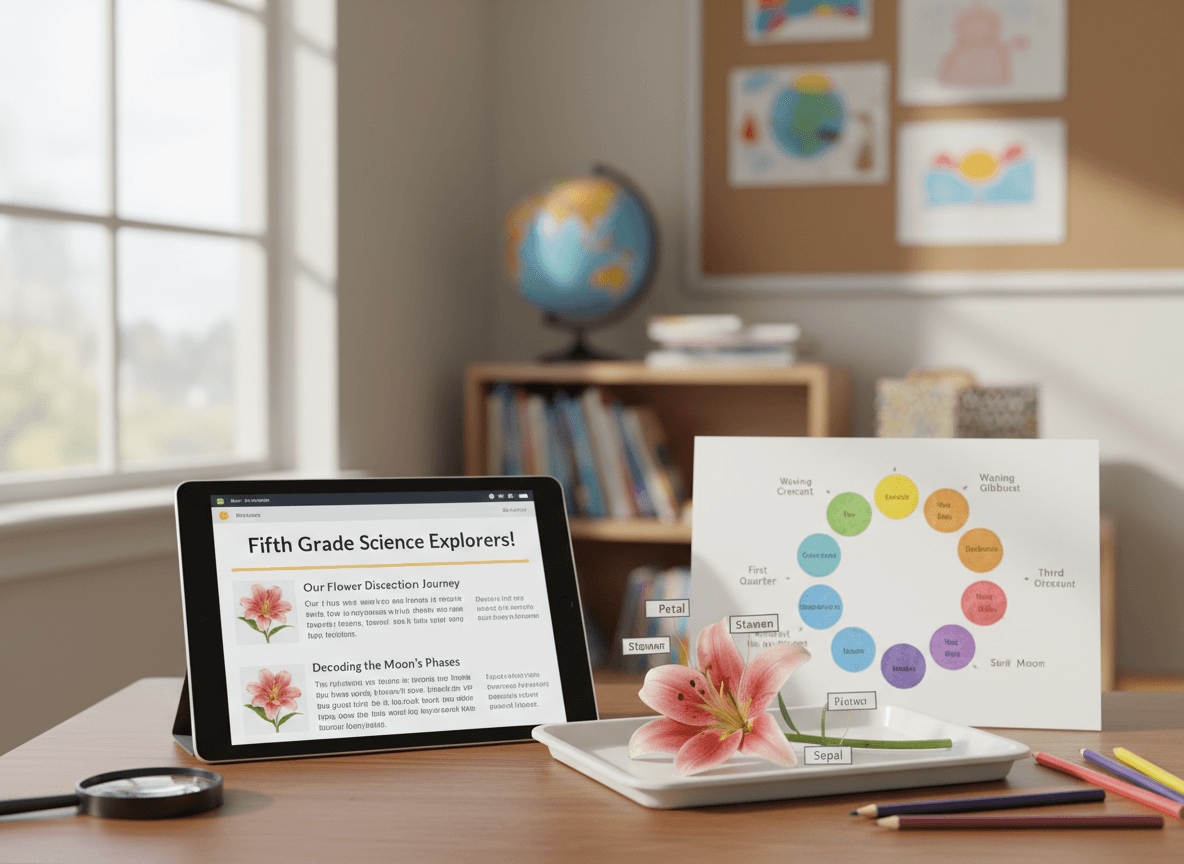
Fifth grade science is the bridge between elementary and middle school. Investigations get longer. Lab notebooks show up. Students start defending claims with evidence and reasoning. Your newsletter has to do two things at once. Reassure parents that what they remember from elementary is still there, and prepare them for what is coming. Five sections, with one small upgrade per section.
Section 1: What we investigated
Three sentences. The question, the procedure in one line, and one result. "This week we modeled the water cycle in clear plastic bags taped to a sunny window. Students predicted where water would collect and most got it right. Tomorrow we open the bags and measure how much water moved." Or for the flower dissection week: "Students took apart a lily and labeled the stamen, the pistil, the petals, and the sepals. S. counted 47 grains of pollen on one anther under the magnifier. We used a real flower from the corner store, $4 for the class, no special kit required."
Section 2: Vocabulary we are using
Five words for fifth grade. The bar is a little higher. For an ecosystems unit: "Producer (makes its own food, like a plant), Consumer (eats other living things), Decomposer (breaks down dead material), Ecosystem (a community plus its environment), Cycle (a pattern that repeats)." Parents who see these get a free vocabulary refresh too.
Section 3: Photo of the week
One image. A student lab notebook page, a model in progress, a dissection at the moment of discovery. Fifth grade student work is actually photogenic because the diagrams get more detailed. Get a media release at the start of the year so this section is friction-free.
Section 4: Ask at home
One question with a follow-up. "Ask your student to name three things in our backyard food web. Then ask what would happen if one of them disappeared." The second question is where the thinking lives. Fifth graders can handle it. Younger siblings will join in too. The space unit gets its own version of this. The 30 day moon log is the signature fifth grade routine. Two minutes after dinner each night. Step outside, draw the moon as a quick circle with the lit part shaded in pencil, date it. By night 7 the pattern emerges. By night 30 the student has lived the lunar cycle. Parents send back photos of the log on day 30 every year. It is the most photographed homework artifact in fifth grade.
Section 5: Coming up
Two or three lines. State testing dates if relevant, field trip, science fair sign-up, supply request. Add a one-line note about middle school habits when relevant. "Students will start a lab notebook this week. They bring it home Fridays and back on Mondays."
Template excerpt: a real fifth grade ecosystems issue
Here is what the template looks like in the third week of an ecosystems unit:
What we investigated: Students built decomposition columns with apple slices, soil, and leaf litter. We measured starting weights and will measure again every Friday for three weeks. The class prediction was that the apple would lose the most weight, and the soil the least.
Vocabulary: Decomposer (breaks down dead material), Decomposition (the process of breaking down), Nutrient (a substance living things need to grow), Cycle (a pattern that repeats), Biomass (the total weight of living things in an area).
Ask at home: Ask your student what is happening in your compost pile or yard waste bin. If you do not have one, ask what happens to a leaf after it falls.
Coming up: Science fair sign-ups due Friday. Spring state testing window starts March 14, science section on March 16. Study guide goes home next week.
Why this template works for fifth grade
Fifth grade parents are starting to think about middle school. They want to see that their student is ready for harder content, longer investigations, and a lab notebook. The slightly upgraded vocabulary section and the two-part ask-at-home prompt signal that without making the newsletter feel heavier. Same five sections, more substance per line. The decomposition column investigation is the moment in the year where parents stop worrying. A jar with apple slices, soil, and leaf litter, weighed every Friday for three weeks, with a hand-drawn graph in a notebook, is a real science investigation. When a parent sees a photo of that, the question shifts from "is fifth grade enough" to "what is coming next year." That is the right shift.
How Daystage helps with fifth grade science newsletters
Daystage gives fifth grade teachers a five-section template you build once and duplicate every two weeks. The structure scales with the content. You can drop in a state testing note, a science fair sign-up, or a moon log without breaking the layout. It sends to your full parent list as a real email. You can write the next issue from your phone during recess duty.
Get one newsletter idea every week.
Free. For teachers. No spam.
Frequently asked questions
What science does fifth grade cover under NGSS?
Three units: matter and energy in ecosystems (food webs, decomposition), Earth's systems (water cycle, geosphere interactions), and space patterns (moon phases, star patterns). Fifth grade also feeds into state testing in many districts, which raises the stakes on parent communication.
How is a fifth grade science newsletter different from third or fourth?
Fifth graders can handle longer investigations and abstract models, and many districts test them on science content. Your newsletter can include slightly more technical vocabulary and a longer ask-at-home prompt. It should also start previewing middle school habits like lab notebooks and multi-step investigations.
Should the newsletter mention state testing?
Yes, but not every issue. Mention it three or four times in the spring: once to tell parents the unit alignment, once with study suggestions, once the week before testing, and once after. Daily reminders create anxiety without changing scores.
What at-home extension works for a fifth grade space unit?
A 30 day moon log. 'Step outside with your student for two minutes each night and draw the moon. Bring the log in on the 30th.' That is the whole unit summarized in one routine. Parents love it because it is portable, no supplies, and the visual progression is striking.
Does Daystage have a fifth grade science newsletter template?
Yes. Daystage gives fifth grade teachers a five-section template (what we investigated, vocabulary, photo, ask-at-home, coming up) you can build once and duplicate every two weeks. It sends as a real email to your class roster and works from your phone in five minutes.

Adi Ackerman
Author
Adi Ackerman is a former classroom teacher and curriculum writer with 8 years in K-8 schools. She writes about school communication, parent engagement, and what actually works in real classrooms.
More for Science Newsletter
Ready to send your first newsletter?
3 newsletters free. No credit card. First one ready in under 5 minutes.
Get started free